Powered by Blogger.
Showing posts with label Politics. Show all posts

Wilt: Just like any other 7 foot black millionaire anarchist who lives next door and is friends with Richard Nixon

Tuesday, January 4, 2011

What is Wilt: Just Like Any Other 7 Foot Black Millionaire Who Lives Next Door doing in the special anarchist collection of the University of Michigan library? Why is Rockin’ Steady: A Guide to Basketball and Cool by Walt “Clyde the Glide” Frazier shelved in the Children’s Literature section? As I was putting books on reserve for my upcoming course on hoops culture, these surprising discoveries got me thinking about what such misplacements can teach us about creative reclassification as means of shedding a burst of light on the shadowed sides of a too-familiar subject.

Wilt an anarchist? Hold up. I'll get to Clyde another day, but for now I want to deal with Wilt. I like anarchism and I like Wilt and I'm going to do my level best to invent a way for it to make profound sense for his autobiography to be in the anarchist collection. All I remember about Wilt’s political life was that he supported Nixon’s presidential run in 1968. For me it’s hard to spin that into anarchism or even radicalism. But, the truth is I last read Wilt’s autobiography in 1975 around the age of 10. So I took another look at the chapter on his involvement in that campaign.

Here’s the outline of the story as Wilt tells it in his anarchist autobiography. Sometime in the mid 1960s, Wilt befriends Nixon on a NY to LA plane ride (a lot happened to Wilt on planes, if the book is to be believed). Nixon impressed Wilt with his intellect and his “willingness to see things in global, rather than just national, terms.” Unconsciously, Wilt admits, he may also have been drawn to Nixon because he, like Wilt, had been saddled as a loser who couldn’t win the big one and as not very smart. Wilt hopes that if he works on the campaign then he’ll have the ear of the new President and be able to influence him on issues he feels strongly about, including overpopulation (“sweeping birth-control programs in the more backward countries”), equal opportunity for blacks, and the legalization and regulation of euthanasia and victimless crimes such as “gambling, prostitution, marijuana, and pornography.”

So first of all, how did Wilt and Nixon, who are both already megacelebrities by the 1960s -- even if they are both not smart losers, wind up sitting next to each other on a cross-country flight? What are the chances of that? Were they in coach? Who made the first move? And, what was Nixon thinking, I wonder. Fast forward years later, Wilt's in the oval office, sitting in front of Nixon who is at his desk. Kissinger in a chair maybe in the corner by the door. How would that have gone down?


Wilt begins, "I think we need some birth-control programs in the more backward countries." Nixon presses a button underneath his desk that starts the tape rolling, nods and smiles and thinks to himself: "This Bill Russell is more interesting than I expected." "For that matter," Wilt continues, encouraged, "I think it's cruel to keep some baby alive when it's born with so many mental and physical abnormalities that it can't possibly enjoy life. I feel the same way about prolong life for some sick old person who's in constant pain -- the way they did with President Truman last year." "But Bi - er, Wilt," says Nixon, leaning back in his chair smirking slyly, all faux innocence testing Wilt, "what about those who say it's humane to preserve life?" Wilt doesn't miss a beat, leaning forward in his chair he gestures with his huge palm, which flutters above Nixon's desk like an enormous black bird. Richard trembles slightly. "I'll tell you what to say to those people Richard: I think the only humane thing to do is end life. We need laws to make that possible." "Sweeping birth control abroad and euthanasia at home, Richard, and you've got that overpopulation problem beat." Nixon, chuckling, almost to himself "We've got our experiments in population control underway in Southeast Asia, you know, Wilt." The edges of Kissinger's lips curl up slightly.

Wilt’s high hopes are disappointed before Nixon even gets out of the gate, by the latter’s choice of Spiro Agnew as a running mate. Charged with selling the Nixon-Agnew ticket to black delegates at the 1968 RNC in Miami, Wilt counsels Agnew: “to say ‘black,’ not ‘Negro,’ and say it like he means it and isn’t afraid of it.” And to “say ‘law and order and justice,’ not just ‘law and order’ – and mean it.” Agnew appears to go along but then the next day “Spiro had a meeting with a group that had a lot of blacks in it. Do you know that dumb fuck must have said ‘Negro’ and ‘law and order’ 10,000 times? I’m sitting right there, looking at him, and sliding further down in my chair every minute. I finally walked out.” He’s further disappointed, once Nixon is elected, by his appointments to the Supreme Court and Attorney General and by his new posse of Watergate-bound henchmen. But the last straw? “I was also pissed off when Richard had our astronauts put an American flag on the moon. Outer space is supposed to be for all mankind, not just Americans. I was disappointed in Richard then.” Wilt wasn't the only one to have been fooled by Tricky Dick. Or to have been disappointed.

Of course, it depends entirely on what you mean by “anarchy,” but the only thing that to me reads as even vaguely anarchical (besides the story itself) is Wilt’s penchant for the world perspective on things; that, and maybe the fact that in the face of those who questioned his support for a Republican candidate Wilt declared himself to be the proto-liberated fan: “I’ve never paid much attention to labels and stereotypes. In sports, I root for individual players, not teams; in politics I vote for the man, not the party.”

And maybe there, in that last quotation, is something like a clue, or rather – more frankly – something that could be spun into a plausible or at least cool-ish reading of Wilt-as-Anarchist. Leonard Koppett once argued brilliantly that the essence of basketball is deception, but he also showed that if there is law of organization in basketball it is that it is “a team game to the nth degree,” more than any other sport. And, while Koppett and other good thinkers will readily admit that you can’t have a great team without great individual players, the law of the game still implies that if in conflict, the interests of the individual must be surbordinate to those of the team.

And so perhaps there is something a little anarchic in Wilt’s assertion of his preference for the individual over the team, the man over the party. Not just because he’s going against the accepted dogma ("basketball is a team game", "African-Americans who support republicans are working against their own interests as African-Americans" – both of which statements are no less likely to be true for being dogma); but because in asserting this he is also affirming that individuals are greater than the categories (party, team) we might employ in order to channel their powers and understand their meaning.

I don’t think that by itself that makes Wilt an anarchist. I do think it makes him a radical empiricist in the tradition of William James, who criticized what he called “vicious intellectualism” or “the abuse of naming”: “the treating of a name as excluding from the fact named what the name’s definition fails to positively positively to include" so that you might "contend that a person whom you have once called an 'equestrian' is thereby forever made uanble to walk on his own feet."

We know Wilt was sensitive to labels, sensitive to the abuse of naming. Labeled a scorer, he bent over backward to lead the league in assists – ironically, probably hurting his team in the process. Labeled a loser, he won a championship and then said that was enough for him, which somehow seems to negate the championship in the eyes of history. There are great players with no rings. It's almost as though, in basketball lore, Wilt has negative rings -- though he had two. Wilt always stood out at a time in American history when standing out as tall, black, physically powerful, and wealthy provoked fear and anxiety and set him up to be labeled.

And so, philosophical and political labels -- precisely -- aside, I bet he felt a desire, proportionate to the labeling, to be himself and to be accepted as such. I don’t know whether Wilt would agree with any thing I’m saying, nor do I really believe that what I’m saying is the explanation for why his autobiography is in the anarchist section of the library. But I do think there’s something anarchical (maybe it’s what FreeDarko calls “the nuclear option”) in the legacy of Wilt – something uncontainable by any hierarchically organizing powers.

Both his solitary individuality and his uncontainability -- he's "amazin'" he's "a problem that'll never be solved" -- seem echoed in the fact his is the only basketball book in the anarchist library. Well, not quite. Of the 76 works in the Michigan library that are classified under the same Library of Congress class and subclass as Wilt’s book (GV 884) – only two others are shelved in the anarchist collection: 1) Bad as I wanna Be, by Dennis Rodman and 2) ... wait for it ... Bad as I wanna dress: the unauthorized Dennis Rodman paper doll book.

In the dazzling novel Hopscotch, there’s a moment where one of the characters is reading a tract called “The Light of World Peace.” Its author, Ceferino Piriz, enumerates the number and type of “National Corporations” (like Ministries or Cabinet Departments, but more encompassing) that would exist in his ideal nation. He proposes a National Corporation of Houses of Collection in which he includes “deposits, warehouses, archives, museums, cemeteries, jails, asylums, homes for the blind, etc.” He reasons that “an archive keeps files in a collection; a cemetery keeps corpses in a collection; a jail keeps prisoners in a collection, etc..” The character over whose shoulder we are reading admires the Piriz, commenting that “he has an intuition for relationships, and that, basically, is true intelligence.

And that character’s emphasis on relationships reminds me that for all the individuality and uniqueness, asserted with ironic understatement in the subtitle of his autobiography – “just like any other 7 foot black millionaire who lives next door” – there is an assertion of relatedness that perhaps corresponds somehow to the affective yearning that those who knew him report Wilt feeling – to be loved. After all, even his involvement in the Nixon campaign seems motivated mostly by an affective connection, expressed perhaps in the self-conscious way he draws attention to the fact that he only ever calls Nixon "Richard" in the book. Journalist Pete Axthelm ventured a similar view even at the time.

To be like any other 7 foot black millionaire who lives next door, of course, is to be like almost nobody else, which is in a sense to be alone, in a group of one’s own, sui generis. But it is to be that because one is related to so many others who aren’t normally related to one another: 7 footers, blacks, millionaires, and neighbors. Wilt, in that sense, the ultimate individual, and the champion and poster-boy -- for better and for worse -- of the rights of the expression of individual potency comes also to stand for relatedness, and for relationship. Maybe it is that combination of an irreducible freedom that finds its highest expression in relation, that makes Wilt at home in the anarchist library.

Or maybe it's something else.

P.S. - for Jorge Luis Borges

Just as I was putting the finishing touches on this, I received the following e-mail reply from Ms. Julie Herrada, Curator of the Labadie Collection, whom I had queried about the book's placement:

Dear Mr. Colas,
Thank you for your inquiry. You ask a very good question. The book in question is indeed one which could easily fit in the general stacks. We purchased it on our Diversity fund in 1999. The Labadie Collection contains materials not only on radical history but also in Black history, Latino/Chicano history, and other subject areas that were once covered under the heading of “minorities”. Sometimes this overlaps with the general circulating collections. This particular copy of Wilt is a first edition with a dust jacket in excellent condition, which makes it more suitable for closed stacks than for the open stacks where dust jackets are routinely discarded before a book is placed on the shelf. It is true that the Labadie has relatively few books in the GV section of the catalog, but we do have over 100 titles, including, one on the Negro League team, the Detroit Stars; a few books on the boxer Jack Johnson; sports in Apartheid South Africa; Floyd Patterson, Dennis Rodman, Alvin Ailey, etc. We even have a couple dozen periodicals in this subject area.

I hope this answers your question. We would be happy to place this book on reserve in our reading room for your class if you wish. Please keep in mind that our hours are 10 a.m. – 5 p.m. M-F and 10 a.m. – noon on Saturdays.

Read more...

Inside Man: Some Thoughts on Spike Lee's "He Got Game" (1998)

Thursday, December 30, 2010

Considering that I am going to be teaching this stuff, it was about time that I finally filled the gap and saw Spike Lee’s 1998 “He Got Game.” While I was occasionally bored or disappointed, I did care enough to watch the whole thing through (not a given for me), and (after a helpful conversation with Claire) I ultimately felt like I expect I might have had I stumbled upon a Brecht play: good message if somewhat heavy handed, cleverly aware of its own medium, and certain moments of aesthetic genius.

If you're looking for ambiguity, this is not the film for you. "He Got Game" unambiguously states the case that in the ever-increasingly high stakes game of finding the second-coming of the transcendent superstar who will win games, fill seats, and sell shoes, the gifted urban adolescent athlete is pure of heart, clear of head and surrounded by scummy parasitic schemers and criminals offering cash, gifts, and women in exchange for a commitment that the young star, will turn pro or sign with their college program. In "He Got Game," Jesus Shuttlesworth, the nation's number one prospect (played pretty convincingly by a young Ray Allen) turns it all down, except for one bizarre lapse where he hooks-up with a couple of pretty gross white prostitutes procured for him by the staff at "Tech U."

I applaud Lee for painting the scene in this way. Though both the goodness of Jesus and the badness of the coaches, agents, and hangers-on feel exaggerated to the point of inexplicable implausibility, this is an appropriate corrective to the somehow still prevailing myth that the young (usually African-American) superstar athlete is morally confused at best (on account of a perilous upbringing) and the (usually white) fixers, scouts, middle-men, agents, and coaches who surround him -- apart from a few opportunistic bad apples -- are just trying "to do what's best for the kids and the game goshdarnit."

Lee reminds us -- and we seem to require it no matter how many books like George Dohrman's Play their Hearts Out or Darcy Frey's The Last Shot, or documentaries like "Hoop Dreams" (and Lee offers a nod to the latter, whose two stars Arthur Agee and William Gates make cameos in the opening credits), come out -- that if you love the game, and Spike definitely loves the game, these are some of the conditions of possibility for what you love. It goes with the territory. Sort of the way that Morgan Spurlock's "Super Size Me" reminded me of what goes into my Big Mac. If I have to choose my basketball propaganda film: I'll take this vision over "Hoosiers"'s nostalgic fantasy of the time we scrappy little white folks pulled it together and through effort and the superior evolutionary leap called teamwork beat that team of frighteningly athletic but hopelessly individualistic Blacks.

Anyway, propaganda aside, "Super Size Me" made me hungry for McDonald's. And He Got Game made me hungry for more game, especially Ray Allen's work-of-art jump shot. But I think for subtly different reasons that have to do with what makes Spike Lee more than a superb (and much needed) propagandist. Super Size me didn't make me want McDonald's because it's images of the food were enticing, or because Spurlock told a narrative that I could relate to. I think it made me want the food because the food is made to be addictive and so almost any mention of it reminds my body that I want it. He Got Game made me want more basketball because when Lee wasn't talking with his voice, but just with his eyes and camera he created tableaus and fragments of narrative into which I could project myself.

So this is genius:


Aaron Copland's score connotes nothing more than the innocent expansive landscape of rural America where individuals with pluck and determination carve each their own modest path and the sum of all those modest paths, the sum of those small triumphs is the greatness of the country as a whole, registered in the crescendos. Lee gives us what the music leads us to expect -- the farm boy playing ball in the dirt driveway a stone's throw from golden fields -- but then gives us more to boot: the middle-aged black men shooting and hanging around an urban playground, two girls executing a perfect give-and-go, a young African-American boy working on his cross in an abandoned lot. All of it tied together with the fabric of Copland's score: do you get the picture yet? he's painting you a portrait of America.

Lee also gets the beauty of the ball in motion, say, on its arc toward the basket: he understands and communicates with his camera far better than I ever could in words the possibility, perfection, and power in that path. He gets and transmits effectively the combination of grace, beauty and force in the basketball player in improvisational motion.

When he shows me, in the clip above, or in the opening credits, just a fragment of a shot in the air, or the beginnings of a move toward the hoop, I can fill in the rest with the memories and fantasies of my own lifetime.

Lee also taps into a particular narrative that, while obviously not strictly speaking universal, certainly works for me: the story of the love and hatred, the collaboration and rivalry that is the relationship between father and son. My dad never pushed me the way that Jake pushes young Jesus in the film's flashbacks, relentlessly baiting him with trash-talk, swatting his every shot attempt, and even knocking him to the ground. But I still felt pushed to tears and desperate rage and moments of excellence by something that I attributed to my father. And so also the fantasy of Jesus, now grown, dominating his father and turning the physical and psychological tables in a final game of one on one, appeals in equal measure.

My own relationship with my dad has certainly evolved over the decades. I now deeply appreciate what he has taught me. I love what he is that I am, for better and for worse, and what he is that, for better and for worse, I will never be. But whatever is unresolved in my relationship to my dad, I am certain, would be resolved once and for all if we could play one game of one on one, under the floodlights. But it would have to have these three elements: 1) me swatting his shot and saying "get that shit outta here" 2) me saying "What you want? Jump shot, dunk?" and, most of all, 3) him relentlessly talking trash -- "I think I'l go around again", "I'm teaching, like I always been teaching" -- even in the face of the overwhelmingly obvious reality that I'm now the better player.


Read more...

Possibility is dead! Long live possibility!

Saturday, December 11, 2010


What I remember best about it is the blur as I lay on my back in bed, shooting it straight up into the air with perfect back spin: red, white, and blue giving way to the vaguely perceived promise of purple, even lavendar. I was not yet ten, and my dad had brought it back from a business trip to Texas: a genuine ABA basketball autographed by the San Antonio Spurs.


I was thinking about that ball this morning because no sooner had I submitted to the Facebook status gods my wish that there be a pro hoops franchise in Saint Louis (less for the games than for the gear) than I discovered that there is one: the St. Louis Pioneers. All life should be so easy. But wait, there's more. Not only is there a pro team in St. Louis, but they play in -- wait for it -- the American Basketball Association. That's right the ABA. It's not your daddy's ABA, but it wants badly to be. It even licensed the name from the NBA which apparently owns it (of course, it owns everything related to basketball).

What David Stern Sees
On the Pioneers web page, the first image you see is the towering afro of Julius Erving, decked out in his Nets uniform and a thin, gold choker. Then the image morphs to side by side images of players that actually have something to do with St. Louis: Marvin Barnes of the old ABA Spirits of St. Louis and Bob Pettit of the old NBA St. Louis Hawks, and then finally Barnes shifts over to the left hand side of the image and Moses Malone takes over the right hand side, dressed in his Spirits of St. Louis # 13 jersey. It's a chaotic little montage, historically speaking, tying together three icons of the scintillating blackness of the 70s ABA with Pettit, the icon of an era when St. Louis resisted the innovations in the game represented by Erving, Barnes, Malone and the whole ABA, not to mention stubbornly refused to integrate its roster and was the worst place in the NBA for visiting African-American players.

But nevermind all that: St. Louis basketball is back. That's the story, the narrative arc: there is this thing that is one, it is called St. Louis basketball. Like God, or the Word, it was made flesh. That flesh was called, first, the Hawks (Pettit), then the Spirits (Barnes, Malone) and now the Pioneers (um, Erving? the ABA).

a spirit of saint louis
Right, if it seems a bit thin as a narrative, in my mind that's just part of what stamps its authenticity as the heir of the old ABA. That old ABA, you remember it from Terry Pluto's Loose Balls, the Fish that Saved Pittsburgh or, today's versions, Chapter 3 of Free Darko's new basketball history and Will Farrell's Semi-Pro. The best thing about the old ABA, for me is its resistance to narrative. As FreeDarko asks there in Chapter 3: "What the Hell was the ABA?" Even the canonical history of the ABA -- Pluto's Loose Balls -- is really just a garbage can full of awesome quotations from participants, arranged in chronological order, and prefaced with a dizzying table that chronicles the emergence and disappearance of franchises like so many bubbles on the surface of a pot of boiling water.


A Time Machine
What story can you tell about a pot of boiling water? "It wasn't boiling, I heated it up, it boiled. Now it's boiling."? Not much of A Story there, though lots of stories: like when none other than the Spirits' Marvin Barnes once refused to get on a plane home from Louisville (Eastern Time) because it would arrive in St Louis (Central Time) before it had left: "I ain't goin' on no time machine." Oh yes you are, sooner or later. Now the St. Louis Pioneers have given him a middle seat on theirs. But I'm down with the Pioneers' weird historical montage because it's weird and ultimately contradictory, incoherent, and unpolished (when I friended the Pioneers on Facebook I got a message from them with a dead link).


A More Dangerous Time Machine
When the old ABA merged into the NBA, not only did the NBA get some dazzling players, a handful of viable franchises, and the rights to the name, it exercised its irresistible Story-Making power to fold the ABA's own non-narrative existence into the NBA's larger story of global domination. It's the titanic chapter of the dialectic of the NBA where individual creativity and entertainment was sublimated by the Association into what would become the racial harmony of the Bird-Magic era + the awesome marketing extravaganza that is Michael Jordan. And it's not that that's wrong or untrue. The nine-years of ABA basketball are part of the NBA's history and it's right to tell it that way. But as always happens with time machines of this sort, possibilities get left behind. Possibility gets left behind.
Another kind of history
But a watched pot, they say never boils, and the part of the ABA that is unwatched, roiling craziness, unwitnessed by just about everyone: that's also part of what should be registered of its existence, then and now. I don't know how to tell that: maybe a poem, maybe a Nietzschean aphorism, maybe just a physical spasm. But I know it when I see it: the St. Louis Pioneers, whose home games are played at St. Louis Community College and whose roster includes nobody I have ever heard of. The ABA is dead. Long live the ABA. nbsp;At first I felt like a fool for having not known (or forgotten) about the new ABA (which began in 2000). But then as I clicked around some more I realized that this league takes the old ABA's resistance to narrative and intensifies it exponentially. It's hyperlink madness. The same hyperlink madness that led me to find a photo of a genuine ABA ball signed by the San Antonio Spurs just one year after I got mine. In fact, Claire just discovered the fine print on the bottom of this page, where the publishers of the online sports media outlet oursportscentral.com -- dedicated to "major league coverage of independent and minor league sports" -- throw in the towel: "Our SportsCentral no longer actively covers the American Basketball Association (ABA) as a professional league due in part to its inability to publish and play a schedule and the transitory nature of many of its teams." You can get an ABA franchise for around $10K (AI's mom did, back in 2008) and that will make your squad one of the 50 or so that float and sink in a given ABA season.

George Karl: One Last Time Machine

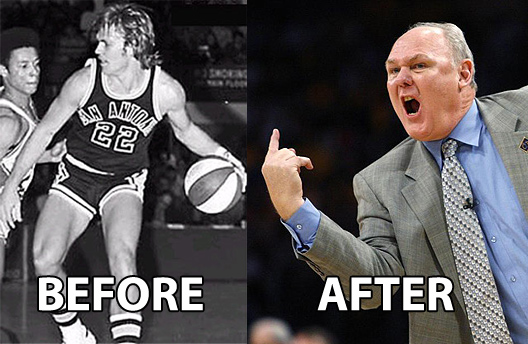
That ball my dad brought me back from San Antonio was one of two gifts from his business trips that I will never forget. The other was a genuine St. Louis Cardinals football helmet. So everything seems to come together, or at least it does when you begin to tell stories about it. The ball bore the autographs of (in order of recognition by me at the time): 1) Swen Nater; 2) George Gervin; 3) George Karl. I imagine their head coach, Tom Nissalke, also signed it since he was our neighbor who lived up the street from us in Madison, Wisconsin (I don't know, don't ask) and was probably the reason my dad got into the Spurs locker room after the game.

[Addendum from my father via e-mail, demonstrating how every history can be improved through surprising complication: "Sorry to disappoint you. Cannot remember the year of the meeting at San Antonio. I can tell you that it was not Nissalke who was instrumental in getting me the autographed ball but the representative of one of the laboratory companies that had a stand at the scientific meeting and when he learned that I planned to attend a game of the Spurs he said he was going too and he would get me the autographed ball. I shall continue digging into my records and hope to find some document (program, abstract, etc.) which might allow me to identify for certain which year was the meeting." My dad's research proved fruitful, determining that he was attending a conference in San Antonio from March 19 to 21 of 1975. That means he had caught the Spurs playing the Virginia Squires at home on March 21, just back from a road trip to -- you guessed it -- the Spirits of St. Louis.]

For many years that ball remained pristine. I saved it -- now displaying, now storing it in a bedroom closet -- long after the ABA merged into the NBA. When I moved out for college it stayed behind in the bedroom. At some point, I came home -- probably from graduate school, maybe later -- and wanted to shoot some hoops. Usually we kept a ball (a regular orange one) in a box in the garage. But for some reason, there wasn't one this time. So, without a second thought I retrieved the old ABA souvenir and used it to shoot away in the driveway, every meaningless dribble wearing away forever a bit of myth made mine. I still am unsure how I could have done that. The truth is, I think that I probably found it in the equipment box, already worn a bit as though someone else had taken a few shots with it. I'm going home in a week or so and I want to see if that ball is still there. If it is, even if it is flat and ordinary, the markings of ordinary time erasing the markings of legend that it once bore, I'm going to bring it back home with me to St. Louis and protect it. Maybe I'll even take it to a Pioneers game and get some autographs. Better yet: maybe I'll bring it with me to a tryout.

Could Be...

Read more...

A Three-Pointer for AnarchoHoops: 101 Words

Tuesday, October 5, 2010

Who do we need?
Once, watching Sheed and the Pistons with me, Claire indignantly asked, “why do they need refs?!”

From Alexander Wolff’s forward to Pickup Artists: “Some folks – the kind who take any exuberant young talent and try to truss it up in a blazer – sneer at basketball in its freest form. Those people would not have an ally in the inventor of the game. . . . The original Doctor J also said, ‘Basketball is a game that cannot be coached. It can only be played.”


Did William Gates, one of the exuberant young talents in Hoop Dreams need Gene Pingatore?

Read more...

Capsule Reviews (II): On Davis, Araton, Boyd and Wetzel and Yaeger

Sunday, October 3, 2010

The four books that I'm including in this second "capsule review" all revolve around basketball culture (NBA, NCAA, AAU, and HS) over the last three decades. They also all share the perspective that something changed dramatically during that time. But each configures the basic components of the story -- the game, race, money, the media, players, coaches, organizing institutions, apparel -- in slightly different ways. These books left me with the impression of four different sound boards, where the components I just listed are the "channels." The volume of each channel and the combination of channels made for sometimes strikingly different outputs; so much so that it was hard to believe at times that they were looking at the same game.

Seth Davis, author of When March Went Mad: The Game That Transformed Basketball (2009), seems like the happiest of our campers. "The Game" of the title refers to the 1979 NCAA Men's Basketball Championship Game, held in Salt Lake City, Utah. That year's title game featured the Michigan State Spartans and their sophomore point guard Earvin "Magic" Johnson and the Indiana State Sycamores, led by their senior forward Larry Bird. It was the highest rated basketball game, of any level, ever televised: nearly one quarter of all television sets in America tuned into it. By the Fall of 1979, Magic and Bird were preparing for their first NBA training camps and the start of careers that would help to transform that league, ESPN would be broadcasting from Bristol, Connecticut, and the NCAA tournament committee was contemplating another expansion of the men's tournament field (to 48). The money involved is perhaps most astonishing. The 1979 tournament grossed $5.2 million in TV revenues. Twenty years later, CBS paid the NCAA $6 billion dollars for an eleven year deal. Last year, the NCAA opted out of the final three years of that earlier deal and inked a new one that will expand the tournament field to 68 teams and net the NCAA $771 million per year for fourteen years.

I've noted before how silly I think it is to trace discernible historical changes back to a single event. And this is no exception. The very fact that 24.1 percent of American television sets were tuned into the 1979 championship game already indicates that some things had already changed before that game: the game was being broadcast live in prime time, the viewing public already knew the players, having had the opportunity to see them each at least once on national television. Among basketball fans, even young ones like myself, broadcasters Al McGuire, Dick Enberg, and Billy Packer were already household names, personalities you loved to hate and celebrities in their own right. So it's not as though this one game transformed basketball. But it was a great story, it does serve as an acceptable symbolic watershed, and since the power brokers in the media seem to think, according to this book, in the oversimplified terms of the single epoch-making event then, in a certain sense, it does also gain some substantive weight.

Davis's story, however, focuses more than anything on the stories behind the two teams. There's a lot of detail here and that very detail, in chronicling the personalities of the players, the conflicts in the locker rooms, and the ups and downs of MSU and ISU's respective seasons, complicates the narrative tapestry that unfolds toward and from the pivotal championship game. This increasing complexity both diminishes and augments the importance of the game itself. After all, I asked myself, reading Davis's account, is the title game more important than Magic's decision to attend MSU (by no means a foregone conclusion)? More important than Bird's to enroll in ISU after having dropped out of Indiana? More important than the coaching changes that occurred at each school? Than the numerous last second shots that kept Indiana State's won-loss record pristine up until their loss to MSU in the championship game? On the other hand, immersed in the myriad contingent factors that happened to converge to produce this particular game and to lend it narrative richness (not to mention with the retrospective knowledge that Magic and Bird would become great rivals and friends in the NBA -- or was that an effect of this game as well?), it's easy to begin to feel, irrational as that may be, that this game was somehow meant to be, the crowning convergence of a number of factors that could have -- that maybe even should have -- gone a different way.

I liked thinking about this, but I feel that this had more to do with me and the basic structure of the "x that changed y" school of sports history. Perhaps Davis knew what he was doing with that and I am undercrediting him. But it didn't feel that way as I read it. The prose tends to be bland, and most of the fascinating social and culture dimensions of the game are barely grazed. Think about it the prevailing attitude among the typical white male fan toward game at that moment: NBA (black, drug infested, overpaid, unpopular) vs. NCAA (white, clean, spirited, popular). Into this come Michigan State University (less glamorous than Michigan, and led by a black star, but one who is charming and charismatic and comes from a solid working class family) and Indiana State (whoever they are, they are not powerhouse Indiana, and they are led by a white star, but who is surly, dirt poor, and from a broken family -- Bird's parents were divorced, his father had killed himself, and Bird himself had fathered a child out of wedlock). The ironic twists and turns of this can get to be dizzying, but Davis barely registers these dimensions.

Finally, a "game that transformed basketball", and featured two of the greatest players who ever played, deserves a more poetic treatment than it gets here. No doubt my own memories of the beauty and enchantment of that game are intensified by the fact that I was not yet 14 at the time. Still, the miraculous perfection, both fragile and inevitable, of a Magic to Special K (Greg Kelser, Spartans forward) alley-oop jam or of Bird's effortless, economical motion on impossibly long range jumpers; both deserve more "french pastry" -- as Al McGuire used to refer to decorative embellishment -- than Davis gives it. Davis's writing reminded me, most of all, of very good young adult sports fiction.

The cover of the book is mesmerizing to me, mimicking a faded handbill publicizing the game. The image is brilliant, giving the multiple sense of a game that perhaps, then, still needed publicizing and in a media (the handbill) that has long-since been rendered irrelevant, perhaps by the very forces that game set in motion, or, at least, accelerated. The image also effectively activates a perfect nostalgia in the sense that it makes me fondly remember something that never happened. And I guess, ultimately, my disappointment stems not from my intellectual critique of the over-simplified history, but from the fact that, for me, this game did transform basketball and I wanted the book that told its story to rise -- like a Magic alley-oop pass, like a Bird long jumper -- to assume the full social, cultural, and athletic dimensions of that memory. It didn't.

Whether or not this one game was responsible, it is clear that the game and its culture, as described in the other books I've recently read, has indeed undergone a transformation since 1979. In a certain sense, these books pick up where Davis leaves off. In Sole Influence: Basketball, Corporate Greed, and the Corruption of America's Youth (2000), journalists Dan Wetzel and Don Yaeger reveal the yucky crap stuck to the soles of my beloved Air Jordans. This is not primarily the story of exploited third world labor, but rather of the weird culture of those who comb America's playgrounds and schools in search of the next Michael Jordan. In the wake of the massive increase in their sales (and the expansion of the sports apparel market more generally) thanks first of all to Michael Jordan, Nike sparked a kind of advanced competition among shoe manufacturers to identify, equip, and secure the future services of young players who might one day rise to superstardom in the NBA and, like Mike, be skillful pitchmen with crossover appeal. In the course of this competition, "stage" parents, ambitious high school, college, and AAU coaches, sychopantic adult groupies who worship teenage boys, pedophiles, drug dealers, and, of course, the barely adolescent young phenoms themselves all have a part to play.

Wetzel and Yaeger provide excellent reporting, good storytelling, and a clear sense of moral outrage. As the title suggests, this for them is primarily the story of multinational corporations obsessed with adding a dollar to the profit margin and more than willing to ignore the harm they do to the pure souls of America's youth in the process. In this respect, at first glance, they give me sort of the same feeling as watching Michael Moore's Roger and Me: namely, isn't corporate greed redundant? Or, in other words, is this really shocking to you? And it even resonates oddly with nostalgic tales about the old days in the NBA. We might remember, then, team play and hard nosed competition for the love of the game and clean-cut, fair, profit-taking in business as both signs of how things were better back in the day.

That's easy to ridicule, but the devil of that story really is in the details. And as I read the numerous particular stories that Wetzel and Yaeger track down and then weave into this overall narrative of unfettered greed and corruption, I find myself persuaded. For each of the few hundred players that actually make it into the NBA and get rich playing ball, there are many, many more who are drawn into a web that distorts their lives and leaves them with an even more restricted set of opportunities than the meager set they were probably born with. This web, the book makes clear, may sometimes expoit the fantasies and desperation of the kids and their families, but it is unmistakably designed by shoe company executives and spun by a decidedly unsavory and selfish cast of hangers-on. The whole thing is then fueled by a vortex of marketing and consumption facilitated by a proliferation of media exposure.

For Wetzel and Yaeger, the game itself has been a main casualty of the shoe wars, to wit:
"The quality of play the NBA is putting out each night is not up to the aesthetic levels of the past few decades. The level of boorish player behavior, however, is at a record high. The league's newest generation of players, the ones weaned on a steady diet of free gear and AAU ball, is generally regarded as pushing the game to new depths. The worst are vocal defenders of their individual rights. They are shocked when informed marijuana is illegal, hustle is demanded, off season workouts are expected. They talk on the cell phones a lot. They don't dive on the floor very often."
Maybe. Though as I've absorbing massive amounts of basketball narrative in recent months, I'm amazed at how widespread is the feeling, in each generation, that the game is worse than it used to be, and worse in a strange moral sense of the word. In their final chapter, Wetzel and Yaeger make a stab at transforming the growing sense of sad helplessness their own narrative has generated into a call to action. But unfortunately, that call can only, I think because of the moralizing overarching structure of the book, be a Peter Parkeresque insistence that with great power (or, they put it, "rights") come responsibilities. Maybe. But even if we subscribe to that same principle, the call itself forgets the larger social and cultural forces that keep that moral from sticking, forces that the authors themselves have painstakingly exposed.


The last two books offer two distinct takes on what Wetzel and Yaeger see as the injury to the game. Harvey Araton seems to share that sense of the NBA as having experienced a recent dip in beauty and moral quality, though he sees hope in the infusion of international players. Meanwhile, Todd Boyd takes issue with the very characterization of the NBA's recent past as a distortion fueled by cultural misunderstanding and racial fear and resentment.

In Crashing the Borders: How Basketball Won the World and Lost Its Soul at Home (2005), Araton, a New York Times columnist, tells the history of the NBA from around the time of the 1992 Barcelona Olympics to the November 2004 brawl between the Detroit Pistons and the Indiana Pacers, and between the Pacers and the Pistons' fans. The arc of that history, for Araton, is obviously a fall from grace (the losing of its soul). However, Araton also seems to see hope for the game in that the very success it enjoyed abroad (as a result of the 1992 Barcelona dream team's popularity) generated an influx of international players who, as Araton sees it, are revitalizing the game and deprioritizing some of those dimensions of the game (one-on-one play, the slam dunk) that Araton feels have hurt it. I'd say that this is just one more middle-aged white man's lament for the loss of the game of his boyhood when the game itself was more horizontal and the players, regardless of race, more -- as they say today -- "relatable".

But I must give Araton some credit here. While I do feel that nostalgia is the overarching narrative governor in this book, he is more than capable of airing a different, and critical perspective on that way of telling the story, and he is able to accommodate and articulate his own mixed feelings about the game today. And, Araton's sensibilities are capacious enough to deal with the social and political forces running through the game. Above all, I appreciate Araton's willingness to air both this ambivalence and honest uncertainty about how to move forward. This allows me to feel included in the conversation as a conversation (as opposed to just a PTI style sports-guys-shouting dialogue of the deaf).


Professor Todd Boyd, of USC, offers a different take on all this NBA and NCAA history in Young, Black, Rich, & Famous: The Rise of the NBA, the Hip Hop Invasion, and the Transformation of American Culture (2003). Though, frankly, I found this book disappointing, frustrating, and hard to get through, I also found it a refreshing alternative to the more restricted analytical scope of mainstream journalistic accounts and I'm glad it exists. Boyd's book positions itself as history with a thesis, as all history must necessarily be. In this case, the history is of the NBA since the 1970s and the thesis is that as the league's player pool grew to be predominantly black, NBA culture intertwined with other forms of black popular culture (primarily hip hop) characterized by an unapologetic individualism and that white owners and white fans find this racialized cultural amalgam highly threatening. I don't really disagree with this. In fact, I find it, particularly in light of the flap over Lebron using the "R-word", refreshing and valuable. Boyd's periodization of the NBA in relation to music history is also provocative and provides food for thought, though I wish that he had deepened it to include analysis of musical structures themselves (rather than restricting himself to the occasional reference to lyrics or marketing styles). I found it interesting to think about the relationships and transitions between Oscar Robertson and Motown or between Magic Johnson and Michael Jackson; as well as Boyd's more general reflections on the politics of relating basketball to various musical genres such as jazz, classical, funk, or hip hop.

At the same time, I found the structure and style of Boyd's writing confusing and, at times, contradictory and alienating. I have no issues with his desire to marry the "formal and the vernacular" as he puts it. On the contrary, I applaud his intention and admire his skill in doing so. But the book also suffers from flaws that I don't think stem from this particular stylistic strategy: unnecessary repetition that makes the book sometimes feel like a series of essays pretending to be a book, unhelpful oversimplification that makes even a sympathetic reader like me take issue, and the presentation of conjecture (however warranted) as fact. I'm glad this book was written, because the topic is both interesting and important to me. But because the topic is both interesting and important to me, I wish it had been written with more care and subtlety and with more desire to persuade a broader audience.


Read more...

HoosiersNation?

Friday, September 17, 2010

Why are we -- I mean the sports media in this country -- so head over heels in love with the American basketball team that just won the FIBA World Basketball Championships last week?  I probably should have been doing my day job, preparing for my first class on Tuesday morning. But, as I sipped my automatic machine made latte on the 2nd floor balcony of the Red Roof Inn, the four story tower of the Hampton Inn looming across the parking lot, I felt the irresistible lure of setting down some thoughts on this infatuation. I'm not thinking of the action on the court itself so much as the storyline -- the myth -- that has been repeated ad nauseum in the American media.  I encountered one of the many instances of this while reading Mike Lopresti's recent column in USA Today over my complimentary Hot Breakfast at the Big Boy adjacent to my digs at the Red Roof.    It's a beautiful life.

Here, for those who didn't follow the tournament, are the facts:  the US won this year's FIBA World Championships and I'm glad.   None of the players that took the gold medal in Beijing in 2008 agreed to play for Team USA in the World Championships, with the result that Jerry Colangelo, who runs the USA Basketball program and Head Coach Mike Krzyzewski, assembled their roster in the two months prior to the tournament from a different, less acclaimed pool of NBA players.  The team played tough defense and ran the ball well and Kevin Durant had a terrific tournament.   I feel glad for Durant because he seems like a good guy and a good ball player; I feel glad that the team won, played well and avoided any kind of "Ugly American" incident on the court or off.  And that's about the extent of my feeling about what actually happened.  But, as I said, this is not so much a story about what actually happened or about my feelings about what happened, so much as a story about the story that has been circulating about what happened and my feelings about that.

That story inevitably begins with a backstory.  It may take different, sometimes very compressed forms for different writers, but in its main lines it goes something like this (which I'm blocking off as though it were a direct quotation to indicate that I'm paraphrasing):

Once upon a time, the US dominated international play fielding teams of the best college players and then, when the rules changes, with a series of Dream Teams of the very best American NBA players.  But there was a snake in the garden.  To begin with, the NBA's own aggressive globalization efforts began to pay off in the form of vastly improved play from international players in a number of foreign countries: Spain, Argentina, the Balkans, and France.   Then, at the same time, selfish and immature US superstars stopped considering it a priority to represent their country in international competition.  Finally, even those players that did agree to play for Team USA were at a disadvantage because 1) they weren't used to playing with another (unlike other national teams whose players had, in some cases, been playing with one another since their teen years); 2) they were selected for individual greatness and not in terms of the quality of the overall team they would combine to form; 3) they weren't coached with an eye toward the style and unique rules of international competition.  The result:  a dark period of USA Basketball:  a third place finish in the 1998 and 2006 FIBA Worlds,  a sixth place finish in the 2002 FIBA Worlds (held in Indianapolis no less), a third place finish in the 2004 Athens Olympics.  Even a gold medal in the 2000 Olympics was judged a sign of demise since several games were won by margins too narrow for comfort.   Finally, the sun begins to shine through these dissipating clouds when USA basketball got its act together, hiring Colangelo and Krzyzewski and requiring a three year commitment to training and competition from its NBA player pool.   This yielded a gold medal finish in 2008 in Beijing and all was right in our basketball cosmos.
But then,  the story arc dips into another trough of difficulty.


None of those players -- not Lebron James, not Dwyane Wade, not Dwight Howard, not Kobe Bryant -- wanted to play in this year's FIBA tournament.  The players that were selected were dubbed "The B-Team".  We couldn't expect much of this team because, for the rest of the world, the FIBA World Championship is more important than the Olympics.  
To intensify our investment in the drama, the typical storyteller injected some additional stakes


Not only the FIBA gold medal, but our spot in the 2012 Olympics in London was a stake because if the US didn't win the FIBA Worlds and its accompanying automatic qualifying bid in the next Olympic competition they would have to qualify for the Olympics through a round of inter-American competition and this would be more difficult than usual given an imminent NBA labor negotiation and the strong possibility that players who might be on strike at the time of the inter-American competition would be ineligible, leaving the US to face stiffened competition with nothing more than their best amateurs.
Now that the tournament has been played out and disaster averted, journalists and bloggers are falling over themselves to herald the over-achievement of "The B-Team," their moral stock rising, seemingly, on the tide of the "Redeem Team" players refusal to join the competition.  Here's how, again in summary, the story reaches its satisfying resolution.


Kevin Durant, humble and likeable, emerged from the shadows of the Redeem Team superstars James, Bryant, and Wade by putting on a tremendous display of scoring prowess.  While Kobe spent his summer lolling in the reverie of his recent NBA championship, and James and Wade spent theirs conspiring to join forces on the Miami Heat and greedily thrusting themselves into the media spotlight, Durant worked hard to get ready to represent his country in international competition and then, when the tournament began, put the team -- at least on offense -- on his shoulders and carried them to victory.  As for the rest of the players, undersized, not all that good, and unaccustomed to playing together, they pulled together under the wise tutelage of Coach K, played gritty old fashioned defense and then celebrated their surprising victory with the innocence and charm of the (all white) Hickory High Huskers knocking off the big, bad, black team from the big city in the 1989 film Hoosiers.  And it's a darn shame that the selfish superstars like James, Bryant, and Wade will probably displace this likeable bunch of underdogs on the team that represents the US at the 2012 Olympics in London.
So that's the story, the myth, that's being created and circulated and relished in the media here. It's a great, rousing story.  The only problem is that it rests on what might generously be called some exaggerations of actual facts, and some omissions of others.  Let me correct these first.

Kevin Durant was already, before the tournament, recognized as one of the top players in the NBA.  Durant was named College Player of the Year for his efforts as a freshman at the University of Texas (the only year of college ball he played).  In fact, he was heralded as the only freshman ever to win the award.  Then he was the second selection in the NBA draft.  In his first season, he averaged twenty points a game and was named rookie of the year.  In his second season, he averaged twenty-five a game.

Yeah, never heard of him
And this past season, his third in the NBA, he became the youngest player ever to lead the league in scoring, averaging 30 points a game, finished second in MVP voting (behind James and ahead of Bryant, Wade, and Hoard), was selected to the Western Conference all-star team, and was chosen as one of the five players (along with Bryant, Wade, James, and Howard) to the All-Pro team. He also helped his team, the Oklahoma City Thunder, to reach the playoffs, where the young, eighth seeded team pushed the top seeded, and eventual champion, Lakers to six games in their first round best of seven series.  Oh yeah, and when he came out of college to join the NBA, he signed a $60 million endorsement deal with Nike.

Certainly, the rest of Team USA's roster, top to bottom, lacked both the record of individual and team success and the star power of the 2008 Beijing Olympic team.  But it's quite a stretch to characterize them as "B Team" players.  Chauncey Billups was the third overall pick in the 1997 draft, the 2004 NBA Finals MVP, and has been an All-Star each of the past five seasons.  Lamar Odom was the fourth overall pick in the 1999 draft and, though his career has been checkered for personal reasons, was instrumental in the Lakers repeat title run this year as the first player off the bench. Derrick Rose was the first player picked in the 2008 draft, the 2009 Rookie of the Year, and an All-Star in the same year.  Among the other players, several were chosen in the top ten in their NBA draft cohort, and some had been first team All-Americans in college.

The FIBA World Championships may just as important to the players in other countries as the Olympics, maybe even more important for some of them.  But if such a generalization may be in some sense true, it doesn't account for the fact that some of the best and best-known international players in the NBA, the very players whose talent and visibility are held up as evidence that the rest of the world has caught up to the US in basketball  -- Manu Ginobili (Argentina) Nene Hilario (Brazil), Pau Gasol (Spain), Tony Parker and Joakim Noah (France)  Dirk Nowitzki (Germany), and Mehmet Okur (host Turkey) -- chose not to participate in the tournament.   One observer close to a several European players claims that the Olympics are, in fact, their top priority (after the NBA).

Finally, this is subjective (who is to say what is the requisite level of innocence and enthuiasm with which to celebrate an international championship?), but having watched most of the games in the 2008 Olympics, I'd feel hard-pressed to say that the superstars of the Redeem Team weren't excited to be there, and, even more, every bit as jubilant upon finally capturing the Gold with their finals victory over Spain.

Yeah, they don't care.
 Those players -- Kobe and others -- were also running around the court after their victory, slapping the hands of American fans in the stands and, in general, celebrating with the innocence and unbridled exuberance of a group of high schoolers winning their first state championship.

So if Kevin Durant didn't come out of nowhere and was already considered one of the best players in the world, why do we keep acting as if he did and wasn't?  If the rest of the US team didn't consist of a bunch of midget also-rans but rather were almost without exception successful and recognized as such, why did we act like it did and they weren't?  And if the rest of the world didn't bring its best players, why do keep insisting that they did?  And if the Redeem Team was excited to win too, why is it so important to say imagine that they weren't?  Why are the same media experts that participated in the circulation of all the facts that I described above now forgetting them?  What purpose is served by this?

I will be blunt, at the risk of over-simplifying.  I think what is served by this particular story, and this sort of storytelling in particular, is a particular national self-image, often not so subtly racialized if not racist, that we expect our athletes, especially our national athletes, to support.  It's that image that I sum up with the title of this post:  HoosiersNation.

Our National Team?
 That film fabricated the story of an invented small, rural Indiana high school team (the Hickory Huskers)  winning the Indiana state championship against a much more athletically gifted, all black team (with all black coaches and rowdy all black fans) from  South Bend Central.  In the process, players, fans, and coaches alike overcome obstacles, learn life lessons, and redeem their pasts.    Nevermind that the actual Indiana team (Milan) upon which the movie was based beat -- as Oscar Robertson, among others, has pointed out in his autobiography The Big O -- a Muncie Central team coached by a white man, supported by mostly white fans, and whose entire roster included only three black players.

But such realities don't need to get in the way -- any more than the facts I listed above -- of our seemingly endless need to see ourselves as a scrappy group of unheralded white guys rising, through hard work and the subordination of individual ego,  to successfully, joyfully, but humbly, meet the challenge of defeating a talented Other whose abilities and superior resources ultimately, cannot make up for their lack of heart and unselfishness.

How perfect that this year's quarterfinal game was played against the Russian team on the 38th anniversary of the 1972 Olympic Finals in which the (scrappy) US team (of all amateurs) lost to the Russian team on a last second basket, after the referees unfairly awarded the Russian team three different opportunities to replay the final seconds.  Though the players didn't make much of the anniversary, the press certainly did.  Nevermind that the 2010 Russian team (unlike the 1972 Soviet team) had done little in international competition.  Like Rocky facing the machine like Ivan Drago in Rocky IV, our boys were playing out of desire and with heart, and, in the moral universe of our national fantasies, that always wills out over talent, technology, and heartless efficiency.  Finally, as if the brew weren't rich enough, this year's semi-final was played on the 9th anniversary of September 11th, 2001, helping to reinforce our collective desire to see ourselves as innocent victims and underdogs and to stoke our collective desire to assert the superiority of our self-assigned national values against overwhelming odds.

I like this year's US team.  I really do.  And I appreciate and respect what they achieved.  But I'm annoyed by the way in which the media has turned their story into a myth that permits us, as individuals and as a nation, on the court and off, to evade so many realities about ourselves (some good, some not so good) and, like an oversized infant blithely lumbering through a Lilliputian world, to cause so much suffering.  I don't want to identify with that team, that game, or that country.

Read more...

  © Blogger template The Beach by Ourblogtemplates.com 2009

Back to TOP