Powered by Blogger.
Showing posts with label Memoir. Show all posts

Cultures of Basketball Course Diary: The Serpent’s Tale (Day 14)

Wednesday, March 9, 2011

This also appeared earlier today on the FreeDarko website. But I'm keeping it here for the sake of consistency and for those few readers of mine who come here first

This is a hallowed day. They asked me to play. They actually asked me to play. Okay, well it wasn’t exactly that they asked me to play, but pretty much. Walking across campus to class from my previous class, the fantasy image flashed into the slide projector of my mind: an intra-class pickup game. The still image sprang into motion: all of us going up and down the court at Crisler Arena. I tried to push it aside, tried to stop it. No way I’m going to propose this in class and have the players break into uncontrollable sneering laughter. But then, I walk into class and I’ve barely put my stuff down on the desk when one of the players, having very courteously asked me how my broken hand was doing, said, “We should have a class game.” Moments later, another player walked into class and said the same thing.

I feel I shall burst with joy and excitement. If God himself, donning sweats, had parted the gray Ann Arbor skies, and entered the class on a Golden Litter, born by Clyde, the Hawk, Dr. J, and Wilt, and said, “you know what, that tree of knowledge thing, I was j/k!”, I could have been no happier. A weight of decades has been lifted from my shoulders. It was an auspicious way to begin the home stretch of Cultures of Basketball, after a two week hiatus, and leading in to the much-anticipated visit of none other than Bethlehem Shoals himself to our Ivory Tower next week.


We all began to babble excitedly about the match-up. “Players against the rest of us!” someone shouted. Oh no, I thought to myself, I didn’t wait nearly thirty years to play Division I ball in order to get clowned by a bunch of college kids. If you wanna go players and teacher against the rest of the class, I’m down, but otherwise we’re splitting the players up. Buoyed by my sudden surge of popularity among the players, and the riotous atmosphere of the room, I took a wild risk. I explained that I’d just been thinking the same thing on the way over to class and added, “But in my fantasy of this game, we’re playing at Crisler. So I want to give the players a special group assignment: make that happen.” I’m thinking that’s an impossibility, but that just saying it will curry even more favor. But lo, another player speaks up and says he thinks that shouldn’t be a problem. What! Verily, yea, I will tread the same hardwood as my forefathers CWebb and Jalen, and their forefather, Cazzie, did before them.

An evening of feverish tweeting and e-mailing ensued in which yet another player and I worked out the details of 1) a class lottery, presided over by David Stern, in which the eight players would draw names to round out the rosters for each of their teams and 2) the field of eight three-player teams would be seeded and compete in an April-Madness extravaganza culminating in the crowning of the first ever Cultures of Basketball national champion. My fiancée then tops it all off by suggesting we have the game on a weekend so that she can come up from St. Louis to witness, testify, and oversee the national media hordes that will certainly converge on Ann Arbor for the Blessed Event. So y’all can just get in touch with her about securing your media passes. I’m pretty sure that Ernie and the TNT gang already have their hotel reservations, Dicky V. called to make sure he wouldn’t be excluded, and the Goodyear Blimp, flown by Captain Jon Conrad and crew, has already secured airspace.

Talking to a student later during office hours, he shook his head with dread: “Maybe the players just wanted to play us so they could destroy us.” “Who cares?,” I said to him, “I just wanna play. It’s like when you’re little,” I explained, “you just want your big brother to play with you, you don’t care that he’s gonna beat your ass. It’s just about the attention.” My student smiled and said, “I was the big brother.” Well, okay, but you get the idea. I know I’ll actually be shitting myself on the day of the game, and I’ll probably dribble off my foot, shoot a couple of air balls, and – horror of horrors – be single-handedly responsible for decimating the ranks of next year’s Michigan basketball team by somehow injuring each and every one of the eight players through some clumsy display of aged overreaching. But really, who cares? It’s the sort of moment when it all comes together and several lifetimes’ worth of minor slights and trivial but embittering disappointments are swept away by a deluge that leaves your soul as brand spanking new and clean and naked as Adam and Eve in the Garden.

Speaking of paradise, today’s class was devoted to the section of FreeDarko’s history on Larry Bird and Magic Johnson, the first segment of Chapter 4: “The Gold Standard: 1980-1990.” But before we got to Magic and Larry Legend, and after we’d settled down, we had one more bit of topical business to address: the controversy over the Heat “allegedly” crying in the locker room after their 1 point loss to the Bulls the other day, at the time their fourth straight loss. I asked them what they thought and they told me, but then I realized that I didn’t so much want to know what they thought as tell them what I thought they should think, or at least what I thought they should bear in mind as they formed their own judgments of the event.

So we briefly discussed the possible meanings of tears and of emotions in general, the role that emotion plays in sport and in human life more generally, and the way that culture and upbringing, especially as coded by gender, shape the way we judge – and that we feel entitled to judge – public displays of emotion by other human beings.

One of the more interesting points was raised by a student, who pointed out that the gender double-standard also works against female athletes who show anger or swag in the course of competition. In both cases, culturally set parameters of appropriately “masculine” or “feminine” relationships to particular expressions of emotion wind up underwriting thoughtless critical judgments of particular athletes for crossing the boundaries of emotional expression.

It’s sad, really, that young men and women, athletes or not, should be subject to such constraints. And sadder, still, perhaps, that other young men and women should participate in limiting the scope of what it is possible to be and to feel and to show you feel as a young man or young woman. Nothing was resolved, of course, but I think that students by the end of our little conversation were equipped to do more than just accept the terms of the discussion as provided by ESPN or the guy next to them at Buffalo Wild Wings.

Having completed my pontification on the topic of emotion, gender, and athletics, we rode the FD time machine back to Bliss, the Gold Standard, the Paradise of the NBA in the 1980s. The religious, specifically Edenic, lexicon that I’ve been trying to weave into this post is neither accidental, nor really of my own invention. The illustration that fronts the Magic Bird chapter shows the two players, in iconic poses, emerging from a garden lush with sunflowers, ferns, daffodils and tropical foliage.

An unpaid student query about the significance of the image gave me the opportunity to say a few words about the myth of Eden and the kind of cultural work it can do in Judeo-Christian societies. I don’t want to go biblical on your ass, or be too dweebishly unsubtle about it (especially, in view of the compact subtlety of Jacob Weinstein’s visual argument), but it’s worth acknowledging, at least, the force and pervasiveness of that myth in the way that we lace often overly simplistic judgements of good and evil into narratives of memory and history. It’s not that Eden is always invoked explicitly, but rather that it doesn’t have to be because by now it is almost second nature (a distinctly un-Edenic concept, or maybe it is Edenic). Everytime you hear someone talk about the good old days, nostalgia, you know the routine, once upon a time – always, there Eden is at work.

In the case of Magic, and Bird, and the 1980s, it’s certainly understandable, and close to my own heart’s experience, that the myth of Eden should appeal. As FD writes in the brief Introduction to the chapter, the decade saw a truly awesome influx of talent into the game: not just Magic and Larry, but Isiah, Worthy, Jordan, Barkley, Akeem, Stockton, Malone, Ewing and others entered the league in the period. Moreover, unlike, say, in the 1960s, that talent was properly showcased by the rise of ESPN and other forms of media exposure and endorsement deals, all carefully overseen by the – whatever else you want to say about him – far-sighted and shrewd PR vision of Commissioner David Stern. The play on the floor was brilliant and more people than ever were getting to see it. FANtastic was born.

But there’s more to it than that. In Magic and Bird, of course, you had two players with a ready-made rivalry established in the 1979 NCAA title game (itself a watershed moment in most accounts of the college game), and a rivalry amped up by the storied history of the Lakers and Celtics, the franchises they joined. Moreover, as we discussed in class after watching clips of the two players, Magic and Larry truly showcased a remarkably complete (and remarkably similar – a fact I think that is often undernoticed) set of basketball skills.

Though neither was an exceptional athlete by NBA standards, each had the intelligence and put in the work to maximize the gifts they did have and so to turn themselves into astonishingly creative passers and effective rebounders, ball handlers and shooters (more Magic than Larry for the handle, more Larry than Magic for the shot). Both were capable of scoring from unpromising angles and traffic situations, both capable of unselfishly raising the game of their teammates, both clutch and both winners, and both driven to lead by example in squeezing every last drop out of seemingly every play on the floor.

In their styles of play, both players, as Brown Recluse, Esq. (BRE) notes, embodied the happy marriage of ABA creativity with NBA stability. BRE even concludes by correctly observing that Magic and Larry left us as a legacy the freedom that would evolve into positional revolution with oversize point guards, and bigs who can hurt you inside or step out and hit the three. And finally, of course, one was black and one was white. Put it all together and that’s hard to top if you’re looking for Paradise in the history of the NBA.

The myth of the Garden of Eden, though, is more than just an emblem of unadulterated bliss. It describes a tricky pseudo-contract in which submissive ignorance is the price exacted for that bliss. Moreover, it tells us that pain, labor, and sexuality are punishments for the violation of that contract. You remember, right? Adam and Eve eat of the fruit of the Tree of Knowledge, aspiring in the process to have their blind eyes opened and to see as God sees and, as a result, are cast out of the Garden. Ultimately, the narrative carries for me a dark side by which we are commanded to remain in a childish state -- lacking knowledge, desire, experience, and agency -- if we are to be happy.

I’m not the first to point this out, of course. John Milton in Paradise Lost (perhaps in spite of himself) and William Blake (very much not in spite of himself) long ago suggested or argued outright that it’s not so clear who might be the good guys and the bad guys in the story of our “Fall.” More recently, the British author Philip Pullman rewrote the whole story in his remarkable trilogy His Dark Materials. There Pullman conceives that our “Fall” was really a kind of elevation, a growing-up of the species if you will, prompted by angels rebelling against a God who was really just the first angel, but had usurped authority, styling himself the Creator of the rest, and establishing a tyrannical Kingdom of Heaven in place of the immanent Republic of Heaven.

In Pullman’s reading, the rebel angels did us a favor and every time we think for ourselves, enjoy our existence as beings with minds and bodies, and make independent decisions, every time we assert the right to determine the course of our own futures, we are embodying the empowering legacy that the Judeo-Christian myth of the Fall would have us lament and repent for unto eternity.

Offering this counter-vision doesn’t mean that I think the myth of a fall from grace, or innocence, is useless or bad. Just that it’s a more complicated tool for organizing our understanding of ourselves than might appear at first glance. In my own case, the bliss ushered in by Magic and Bird’s appearance in the NBA (which was indeed a paradise for me: my room was plastered with Magic posters, and I still have a scrapbook I started keeping in 1979 with Magic clippings from the local papers and Sports Illustrated) coincided with my exit from the innocence of childhood via a number of doors simultaneously: I learned to shoot a jump shot, my parents separated, and I entered puberty.

So it was a complicated Eden for me, that: one that sends my mind and my emotional memories snapping back and forth wildly like a standard in a strong wind. But I wouldn’t trade that complicated and painful time – and all that grew from it – for the relatively less complicated, ignorant bliss of pretending to be Clyde in the driveway at age 7.

By now you might be imagining that I am of the Devil’s party, as Blake once said of Milton. Maybe that’s true in some sense. It is certainly true that the serpent is for me the most interesting character in the story. And, in relation to this Golden Era of NBA history, I certainly wonder where (or who or what) the serpent is.

About fifteen years ago, in a first futile stab at doing this kind of writing, during a leave year in which I received tenure at the University, I became fascinated with Dennis Rodman. Around this time Terry Pluto published a book called Falling from Grace (1995). Its subtitle was “Can the NBA Be Saved?” In it, if I remember correctly, Pluto characterized the then-current crop of young players as brawling, trash-talking thugs whose basketball fundamentals were decidedly underwhelming. I’m pretty sure Dennis was singled out in that book, along with a few other players as symptomatic of all that had gone wrong with the game.

At the time, I wrote an essay – now long lost – on the joy of being Dennis Rodman. I wasn’t interested so much in defending Dennis’ style choices (or behavior), so much as pointing out that in his play on the court (tenacious defense, hard-nosed intelligent rebounding, good passing), Rodman embodied many of the values that Pluto himself was nostalgically associating with a different, now bygone era (not to mention race, I remember feeling upon reading the book).

I’m not sure what I’d think of Pluto’s book or of my own argument now. Maybe I wouldn’t stand by it any longer. But I definitely do stand by the impulse I acted on to complicate simple notions of human history that characterize it as either a steady progress toward something good or a steady (or precipitious) fall from something good. That much, perhaps, is the serpent in me.

In fact, maybe the serpent isn’t so much a character in the story, or not only a character in the story, but a role we all step into whenever we question the story and read it against the grain; whenever we take the childish dichotomies we are offered – and which, make no mistake, can be quite useful in limited cases – and begin to poke at the boundaries separating them.

So when I think of the NBA since Magic and Bird’s time, back, when, as they recently wrote, “the game was ours,” I think as much of Bird’s legendary trash-talking, I think of the image of Magic posterizing some chump with a tomahawk jam and then pointing to him as he lay splayed on the floor along the baseline. He wasn’t beaming. Sure I think of and marvel at their amazing array of skills and their run of titles. And I’m genuinely moved by the way their rivalry evolved into friendship and love. But I also think of their personal lives, seriously troubled at times like those of any human being. I think as well, as Brown Recluse, Esq. advises, of the marvelous players that have come after them in a more or less continuous stream since that time, patterning their unusual combination of skills and size and styles of play on some permutation of Magic and Bird.

And when I think that way, the gate at the Eastern end of the Garden of Eden, the one guarded by the angel with the flaming sword, the one that Adam and Eve left through, and that supposedly clearly marks the line between paradise and our own sorry existence starts to blur and fade.

I like that moment because the alternative offered by subscribing to the Eden story is to spend all of existence trying to make up for something I didn’t do and that I don’t think was wrong in the first place. It is to hate actual existence in the name of a time that has long since ceased to exist and that I don’t think ever existed in the first place.

So when the gates swing open, and I can acknowledge the splendor of Magic and Larry Legend in all its complex shadings, then the present and the future open back up and I am once again in a position, as one of Phillip Pullman’s characters urges: “to build the Republic of Heaven right here, because for us there is nowhere else” and to appreciate those in the game and the world today who are laboring to build it too.

go back to read my account of Walton and Jabbar and the politics of the late 70s NBA

or

Go on to read about our discussion of the Young Michael Jordan here

Read more...

Possibility is dead! Long live possibility!

Saturday, December 11, 2010


What I remember best about it is the blur as I lay on my back in bed, shooting it straight up into the air with perfect back spin: red, white, and blue giving way to the vaguely perceived promise of purple, even lavendar. I was not yet ten, and my dad had brought it back from a business trip to Texas: a genuine ABA basketball autographed by the San Antonio Spurs.


I was thinking about that ball this morning because no sooner had I submitted to the Facebook status gods my wish that there be a pro hoops franchise in Saint Louis (less for the games than for the gear) than I discovered that there is one: the St. Louis Pioneers. All life should be so easy. But wait, there's more. Not only is there a pro team in St. Louis, but they play in -- wait for it -- the American Basketball Association. That's right the ABA. It's not your daddy's ABA, but it wants badly to be. It even licensed the name from the NBA which apparently owns it (of course, it owns everything related to basketball).

What David Stern Sees
On the Pioneers web page, the first image you see is the towering afro of Julius Erving, decked out in his Nets uniform and a thin, gold choker. Then the image morphs to side by side images of players that actually have something to do with St. Louis: Marvin Barnes of the old ABA Spirits of St. Louis and Bob Pettit of the old NBA St. Louis Hawks, and then finally Barnes shifts over to the left hand side of the image and Moses Malone takes over the right hand side, dressed in his Spirits of St. Louis # 13 jersey. It's a chaotic little montage, historically speaking, tying together three icons of the scintillating blackness of the 70s ABA with Pettit, the icon of an era when St. Louis resisted the innovations in the game represented by Erving, Barnes, Malone and the whole ABA, not to mention stubbornly refused to integrate its roster and was the worst place in the NBA for visiting African-American players.

But nevermind all that: St. Louis basketball is back. That's the story, the narrative arc: there is this thing that is one, it is called St. Louis basketball. Like God, or the Word, it was made flesh. That flesh was called, first, the Hawks (Pettit), then the Spirits (Barnes, Malone) and now the Pioneers (um, Erving? the ABA).

a spirit of saint louis
Right, if it seems a bit thin as a narrative, in my mind that's just part of what stamps its authenticity as the heir of the old ABA. That old ABA, you remember it from Terry Pluto's Loose Balls, the Fish that Saved Pittsburgh or, today's versions, Chapter 3 of Free Darko's new basketball history and Will Farrell's Semi-Pro. The best thing about the old ABA, for me is its resistance to narrative. As FreeDarko asks there in Chapter 3: "What the Hell was the ABA?" Even the canonical history of the ABA -- Pluto's Loose Balls -- is really just a garbage can full of awesome quotations from participants, arranged in chronological order, and prefaced with a dizzying table that chronicles the emergence and disappearance of franchises like so many bubbles on the surface of a pot of boiling water.


A Time Machine
What story can you tell about a pot of boiling water? "It wasn't boiling, I heated it up, it boiled. Now it's boiling."? Not much of A Story there, though lots of stories: like when none other than the Spirits' Marvin Barnes once refused to get on a plane home from Louisville (Eastern Time) because it would arrive in St Louis (Central Time) before it had left: "I ain't goin' on no time machine." Oh yes you are, sooner or later. Now the St. Louis Pioneers have given him a middle seat on theirs. But I'm down with the Pioneers' weird historical montage because it's weird and ultimately contradictory, incoherent, and unpolished (when I friended the Pioneers on Facebook I got a message from them with a dead link).


A More Dangerous Time Machine
When the old ABA merged into the NBA, not only did the NBA get some dazzling players, a handful of viable franchises, and the rights to the name, it exercised its irresistible Story-Making power to fold the ABA's own non-narrative existence into the NBA's larger story of global domination. It's the titanic chapter of the dialectic of the NBA where individual creativity and entertainment was sublimated by the Association into what would become the racial harmony of the Bird-Magic era + the awesome marketing extravaganza that is Michael Jordan. And it's not that that's wrong or untrue. The nine-years of ABA basketball are part of the NBA's history and it's right to tell it that way. But as always happens with time machines of this sort, possibilities get left behind. Possibility gets left behind.
Another kind of history
But a watched pot, they say never boils, and the part of the ABA that is unwatched, roiling craziness, unwitnessed by just about everyone: that's also part of what should be registered of its existence, then and now. I don't know how to tell that: maybe a poem, maybe a Nietzschean aphorism, maybe just a physical spasm. But I know it when I see it: the St. Louis Pioneers, whose home games are played at St. Louis Community College and whose roster includes nobody I have ever heard of. The ABA is dead. Long live the ABA. nbsp;At first I felt like a fool for having not known (or forgotten) about the new ABA (which began in 2000). But then as I clicked around some more I realized that this league takes the old ABA's resistance to narrative and intensifies it exponentially. It's hyperlink madness. The same hyperlink madness that led me to find a photo of a genuine ABA ball signed by the San Antonio Spurs just one year after I got mine. In fact, Claire just discovered the fine print on the bottom of this page, where the publishers of the online sports media outlet oursportscentral.com -- dedicated to "major league coverage of independent and minor league sports" -- throw in the towel: "Our SportsCentral no longer actively covers the American Basketball Association (ABA) as a professional league due in part to its inability to publish and play a schedule and the transitory nature of many of its teams." You can get an ABA franchise for around $10K (AI's mom did, back in 2008) and that will make your squad one of the 50 or so that float and sink in a given ABA season.

George Karl: One Last Time Machine

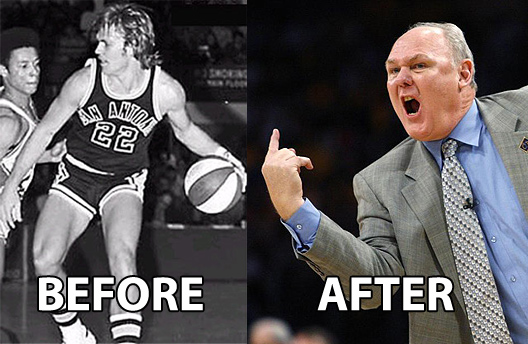
That ball my dad brought me back from San Antonio was one of two gifts from his business trips that I will never forget. The other was a genuine St. Louis Cardinals football helmet. So everything seems to come together, or at least it does when you begin to tell stories about it. The ball bore the autographs of (in order of recognition by me at the time): 1) Swen Nater; 2) George Gervin; 3) George Karl. I imagine their head coach, Tom Nissalke, also signed it since he was our neighbor who lived up the street from us in Madison, Wisconsin (I don't know, don't ask) and was probably the reason my dad got into the Spurs locker room after the game.

[Addendum from my father via e-mail, demonstrating how every history can be improved through surprising complication: "Sorry to disappoint you. Cannot remember the year of the meeting at San Antonio. I can tell you that it was not Nissalke who was instrumental in getting me the autographed ball but the representative of one of the laboratory companies that had a stand at the scientific meeting and when he learned that I planned to attend a game of the Spurs he said he was going too and he would get me the autographed ball. I shall continue digging into my records and hope to find some document (program, abstract, etc.) which might allow me to identify for certain which year was the meeting." My dad's research proved fruitful, determining that he was attending a conference in San Antonio from March 19 to 21 of 1975. That means he had caught the Spurs playing the Virginia Squires at home on March 21, just back from a road trip to -- you guessed it -- the Spirits of St. Louis.]

For many years that ball remained pristine. I saved it -- now displaying, now storing it in a bedroom closet -- long after the ABA merged into the NBA. When I moved out for college it stayed behind in the bedroom. At some point, I came home -- probably from graduate school, maybe later -- and wanted to shoot some hoops. Usually we kept a ball (a regular orange one) in a box in the garage. But for some reason, there wasn't one this time. So, without a second thought I retrieved the old ABA souvenir and used it to shoot away in the driveway, every meaningless dribble wearing away forever a bit of myth made mine. I still am unsure how I could have done that. The truth is, I think that I probably found it in the equipment box, already worn a bit as though someone else had taken a few shots with it. I'm going home in a week or so and I want to see if that ball is still there. If it is, even if it is flat and ordinary, the markings of ordinary time erasing the markings of legend that it once bore, I'm going to bring it back home with me to St. Louis and protect it. Maybe I'll even take it to a Pioneers game and get some autographs. Better yet: maybe I'll bring it with me to a tryout.

Could Be...

Read more...

In the Beginning was The Handle

Sunday, October 24, 2010

"Hi! Can Yago play?"

Which came first, the comforting feel of the ball in my hands or my ability to keep it in my hands?

I don't know. But I know I don’t remember ever feeling bad with a basketball in my hand.

To this day, there is some mysterious connection that occurs when I pick up the ball, a current that begins to flow. I do remember sometimes feeling bad when thinking about basketball, especially in high school, especially junior and sometimes, more rarely, senior year. I might feel bad in a game when the ball was knocked out of my hands, but never, ever when the ball was in my hands. When the ball was in my hands, and even just when I stepped on the court, all was right: I always felt good, confident, hopeful, optimistic, relaxed, and at ease.
Don't Think Too Much

If I wasn’t playing I was looking forward to playing. When I finished playing I felt a bit of sadness, loss. Sometimes I’d feel disappointed in how I’d played. Sometimes I’d feel frustrated about the play of teammates or the breaks that hadn’t gone our way. Sometimes (usually) I’d feel nervous looking ahead to a game. But those feelings never grew to the point where I dreaded playing, or was afraid to play. On the contrary, they were always swaddled in eager anticipation of the next game, the next time the ball would be in my hands. Usually, just lying back in my bed, picking up my ball, move it around in my hands, just feeling it was enough to comfort me.

Near the beginning of his basketball memoir My Losing Season, the novelist Pat Conroy talks about the staccato rhythms of the ball on the floor:

Where did all those games go, the ones I threw myself headlong into as a boy, a rawboned kid who fell in love with the smell and shape of a basketball, who longed for its smooth skin on the nerve endings of my fingers and hands, who lived for the sound of its unmistakable heartbeat, its staccato rhythms, as I bounced it along the pavement throughout the ten thousand days of my boyhood.
I know well the comfort of that feel and of that sound. The sense of absolute easy, effortless control dribbling the basketball. It was on a string, a part of my hand. Casually dribbling, then springing into motion, intensifying the rhythm of the ball, which followed me a like a cheerfully obedient pet. And there was a kind of pleasure I felt and indulged in varying and controlling the rhythm of the ball hitting the pavement on the floor. I can’t consciously keep a beat to save my life, but with the ball in my hands, I was a percussionist -- the ball and pavement my instruments -- and more than once I dribbled around the driveway laying down the track of the bouncing ball over the rhythms of Earth, Wind and Fire blaring out of my father’s boom box (which he’d allowed me to take out to the garage).

I don't know. But I know I developed and refined my handle playing against my older brothers and my father in the driveway, probably starting around the summer I turned 5. They were bigger, stronger, and faster than me. Tony was the best athlete and most skilled, my Dad was the toughest and most physical, and Juan was the one would wear me down psychologically. But the truth is, I couldn’t shoot over any of them and I couldn’t back any of them down, and they were all three aggressive defenders who got up in my chest, suffocating me, and they all three got under my skin. If they took it easy on me on account of our age and size differences, they were masters at disguising it. My game was protecting the ball, and using its motion as I protected it to create an opening, a passage, a line of flight through which I could burst on my way to the hoop. Post moves, jumpers, fade-aways, they came later (in response to different defenders and different defenses).

This primal ability to protect the ball stayed with me and served me well, even years later, in high school. Our coach installed the North Carolina four-corners offense for the first time in my junior year when I joined the varsity as the starting point guard.
It's all about me
It might have been my favorite part of the game. We would lead by a point or two in the final couple of minutes, coach would signal for the four corners, and I would be back in my driveway, dribbling and dribbling, beating my man, dishing off to one of my teammates in the corner, keeping alive an endless possession, the feel of the ball in my hands - an opportunity to be selfish in a system that mostly had me thinking about others.

Those possessions in high school might end with a teammate’s easy lay-up; more often with me shooting free-throws, which I made, especially at the end of games. I loved being at the line at the end of close games with the ball in my hand. But at the beginning, when I was a kid, it was all lay-ups, earned lay-ups crafted in traffic, under duress. They never gave up, even when I’d created my half-step margin, they rode on the back of my hip, the steel bar of a man’s arm across my chest, a sharp knee in my thigh as I pushed past, knowing in my bones and muscles that the path to the hoop was mine, a thing I had made and that I had a right to.

Tony was the best athlete and the most skilled of my first three opponents. And so even as I got my step on him (earned when I was older, granted perhaps by him sometimes when I was younger, either because he wanted to keep it interesting or he wanted to teach me wordlessly), I know it wasn’t done. He might block my shot from behind and so I developed the knowledge of using my body and the hoop to protect the shot, to protect my space.

I learned that I could go under the basket to shoot the reverse, I learned to change my shot in mid-air, I learned to stop on a dime, fake, and when he had committed and gone up or by me I would toss it up softly off the board. So if my handle and my quickness were my first game, finishing strongly and creatively near the hoop were the second, and a corollary of the first, and like my handle forged by the conditions of the games and especially the opponents I had at hand.

(Here is a hoops axiom: You develop what your toughest competition forces you develop, or, You become what you cannot yet beat. It is true at the improvisational level of a single one-on-one play and it is true at the level of teams and organizations from season to season.)

My ball handling skills could also have been built upon the foundation of drills I would only learn later, and they were certainly eventually enhanced by those drills. But the fundamentals and their principled, systematic and orderly, development by rote came much later. First there was this pragmatic academy founded on the chaotic urgency of my small body and my desire to keep up, my will to be grown, and equal at least to the best around me. Somehow, there was no intimidation, no fear. I was anger and determination, I was that ball on a string in the beginning and that crazy, intuitively calculated prayer I would toss up off the glass at the end.

Read more...

An End to Innocence, or How I Learned to Shoot a Jump Shot

Wednesday, October 6, 2010

My brother, Tony, through my childhood eyes
Tony is nine years older than I, my oldest sibling. As a boy, I idolized him completely. It wasn’t one thing in particular about him that I idolized, it was just his way of being in the world: energetic, confident, attractive, imaginative and spectacular in both success and failure. There’s a lot that I didn’t know about Tony’s life when I was young, a lot about his struggles that I didn’t really discover, let alone understand, until much later.

When Tony graduated high school, I was not quite nine years old. After one year of college (where he studied agronomy, trying to nourish into reality a long held dream of being a farmer), he moved out of my parents house and embarked on the first in a series of jobs in construction. At this point, the daily reality of him begins to fade from my memory, yielding to a simple, vague image of Tony as the embodiment of misunderstood strength, a strength that masked a tenderness and sensitivity that I fantasized he only revealed to me, his baby brother. He called me “Bean.”

But the concrete focal point of my admiration had already been established years before. Tony was a naturally gifted athlete with a special gift for basketball. He played ball as he lived: with an intensity that veered into recklessness, with intelligence, and with grace. He was also played out of position. An even 6 feet tall, with great quickness, strength and leaping ability, not to mention a fine jump shot and good ballhandling skills, he ought to have played guard. But on his high school team, he played center. He excelled, and maybe enjoyed himself. I don’t know. But I’ve often imagined that playing center confined the expression of his skill and athleticism and that somehow that stands for other hard luck constraints he would face in life. But I didn’t know any of that then. I just remember that on Friday or Saturday nights my parents would take me to his games and then for the rest of the weekend I would replay those games by myself in the driveway.


Me, in the driveway
I wasn’t in the driveway trying to do the particular things that I’d seen Tony do, nor was I practicing the things that he had shown me that I might want to learn first. I was just playing basketball by myself. Dribbling that perfectly beautiful orange rubber ball with the mysterious lines whose pattern I could never quite grasp around the driveway and then trying to heave it through the hoop. Just playing basketball. The patch of grass around the basketball pole grew bare so that when it rained mud puddles formed. My dad (or one of my brothers – I don’t remember which) put a couple of small pieces of scrap plywood there so that I could use that space without the ball thudding in a puddle, dead. Someone – I was so ignorant of the many little things that the grown-ups did to make my life easier -- also rigged a couple of extra workshop lights to the gutter of the garage to illuminate the driveway so that I could play after dark. In the winter, we shoveled away the snow, put salt on the patches of ice, and wore gloves. Year round, I played nearly every day.

When I got to middle school I made my school team and began to learn about plays and defenses and teamwork. But in terms of individual skills, I still just did what I had always done in the driveway. I dribbled, passed, and shot the ball, just as I had naturally grown to do them. Even the drills we did in practice to reinforce those skills were pretty much the same as what I did in the driveway, except that there were other people around doing them too. I got along just fine, an above average guard with good ball-handling, passing, and shooting skills and a growing intellectual and intuitive sense of the ways of the game. And I loved the game.

Most kids, when they shoot a basketball, will just push it up toward the basket from around their chest with two hands. They might leave their feet to do so, but it is more that the momentum created by their upper bodies pull their feet up off the ground in a kind of half-hearted, uncontrolled jump after the fact of the shot. And for most kids, including me, if you do it enough times, it starts to work pretty well. But around eighth grade, some of the kids suddenly grow, not just taller, but facial hair and defined muscles. If you happen to be defended by one of these kids when you are trying to push that ball up to the basket from your chest, you are very likely, as they used to say, to wind up with “Spalding” imprinted on your forehead. You’ll get your shot blocked.
This sucks

Enter what is called a “jump shot.” Enter my first teacher. Enter my first lesson in the art and value and pain of discipline, practice, and the cultivation of a second nature. Or, in another words, enter the trying rewards of being banished from The Garden. One day in eighth grade, before our season had started, as we were all just shooting around before practice, or maybe it was after practice, Coach drew me away from the group and toward a side hoop. “Yago,” he said, “I expect you to do more scoring this year. But you are doing to have to develop a jump shot.”

Now, I was a pretty conformist kid, afraid enough of getting in trouble and eager enough to please that I rarely questioned or rebelled against authority. And I didn’t this time either. But I did feel a kind of dread and inner resistance upon hearing Coach’s words. It wasn’t that I didn’t want to learn to shoot a jump shot, or didn’t want to score more points, or help the team. I think it was mainly that I didn’t want to change what had always worked just fine for me, and then maybe partly also that I was a little afraid that I wouldn’t be able to learn to shoot a jump shot. It’s still that way for me sometimes, for example when someone has read a draft of something I’ve written and tells me they have some suggestions.

But as I say I was a pretty obedient kid and I did respect my Coach. So that day I learned the mechanics of the jump shot. In almost every way, it ran absolutely counter to everything my body and mind had been doing with a basketball for the last nearly ten years. To begin with, there were the physical changes in my shot. Now, I had to shift the ball from my chest to just above my forehead, my right arm cocked at a ninety angle below the ball. Plus I had to push with just my right hand, positioned in the center of the ball, halfway between the bottom and the middle, while my left hand was relegated to a spot alongside the ball, merely guiding its path. And then, of course, I had to jump. But I had to jump, while beginning to push the ball, and releasing it only at the top of my jump. You might be surprised at how hard it is just to execute the motion – let alone putting the ball in the hoop -- if you’ve never done it before. It was incredibly awkward. My first attempts looked much more like the seizures of an epileptic frog than like the graceful jumpers I’d seen my older brother drain hundreds of times.

But the very hardest change was the mental one. Or rather, more precisely, the hardest change was the fact that now there was a mental aspect. For the first time, I had to think about what I was doing with a basketball in my hands. The physical motions of the jump shot certainly were awkward. But I felt absolutely out of my element thinking at the same time, trying to coordinate the rapid fire list of instructions I had internalized with the still unfamiliar and uncomfortable motions of my body. I felt intensely self-conscious and judgmental. Before this I felt myself one with my body and the ball. I dribbled. I passed. I shot. It went in or it didn’t. I don’t even remember thinking I was good or bad or that I’d done something well or poorly.

But a separation now grew within me. My mind knew what it was supposed to do and what my body was supposed to. And my body would gamely, but highly erratically try to follow along. Running alongside this was an annoying mosquito buzz of self-assessment, usually negative and rarely constructively so. This split weighed on me. It introduced a dimension of experience and tragedy into what had been for me a completely innocent and joyful activity. Of course, I didn’t think in these terms at that age. I just felt for the first time in my life ill-at-ease with a basketball in my hands. And so also for the first time in my life I felt unhappiness on a basketball court.

Not only that, but my accuracy plummeted. I could barely hit the court with my new jump shot, let alone put it through the hoop. And I wasn’t even doing it with one of those big, muscly, hairy guys with body odor in my face. Coach encouraged me, told me not to worry about it, that this happens to everyone when they learn a jump shot and that soon, if I kept at it, I’d be more accurate than I had been before and in a greater variety of game situations. But I had almost no faith that this jump shot thing had been a good idea.

Almost no faith. But a lot of some other things that wound up working much the way that faith is supposed to work. Whether it was the desire to please someone I respected, a prideful aversion to looking like an idiot, or some kind of stubbornness within me, I don’t know. I know it wasn’t some sort of Rocky-esque heroic determination to succeed, grounded in a solid belief in what I was doing. Whatever it was, semi-depressed,


This feels weird


I stuck with the jump shot. I shot hundreds a day. I took extra time in the gym after practice. Then after dinner, go out to the garage, retrieve my ball out of the big wooden box my dad had built for our sports equipment, switch on the lights, and shoot jump shots. I no longer just dribbled aimlessly around the driveway, heaving set shots at the hoop. I no longer played out the last seconds of a championship game culminating in my hitting the winning bucket at the buzzer (or, if I missed, in getting fouled and sinking the winning free throws or, if I missed those, getting another chance because my opponent had stepped in the lane prematurely).

I wasn’t just playing any more. I was practicing. Five spots: baseline on either side of the hoop, each wing (a forty-five degree angle from the baseline), and right in front of the hoop. I did what Coach told me to do. I shot from those spots, beginning just five feet or so away. I tried to shoot one hundred shots from each spot. Sometimes I made it to 100. More often, I’d yield to despair and discouragement and pack it in after about fifty, angrily slam the ball into the wooden box and storm upstairs to my room (having sullenly grabbed a handful of chocolate chip cookies), where I’d eat and rage silently in self-pity at the injustice of having to change my shot.

But then, after a few minutes of sulking I would take my other basketball, and just lay there in bed, practicing the arm motions of the shot, practicing my follow through, the ball just rising with backspin in a straight line for a few feet before descending back into the open palm of my right hand. I still don’t know how that works. What made me pick up the ball and do that. It could have been – it could be – so many different things. Just contingencies of the moment I guess.

All the while, I was growing physically stronger and little by little I didn’t have to think so much about the motions. I still practiced constantly. But I made up little games for myself. Make three in a row from a spot and then move to the next spot. Make three in a row from all five spots and then back up a couple of steps and do it again. Then as a treat I would let myself take a few dribbles to one side or the other and then pull up to shoot the jump shot. Or I’d toss the ball, with back spin (so that it would bounce back toward me), step to it and catch it like a pass and then square up to shoot. It felt like an eternity at the time (imagine how time felt to Adam and Eve after they got in trouble with God), but looking it back it probably wasn’t more than a month or so before the bulk of my time spent in the driveway looked a lot like it always had. Sure there was some structured practice at the beginning. But mostly I’d dribble around the driveway, counting down the final seconds in my mind, evade an imaginary defender and then pull up, rising over his helpless teammate, and effortlessly swish a jump shot to win the championship game.

The striking thing to me is that it is still with me. I love to get into pickup games, especially full court. But sometimes, when I can’t find a game, or just because, I take my ball and go to the gym or the playground and I practice my jump shot. I’m not 13 anymore trying to get better to as to impress a coach, or make a team, or get to the next level. I have no hopes of that sort.
Same, but different
I’m 45 and my knees often hurt and there is no next level for me. But I still start on the baseline, five feet away, and take a five jumpers. I still check and correct my mechanics when shots go awry. I still work my way around the perimeter, gradually increasing the distance until I’m working my way around the three point line. A hundred, two hundred, three hundred shots. I don’t really find myself imagining game winning shots anymore. I think I'm probably a better shooter than I ever have been, but I don't think that even matters to me too much. But I find that take a deep, comforting pleasure in the feel of the ball, the sight of the rim above me, the breaking of a sweat, the entering into a rhythm and, above all, the sound of the ball rustling the net. I love this practice that has no purpose other than itself, this practice that has become play.

I only wish that I could play a game of one on one with my brother.

Read more...

You can't guard me

Wednesday, September 29, 2010

How do you get to be a trash talker? What is that all about anyway? Why do I love it? And, since I love it, why can’t I seem to do it? I don’t mean, why am I incapable of executing trash talk. I mean, why am I unwilling to talk smack? What does it mean to me that stops me short?

A couple of weeks ago, on one of my recent commuting trips from St. Louis to Ann Arbor, where my job is, I went to the North Campus Recreation Building to try to run some pick-up ball. It took a little doing, since faculty members at the University of Michigan don’t get into the campus recreational facilities for nothing, but I finally got some cash, paid my $10 for a courtesy day pass, checked out a ball, and made my way to the gym.

There are two courts at the NCRB. On one there was a full court game going with a line several players deep for next game. I went across the gym to the other court and saw that one half had a volleyball game going and the other a half-court four on four game with only a couple of guys standing around on the sidelines. I’d have preferred a full court run, but was kind of tight for time so I approached one of the young guys who was holding a ball near the baseline and watching the half-court action. He was a lanky kid, around 6-1. I asked him if he had next, he nodded silently, and I asked if I could run with him. He nodded again, again silently. Then he wandered around to the sideline and asked another guy – short and stocky – if he wanted to play with us as well. When the game finally ended, we picked up another 6 footer, also lanky, who had shown some outside shooting ability for the losing team.

While the winning team filed over to the water fountain, my new teammates and I shot around a little bit. I like to know the names of my teammates. It helps with communication on defense and on offense, and, I believe, facilitates building a little chemistry, even in a half-court pick up game. I also think it makes me feel a little less inhibited during the game. The winners came back and we started our game, up to 12, straight up, by 1s and 2s (that means that shots from behind the three point line count as 2 points and everything else counts as 1 point and that the first team to 12 wins without having to win by 2 points).

We won that game, Charles, Leon, Andy, and myself, and then we won five more after that before I had to get going and so we retired, undefeated. I had a great work out, played pretty well, and enjoyed the wins, some of which involved exciting rallies in which we banded together to lock down on defense and worked patiently to get higher percentage shots on offense.

Nonetheless, I couldn’t help but feel a little empty, a little disconnected from the action. Though we were all – my teammates and our opponents -- clearly working hard to win games, something was missing. The only sounds were the pounding of the ball, the squeaks of their sneakers on the polished wood floor, and the occasionally correctly called out “pick right!”, “Switch!” or “Shot!” and then the obediently mumbled “good game” after the run ended. They were competent, business-like and joyless. I thought about my recent experiences playing on the outdoor courts at Heman Park in St. Louis, and how joyful and expansive I feel after every run, even when my team loses so that we don’t get to hold court like my team did in Ann Arbor.

I’m guessing that most people reading this know that trash talk, also known as talking smack or smack talk (and probably by a bunch of other names that I don’t know), involves a running commentary on the action while a game is underway. It usually takes the form of boasting about your own talent, declaring the success of the play you are about to execute, or insulting your opponents abilities, or a combination of all of these. Sometimes it sounds serious and intense, though in my experience it’s mostly humorous.

At Heman Park, it seems to me, everyone talks trash, everyone but me. From the prepubescent 8th grader, Mook, who is talented but still shoots a push shot from his chest to the 6-4 “old school” guy, whose name I don’t know, but who dominated play the couple of times he showed up to play, trash gets talked. Even Bob, a 64 year-old white dude with knee braces, a backward baseball cap, and wrap around sunglasses. Bob can’t even walk without visible effort, but he talks trash. Just like Mook, just like Old School.

One player, about 6-3 and in his late 20s, I would guess, and who looks like Dwyane Wade, pulls the ball out to the three point line, executes a series of complex stationary cross-over and between-the-legs dribbles, all the while repeating “Class is in session. Hoopin’ 101.” Then, he laughs, and just before either flying past his defender or draining the three ball, asks “You ready for school?” and then, after the play, “Go home! You ain’t ready for school!”

My favorite is probably Vic, the nearly toothless drunk who plays in street clothes and boots and one time not only won our game of “buckets” (the St. Louis version of “21” – actually played to 32); but then went on to lead our four to two victories before leaving us with this vintage piece of smack for our opponents – “Y’all can’t guard me and I’m drunk. I’m’a come back sober and y’all really see something.” Everyone broke out laughing and a bystander came back with “If you were sober you couldn’t even find your way here.”

I loved this exchange as I love all the trash talk on the courts at Heman. It’s an integral part of my enjoyment of the game. So, given the choice, I’ll take the game with the good trash talkers. The question is why doesn’t it come out of me? By the time I was in high school I was regularly playing on playgrounds in Madison where trash talk was the rule of the day, so it’s not as though this is some unfamiliar cultural form or a court protocol that’s foreign to me. On the contrary, I immediately relax when I hear it, as though I were returning to my native land after a long stay abroad.

I feel like I have the requisite qualities for talking trash. I’m competitive. I love dominating as much as the next guy. I have no problem telling guys where to go on offense or defense, even guys I don’t know, or that are individually more talented than I am. I do tend to be a little shy socially at the park or gym, but that just seems to beg the question of why that is so and why my shyness doesn’t prevent me from asserting myself in other ways on the floor. So, like with anything else I find puzzling about my own behavior I asked my therapist about this (yeah, I know). Doc did the therapist thing and threw the question back at me. In fact, I knew this would happen, like I know what would happen if I took the ball into the paint on Ben Wallace. “Let’s explore this. What comes to mind for you?”


“Larry Bird.” I could’ve said Michael Jordan or Reggie Miller or Kevin Garnett. Or, my favorite trash talker, because he looks like he’s having so much fun doing it: Rasheed Wallace. But at the time I had been reading Bird and Magic Johnson’s book about when the league was theirs. One of the things that stood out to me in that account – more as a reminder of a fact I’d forgotten than as something new – was Bird’s legendary trash talking. The usual stories were there, the ones I remember from his playing days. How on a Christmas game he told Chuck “The Rifleman” Person (who had previously made some comment about “The Rifleman going Bird hunting”) that he, Bird, had a present for him. Then he proceeded to launch a three right in front of Person on the Pacers bench while saying “Merry Fucking Christmas”, just before the ball dropped through. Or the time he pointed out to Xavier McDaniel the spot on the floor from where he would hit the game winning shot. Then went to that spot, got the ball, and hit the game winner over McDaniel.

So I tell my therapist about this and he sees me smiling and animated as I tell the stories and just voices this observation, asking me why I think I’m drawn to that story. My first stab is the obvious. “It’s the confidence. I mean, I feel pretty confident when I’m playing basketball and I know my limitations so I’m not too often in a position where I’m trying to do something that’s not going to work. But that just seems like a crazy level of confidence,” I say. Then I trail off, unconvinced and feeling that by-now familiar feeling that there are more thoughts and more feelings. I’m observing them in my head or wherever they are, like a dark opening into a darker forest, and briefly but deliberately mulling over whether I feel like going there, like starting down that path that I know is going to lead to something surprising, something that is closer to the bone.

This time I do. I continue, “It’s not just the confidence. I have that when I play. It’s the verbal aggressiveness. It’s one thing to be confident, it’s another thing to explicitly assert your superiority by telling your opponent what you are going to before or while you are doing it, and then doing it anyway, showing up that they are powerless to stop you so superior are you.” Now, let me just acknowledge that I’m rarely in the position of superiority (the need to acknowledge that is like a vacuum sucking the trash-talk energy right out of me), but that fact doesn't stop most of the players at Heman from talking trash.


Please like me (or at least don't be mad at me)
The more relevant explanation is that I’m too concerned with other people’s feelings, too worried that too much feeling, too much self-expression, too much me will cause problems for them. So I’m a pleaser (interestingly, though Magic could talk trash, he rarely did, and close teammates described him as a pleaser too). This concern with other people’s perceptions becomes a kind of abyss for me when it comes to trash talking. A corollary avenue of exploration would be my almost compulsive need to say “My bad” on the court. My guy scores, no matter how tough the shot, no matter how good my defense, I will say “My bad” to my teammates (and “Tough shot” to the opponent). Pathetic.

First off, there’s just the obvious worry that I won’t deliver on the promise of whatever smack I throw out there. I see myself falling away on a baseline jumper – “Money!” – and then watch in horror as the ball barely grazes the bottom of the net. Then, there’s an additional worry that my trash talk will be outdated or in some other way idiomatically clumsy or inappropriate. But most of all, I’m worried that the other guy will be mad at me, won’t like me anymore.

What’s interesting to me about this is that the first two worries, which really aren’t seriously inhibiting concerns of mine, are the more likely outcomes in reality. On the other hand, my third concern, which I think is what really holds me back, is the least likely, particularly in a neighborhood game like the ones at Heman park where I know most of the guys by their first name and they know me. Maybe I’m unrealistically terrified in proportion as I am desperately grateful for the sense of inclusion that playing at Heman gives me.

That’s probably true. But it’s also true that after throwing all this out there for my therapist, as a kind of afterthought, I added “Larry Bird must have been filled with rage.” Awkward moment. I realize I have never read or heard that about Larry Bird. I feel as though my psyche just farted. Loud. I realize I’m not talking about Bird anymore. I’m talking about myself. It’s not just asserting myself, not just worrying about doing something awkwardly, it’s about expressing something particular that I feel: my rage. And it’s made all the more tempting because trash talk on a city playground is an absolutely acceptable form of expression and all the more alarming because I certainly have no reason to be angry with my opponent at Heman Park. That’s just what scares me about rage, that it will be out of off target, out of proportion, and out of control.


My fear, my wish

I think about the only basketball situation in which I was ever really comfortable talking trash. It was when I used to play one on one with my older brother, Juan. Juan is 8 years older than me, the second in our family. Our oldest brother was probably the best athlete in the family and Juan never played competitively. But he was no slouch. He was about four inches taller and about 25 or 30 pounds heavier than me. He had a pretty good jump shot from the wings, released from behind his head which made it hard to block, and he was (having also played against my dad) physical and aggressive on defense and on the boards. As I got older, and spent more and more time playing ball and as Juan got older and spent less and less time playing ball, I began to beat him more regularly. And I started talking trash to him.

Did I not care what Juan thought of me? Was I so sure of his affection for me that I could risk giving free rein to these scandalously excessive self-expressions? Maybe. But Juan, in addition to his accurate over the head jump shot, has a wickedly incisive, dry sense of humor. In other words, he started it (or at least that’s how I remember it). He might call me too weak, or too small, or tell me I didn’t have the heart to really d him up. And that would make me angry and in my anger I would play harder and better and then, especially by the time I was around 18 or 19, I would want to humiliate him, not just by beating him, but by telling him I was beating him and how I was beating him and making it evident that there was nothing he could do to stop it.

I think of how many of my formative basketball experiences in that driveway in Madison were filled with rage. I don’t know why (it’s typical of me to think that there had to be some reason, to try to domesticate and justify and rationalize rage). I just know that as I contended with my father’s physical play, or my brother Juan’s teasing, or my oldest brother Tony’s effortless, unreachable superiority over me – as I contended with the feeling of being too damn small, smaller than everyone else, the rage would grow in me. I see my small body going harder, faster, digging in on defense, seeking rather than trying to avoid contact, unafraid of pain.

I see the bemused expression on my brothers’ faces as I hurl my angry body around the court, and I get angrier and I’m determined that when I grow, when I finally, grow, I will leave them standing still, a blur on my way to the hoop. “You can’t guard me.” I will swat the ball back in their faces, then give it to them to try again, and then swat it again. “Get that weak shit outta here.” And then, when it’s game point, I will spot up from way in the corner, 25 feet away from the hoop and when they dare me to shoot it, I will look them in the eye, and then as I effortlessly shoot my jumper I will say “Cash.” Of course, the ball will go in, and they will finally collapse like the deactivated droids in The Phantom Menace, left powerless and humiliated by the recognition that they can’t stop me.

(Sorry. My bad.)

Read more...

The Voices of My Father

Friday, September 24, 2010

Sometimes it felt like this too
What is my father’s voice? What does it sound and feel like? What does it say? What difference does it make? In a recent post, I told part of that story, recalling how radio broadcasts would help me mute the sound of his voice as he and my mother argued and also, how, at a metaphorical level, my father desires and voice loomed as large in my childhood perceptions as Wilt Chamberlain in the Philadelphia Warriors offense. But in fishing out the memories of those feelings, I’ve also snagged some others, other memories, other stories, other feelings. They don't all literally involve his voice, but the most important one does.

My dad was one of my earliest opponents on the basketball court (my two older brothers and, on occasion my sister or her boyfriend, were the others). My father loved to watch basketball, and he was a quick and intelligent student of the game’s more subtle dynamics, but, a Spanish immigrant to the United States, he was neither experienced nor skilled as a player. Moreover, around the time I was 8 or 9, he suffered a serious back injury that made it impossible for him to run and jump. Most of my memories of playing against my dad come from that time, when he was grounded, but still willing – somehow – to come out and play with me.

What a complex classroom in basketball and in life those contests would be. I say he was inexperienced, unskilled, and hampered by injury. But my father, as I recall his game, possessed a fair bit of natural athletic ability. I don’t remember him jumping, but I imagine he had pretty good hops in his day. Around 5-9 with a medium build, he was quick with wiry strong muscles in his legs and arms.

And he was a very determined competitor, which I appreciated because playing ball at that time was for me most of all about playing against grown-ups and thereby feeling like less of the family baby and I couldn’t tolerate the idea that someone was going easy on me. I’m aware now that the grown ups were 1) probably going easy on me to some degree and 2) protecting me from the knowledge of that. But the memory I have of my experience of those games is of an all-out war of bodies and minds.

Offensively, my dad had a somewhat limited repertoire. He had a fairly accurate one-handed set shot, given the time to set it up. He had a pretty quick first step to the basket, but for the most part he needed to look at the ball to dribble and so that slowed his drives to the hoop. He also had a methodical way of backing in toward the basket, keeping his dribble alive, and then, finally close enough, a kind of quick turn-around toss, half shot, half hook, off the backboard. That was tough for me to stop because he was bigger and stronger and I remember still feeling the dread of the inevitable as I desperately dug in, trying to hold my ground.

But what I remember most viscerally is his suffocating style of defense. My dad gave new meaning to the phrase man-up. I see him feet wide apart, crouched low, back ramrod straight, my dad played torso to torso defense. He got as close as he possibly could without touching, his hands stretched to the side or straight up in the air depending on whether I was shooting. Most vividly in my memory, as I begin to dribble (because of course I can’t get a shot off over him when he’s so close with his hands up – I am probably somewhere around 5-1 or 5-2 or so at the time), his arms begin to come together, a kind of stiff-armed hug so that as I continue to press my drive around him I feel like I’m trying to go through a turnstile the wrong way: there’s a little play, but I’m not getting through that way. I imagine that we acknowledged fouls in those games, but I don’t actually remember calling them or having them called on me at all.


Kinda like my dad playing defense

I do remember the combination of frustration and determination that his intense defense used to provoke in me, as well as the sense of elation and triumph I would feel when I scored. Sometimes I felt so beaten and trapped that I wanted to cry in frustration and complaint. Sometimes, I’m sure, I did (I cried easily as a boy). But sometimes, I found that my father’s will to stop me seemed to infect me in transmuted form and I felt an unshakeable will not to give up until I got past him. Then, no matter how many times I slammed into that turnstile, I’d backtrack my dribble, try a still emerging cross-over or fake, and try to get around him on the other side, or I’d try a wider path to the hoop, trying just to elude his reach entirely. Five, six, ten times this might happen and more than anything what stays with me is the sense that I lost myself, in a way that felt good, in that tiny, intense battle for a swath of poured concrete.

On those times I made it, I felt elated, proud, relieved, but also a little anxious – I couldn’t tell what my dad felt and that worried me: was he proud? Hurt? Angry? All I felt that I could be sure of was that he was determined and serious. But probably I was wrong even about that. Maybe all he was doing was trying to endure the pain caused by the herniated disk in his back. Maybe he was thinking about something else entirely. Yet it never felt that way. It felt like he was all there, and all about stopping me by hook or by crook, and that there was something personal at stake in it for both of us.

Maybe sometimes this was confusing for me, or unsettling, but most of all I remember those games against my dad as strengthening, and building my confidence, not to mention certain skills and qualities in my game that I still notice today in pick-up games, when I am being guarded by a stronger, bigger, more physical player. I still usually respond by going to the basket with extra determination, I still do my best to bang underneath and to hold my ground when he tries to post me up. And so, above all, I feel the surging and energizing desire to win – more, to vanquish. And if I do, when I do, I feel as much that it has to do with will, with wanting it more, and I think of my dad, and feel sure that nobody but him could have instilled that in me.

I’m reminded a little of Dave Hickey’s excellent essay “The Heresy of Zone Defense” in the book Air Guitar, his collection of essays in art criticism. Hickey opens this way, with a description of this play:


Julius [Erving] takes the ball in one hand and elevates, leaves the floor. Kareem [Jabbar] goes up to block his path, arms above his head. Julius ducks, passes under Kareem’s outside arm and then under the backboard. He looks like he’s flying out of bounds. But no! Somehow, Erving turns his body in the air, reaches back under the backboard from behind, and lays the ball up into the basket from the left side.
Hickey thinks about the joy the play elicits, still today, watching it in replay and decides that the perfection of the play is as much Kareem’s doing as Dr. J’s. Kareem’s perfect defense elicited Dr. J’s perfect response. That’s how I think of my dad, now, as my Kareem: as the one whose perfect intensity and, ultimately, respect for me as his opponent, elicited from me my best, not only a set of technical skills, but also endurance and determination, not to mention the ability to transform feelings of frustration and anger into a combination of focused desire and intelligent calculation on the floor.

But my dad was more than my opponent. For once I started playing competitively, he was also my biggest, most conscientious, and most enthusiastic and vocal fan. I started playing soccer in competitive leagues when I was around 5 or 6 and played every season through my senior in high school. I started playing competitive basketball in 6th grade and, likewise, played all the way through high school. I'm sure he must have missed a game or two because I know he was traveling regularly during part of that time. But I don't remember him ever missing a single game.

Always he was there, with my mother, a fixture among the sparse crowd of parents and friends on the sidelines of a soccer game, or up about five or six rows behind our bench in our more crowded basketball games, home and away. He had a terribly painful bad back. I don't know if it really hurt him to sit in the pull-out wooden bleachers, or to stand for the duration of a soccer game. I always imagined that it must, that this why he paced the sidelines. But if it did, he never told me about it, never complained to me about that.

What’s more, and I've never heard of any other dad doing this, he kept track of the statistics at my basketball games all the way from 6th grade through high school. He used a small yellow steno pad and one of the ever-present fine-point pens from his shirt pocket. And on that, in neatly labeled colums, he recorded my field goals attempts, field goals, free throw attempts, free throws, assists, steals, turnovers, rebounds, fouls, and points. I believe that when I joined the high school varsity, he started doing this for the whole team as well, at least in my senior year.

My dad never used these statistics as the basis to criticize me or my teammates. I don’t remember him actually ever even making any neutral observations about the statistics he eventually came to enter into a database and to print from his new personal computer in the early 1980s. My dad was a scientist, a very capable scientist, with a brilliant statistical mind, and love of numbers. Though I never had his aptitude, I did love the mathematical games and tricks he shared with me when I was a boy, and I did love to pore over sports statistics. I even, I am a little embarrassed to say, kept track of the statistics of the different players I would imagine myself to be incarnating in one-on-one games against my friend Robb (I kept track, consulting him of course, of his “players” statistics too). All of this to say that I think what my dad was doing there was connecting more deeply to my life. It was enough that he was always there at the games, no matter what else might be going on. But he also joined one of his abilities and passions to one of mine and in so doing enhanced and augmented the space we shared.

Of all these memories, though, of competing with my dad, of poring over statistics with him, the one that most sticks out in my mind is the sound of his voice – deep, hoarse, slightly accented – bellowing over the sound of my coaches and the hundreds of fans at one of our basketball games: “Go Yago! Goooooo Yago!!!!” My friends sometimes made a little fun of me for that and I felt simultaneously embarrassed and annoyed with them and, very secretly, grateful to my dad for being the kind of dad-fan who yells for and not at his kid. Not all my friends’ dads were like that. Some of them never came to games. Others came but were quiet supporters. Others came and berated their sons publicly during and after each game. My dad came, kept stats, and shouted “Go Yago!!!!” (Maybe he also laid into the refs a little bit.)

It’s not just that he yelled “Go Yago!!!”, it’s that in that Go Yago he expressed all the pride and love and joy he drew not only from my accomplishments but from my participation. My dad let me know that he was proud of me when I won an award, or made all my free throws, or had a high assist-turnover ratio. But he also let me know, just as frequently, that he was proud of me and loved just watching me run down the floor. He just loved to watch me run. I don’t even know if it was the running per se. I dimly feel that my running on the court (or on the soccer field) really just stands for my being. And, in that way, that in loving my running my father was expressing his love for me, just as I was, just because I was. So “Go Yago” – the name of my basketball blog – is most deeply that: a calling forth of the love and acceptance of my father for me, not because I accomplish a particular thing or because I do it well, but just because I am and my being brings him joy.

Read more...

  © Blogger template The Beach by Ourblogtemplates.com 2009

Back to TOP