Powered by Blogger.
Showing posts with label Anarchism. Show all posts

Viveza Criolla: Manu Ginobili, Race, Globalization, and the Essence of the Game

Friday, April 1, 2011

On September 4, 2002 a watershed event in the history of basketball took place. After 58 consecutive wins, a United States team composed entirely of professional stars lost a game for the first time. The score was 87-80. Their victorious opponent was Argentina. And the star of that Argentine national team was Manu Ginobili. In one symbolically significant play, Ginobili, a 6’-6” guard sped down the court with the ball. 6’-11” American defender Jermaine O’Neal angled toward the basket, aiming to cut off Ginobili’s path. Ginobili came at the basket from the left side, as though oblivious to O’Neal’s approach. As Manu elevated toward the hoop, O’Neal, seemingly in perfect defensive position, rose with him anticipating an easy block. But then, Ginobili switched the ball to his right hand, hanging in the air as O’Neal flew by, and then floated under the basket to score on a reverse layup.

Since that time, Manu has won three NBA championships, one Olympic Gold Medal, and the NBA 6th Man of the Year award for the best reserve player. He has made the NBA All-Star team twice (including this year, where he is widely acknowledged as the most important player on one of the NBA’s best teams, the San Antonio Spurs) and he has earned close to 70 million dollars in salary in his 8 year NBA career. But in September 2002, he had yet to play an NBA game. In fact, the Spurs picked 2nd to last of the 58 players selected in the 1999 NBA draft. Though he was well-known in Argentina and among fans of European professional basketball, in some real and important senses, Manu debuted on September 4, 2002.

In his 2005 book Crashing the Borders, Harvey Araton, a New York Times sportswriter, interpreted the significance of that 2002 US-Argentina game and, specifically, of Manu’s spectacular basket over Jermaine O’Neal. Araton writes “From that moment on, the prototypical foreign player was no longer a mobility-challenged white boy in a crew cut. The story was no longer Hoosiers with subtitles.” Araton succinctly identifies a cultural context important for understanding the way meaning gets constructed in basketball: namely, the racialization of different facets of the game and different styles of individual and team play.

With the phrase “mobility challenged white boy in a crew cut,” Araton evokes a stereotypical basketball image – as in a black and white still photograph: the rural, probably Midwestern, probably Indiana, white farm boy. Maybe it is dusk. Maybe, having just finished chores, he is in dungarees and a flannel shirt. Maybe he is frozen in mid-jump shot, the ball paused in its inevitable arc toward the makeshift basket nailed to the side of the barn.

In the racialized cultural discourse of basketball this stereotypical image might be set into the motion of narrative (and thus associated further with other qualities, not specific to basketball): thus, the white hero overcomes his lack of “natural” athletic ability through some combination of the following: 1) the tireless, orthodox repetition of the game’s fundamental skills, 2) humility and subordination of his ego to the collective identity of the team (as represented by the sternly benevolent figure of the Coach), 3) persistent effort and desire, and, of course, 4) intelligence.

The other of this figure and narrative trope is the stereotyped African-American player: he is blessed with “natural” athletic abilities – speed, strength, leaping ability -- perfectly suited to the game of basketball; and though often untutored, he develops on his urban playground an unorthodox skill set that he uses – with a creativity viewed as instinctive, flamboyant, and selfish -- to assert his individuality.

Never mind for the moment the myriad problems, some disturbing, that attend what I’ve just sketched out. This binary racialized discourse has framed the history of basketball in the United States, as it has drawn from and contributed to racial discourse in the country beyond the basketball court. Though the intention is not always explicitly to malign or even to limit, and whether the player being discussed is black or white, in most gyms and playgrounds in America today you might well overhear a conversation in which the phrases “white game” or “black game” are earnestly and apparently meaningfully invoked to describe a player’s style of play. Of course, in most of the game’s history, this racialization has not been innocent but rather has informed and supported harmful, sometimes even violent, expressions of hatred and resentment toward African-Americans.

This discourse, in turn, exists alongside a racially segregated institutional structure whereby today’s NBA consists mostly of African-American athletes playing mostly under the direction of white coaches, for franchises owned mostly by white businessmen, before a mostly white paying public, and covered by a mostly white media. The tensions – to put it mildly – created by this structure have been described, analyzed, and critiqued in detail by a number of authors. Here I want only to identify only one effect: the stimulation of white American fans’ desire for the “Great White Hope.”

The Great White Hope is the Caucasian player who will be able to rival his African-American counterparts on the hardwood, redeem whiteness and the attributes putatively associated with it, and, for that white fan, exorcise the complex emotional demons of racial injustice. Since the early 1960s, when the game at its highest level was definitively dominated by African-American superstars (and politically outspoken ones at that), every few years white fans and the media have identified a new, promising, white collegiate talent and anointed him the new messiah: Bill Bradley for the 60s, Pete Maravich for the 70s, Larry Bird for the 80s. While among the most talented and effective players ever, these players all received an outsized portion of media attention and white fan adulation on account of their whiteness.

Over the course of the 1990s, more and more white European players entered the ranks of an NBA more and more powerfully marked by the hip-hop culture of inner-city African-American youth. And white fans came to cast these players all the more desperately as Great White Hopes. In the process, fans stripped the European players’ games of their specificity and ignored their geographical and social origins. Many of these players had come to basketball from impoverished surroundings in war-torn Eastern European ghettos much more like American inner-cities than Indiana farm town. Not for nothing did Detroit Pistons veteran Rasheed Wallace refer to his rookie teammate Darko Milicic as a “Serbian Gangster.” It is then precisely the racist and reductive view of the white European player as incarnation of the stereotypical American white game that Araton, to his credit, attempts to nullify by declaring that, after Manu’s basket on Jermaine O’Neal, “The story was no longer Hoosiers with subtitles.”

Fair enough. But if that is no longer the story, what then is the story? In Araton’s book, the story seems to be that players like Manu Ginobili embody a kind of dialectical synthesis of the racialized stylistic antithesis between white and black. Like the stereotypical white player, they are heady, skilled, and work hard. Like the stereotypical black player, they are athletic, creative, and exciting. It certainly is the case that Manu combines a highly developed set of fundamental skills with athletic ability. But this doesn’t set him apart from a number of other NBA players. One thing that does set him apart from that particular group of players is that he is white.

And this fact leads me to feel that Araton’s interpretation runs unfortunately close to the grooves of a logic I doubt he intended. First the American game is divided into a white game and a black game and these set against each other as incomplete halves of a whole. Then the American game is opposed to the International game -- represented by Manu. This international game at one and the same time heals the ills of basketball and the racial conflicts of American society. But it does so via incarnation in the white body of Manu Ginobili. And in this way, Manu becomes (secretly) the Greatest of the Great White Hopes because he is the Great White Hope who ends once and for all the need for a Great White Hope because he transcends the very antagonism – white game vs black game -- that historically provoked White feelings of inferiority and engendered the desire for a Great White Hope in the first place.

There are, as you can imagine, a number of problems with the story. I’m here most interested in what the story seems to leave out about Manu’s game, and about what that game – read closely -- might say about class, the global economy, and politics. Let’s begin with his game. Watching even a short clip of Manu will leave you with the impression that, perhaps even more than the skill and the athletic ability, what makes Manu remarkable and exciting is his deceptive, improvisational creativity: his ability to make a play where there doesn’t appear to be one.

As you watch the following clip (Manu is number 20 in white or black) look for some of the following: the way he appears to throw himself headlong into a crowd of defenders; his use of deceptive dribbling and passing techniques such as moving the ball behind his back or between his legs (or the legs of the defense); his use of awkward-seeming footwork to present defenders with unfamiliar shapes and possibilities, and his use of his body and the basket to protect the ball. Lastly, try to form an overall feel for the way his body moves on the court: its relationship to congestion and freedom, the variations of fluidity and punctuation, finesse and awkwardness, speed and power.

(By the way, as you watch the video you might notice that this particular curator has set Manu to the sounds of the hip hop song Back-Up by the Miami-based, Cuban-American rapper Pit Bull. Melodically, and especially rhythmically, with its syncopation, the hook of this song evokes the tango and in turn mimics the footwork for which Manu is best known: the Euro-Step which involves two quick steps and one long lateral slide. Rhythm and melody, in other words, might be ways to watch basketball as well.)


Manu seems almost to look for trouble only to always get out of it. He breaks many of the time-honored tenets of sound (read: safe) basketball on the court: throwing one-handed passes, leaving his feet without having a clear path to shoot or pass, exposing the ball to the defender while dribbling, shooting without facing the basket. But he gets to the basket and finishes (or makes the right pass) with such maddening effectiveness that you begin to realize that perhaps it only looked like trouble to us; that he knew all along what he was going to do, or at least what it was possible for him to do, and perhaps even that the appearing to be in trouble was an integral part of the success. That is part of why one NBA observer has singled him out as among the five most deceptive players in the league. Manu transforms what appears as inevitable constraint in the world around him – an opponent’s dunk on a breakaway or a blocked path on offense – into the viral unstoppability of his own invention.

When I asked followers on Twitter to talk about Manu’s significance, inviting them specifically to comment on whether or not his game had a “race,” one replied with the following, illuminating remark: “I always thought his game had a class more than a race. Scrambly, improvisational but w/ a very limited lexicon.” Intrigued, I pressed him to specify the class. He responded: “I have in mind ‘street, the ‘common man’ of de Certeau...urban, not (necessarily) underclass.” He then agreed with me that “lumpenproletariat” would work as the classical formulation.

Classical, that is, as in “Classical Marxism.” Marx had some famously unflattering words for the lumpenproletariat. In the Eighteenth Brumaire of Louis Bonaparte, Marx referred to them as the “refuse of all classes”, including “swindlers, confidence tricksters, brothel keepers, rag-and-bone merchants, and beggars.” Unlike the virtuous, hard-working and productive members of the industrial working class, the cast-off rags of the lumpenproletariat were shifty and unproductive, lazy, trying to get something for nothing, politically unreliable and deceitful.

My Twitter friend’s comment in turn reminded me of a description that serves as well as any to describe, quite concretely, Manu Ginobili’s work on the basketball court: “it operates in the ‘cramped quarters’ and ‘impossible positions’ of the ‘small peoples’ and ‘minorities’ who lack or refuse coherent identity.” These are the terms used by Deleuze and Guattari to describe what they call “minor politics.” I invoke them directly here for two reasons. First to suggest how a basketball maneuver – when read in close detail – may be seen as an artistic performance and a philosophical proposition. But second, because I think Deleuze and Guattari’s words describe the kind of political activity that was especially important in Argentina around the time of Manu’s debut.

Let me emphasize the where and when of that debut: first, the FIBA championships in Indianapolis, Indiana – the symbolic heartland of white American basketball and second, the NBA, athletic emblem of untrammeled American corporate globalization at the dawn of 21st century. And then, the when: 2002, just months after the most devastating economic crisis in Argentina’s history and in the midst of the massive, subsequent political upheaval it provoked. That crisis, of course, was partly precipitated by the Argentine government’s complicity with neo-liberal economic policies originating in the United States; policies that, ironically, had facilitated the globalization of basketball and the NBA brand, leading, in turn, to the development of the game abroad. In a very real way, the late 2001 crisis converted vast numbers of middle and working class Argentines into a contemporary lumpenproletariat.

At the same time, many of these individuals spontaneously organized themselves, not only to protest and not only to disrupt attempts to carry on business as usual, but also to form communities and networks of communities charged with providing education, health care, food, clothing, and social services. If the upstanding Marx missed the political potential of the lumpenproletariat, Bakunin did not: he saw them as the “flower of the proletariat” and believed, like Deleuze and Guattari after him, that those who were most alienated from the structures and values of power were in the best position to embody an alternative to the status quo; in much the same way that Manu relies upon the appearance of trouble to elude his defender, the way he uses the apparent inevitability of his own failure as a condition for his success.

There’s a tradition of this in Argentina. A tradition, I mean, of radical, horizontal, self-organizing that eludes wherever possible and by whatever means the apparatus of the state and I mean the supposedly benevolent paternalist state as much as the nakedly repressive authoritarian state. But there’s a tradition, also, I mean to point out, of crafty creativity in cramped spaces, of making something out of what seems like nothing. Hearing me talk about Manu’s game, Claire connected it to “viveza criolla.” Jason Wilson in his Buenos Aires: A Cultural and Literary History speaks of it in terms of “artful lying and cheating” and of the “vivo,” its practitioner, as “the improviser, the quick-fixer, the street-wise survivor.” Sometimes, these two traditions – the anarchist self-organizer and the crafty vivo -- seem, as in the fiction of Roberto Arlt, to wind together. Even what fans who don’t like Manu don’t like about his game – his “flopping”, where he falls to ground as if he’s been fouled in order to deceive the referee into calling a foul on his opponent – expresses this quality of his game.

In light of all this, Manu’s game might best be read as Argentine and, more specifically, Argentine in the spirit of radical, improvisational, immigrant anarchism, viveza criolla, and unbeautifully styled inventions of Roberto Arlt. If so, it is disappointing at best, telling at worst, that the specificity of Manu’s game is drained from even the most intelligent mainstream US commentary on his emergence. In part, this may simply involve ignorance of the local traditions embedded in Manu’s style. But it may also express, I am arguing, the persistent force of the desire on the part of the American white fan to somehow, finally and for once and for all, overcome the inevitable, overpowering blackness of basketball.

I believe all that. But lest I appear to be dribbling foolishly into the troublesome traffic of triumphant Argentine nationalism, let me emulate the subject of my talk and slip out of it by pointing out that if the essence of Manu’s game is deception, and though that deception in some way derives from Argentine culture and even from the Argentine political response to the crisis, then in the view of one respected philosopher of the basketball, Manu’s game is also nothing more and nothing less than the essence of basketball itself.

I’m referring to Leonard Koppett, who in 1974 published a volume of meditations on the game entitled The Essence of the Game is Deception. Koppett acknowledges that the theoretical goal of the game is to throw the ball in the hoop, but goes on to argue that “on the real world, physical level, you must ‘deceive’ your opponent in order to get a decent shot, and so basketball is a game in which various types of fakes and feints, with head, hands, body, legs, eyes, are proportionately more important than in other games.” The game, he argues, “boils down to getting good shots, and getting good shots boils down to deceiving the defense.”
Koppett then goes on to introduce the implications of his insight. The first of these is that the game is likely to attract, at its highest levels, a psychologically “devious” type; or, to put it in less dramatic terms, individuals who enjoy deception, who are, as Koppett puts it, “poker” rather than “bridge minded.” Of course, he’s not arguing that this sums up the totality of every basketball player’s psyche. He’s just drawing out the point that just as certain physical gifts draw on to and are in turn reinforced by the particularities of a given sport, so that is also true of psychological propensities. In the case of basketball, it is a kind of delighted and delightful deception, a delight in deception – a “viveza criolla” -- that basketball cultivates, attracts, and rewards.

The second implication of his hypothesis that the essence of the game is deception is that “style attracts more attention in basketball than in other games.” Because, Koppett, argues, a basket is always worth the same amount, and because there are so many in the course of a game, “The peaks and valleys of spectator delight, therefore are reached as easily by awesome maneuver as by the mere fact of scoring: the dunk or ‘stuff,’ the high speed fast break, the blocked shot, a sequence of passes, fancy dribbling – all transcend sheer efficiency.” That is why, as he puts it, “Any knowledgeable crowd will cheer louder for a fancy pass, behind the back, or through the legs, that doesn’t lead to a score than it will for a routine basket. And an acrobatic shot that goes in is best of all.” While Koppett acknowledges that ultimately winning matters, he also argues that it matters to a proportionally smaller degree than in other serious team games. Because, as he puts it, “in basketball, flair and style are less separable from result, and closer to the essence of the action, and the underlying logic of this attitude folds back over the subject of deception: style is deception, made visible.”
Manu doesn’t have to pass the ball behind his back or through an opponent’s legs every time he does it. He does that because doing that makes visible, in Koppett’s words, or draws attention to what he is more subtly doing all the time: deceiving his opponents. In this sense, the functionally unnecessary flourish on the deceptive play announces itself as deception. And what could be a more joyful, exuberant declaration of resilient unstoppability than to deceive someone while announcing to them that you are deceiving them? That is basketball and that is Manu’s game.

With his title – The Essence of the Game is Deception -- Koppett makes me think of Nietzsche’s subtle view of essence, appearance, and truth and his – dare I say deceptive – style to match. For Nietzsche the supposition that there is some hidden essence veiled by a deceptive appearance and accessible only to philosophical reason was a harmful proposition that expresses nothing so much as an aversion to the ever-shifting reality of existence, a hatred for life. Accordingly, Nietzsche harshly criticized philosophies that maintained that view and tried to develop in his own, highly poetic and suggestive style of writing, a philosophy that would emphasize the life-affirming joy of appearance. And nowhere did Nietzsche see this affirmed more strongly than in art, which he saw, in the words of one contemporary commentator, as “the highest power of falsehood” and the “sanctification of the lie,” and as endowed with the power to invent new possibilities of life.” It is the art of viveza criolla; the art of rhetoric, the art of turning the inevitability of sadness and death into the unstoppability of joy and life. It is the art of Manu and it is the art of basketball.

Read more...

Wilt: Just like any other 7 foot black millionaire anarchist who lives next door and is friends with Richard Nixon

Tuesday, January 4, 2011

What is Wilt: Just Like Any Other 7 Foot Black Millionaire Who Lives Next Door doing in the special anarchist collection of the University of Michigan library? Why is Rockin’ Steady: A Guide to Basketball and Cool by Walt “Clyde the Glide” Frazier shelved in the Children’s Literature section? As I was putting books on reserve for my upcoming course on hoops culture, these surprising discoveries got me thinking about what such misplacements can teach us about creative reclassification as means of shedding a burst of light on the shadowed sides of a too-familiar subject.

Wilt an anarchist? Hold up. I'll get to Clyde another day, but for now I want to deal with Wilt. I like anarchism and I like Wilt and I'm going to do my level best to invent a way for it to make profound sense for his autobiography to be in the anarchist collection. All I remember about Wilt’s political life was that he supported Nixon’s presidential run in 1968. For me it’s hard to spin that into anarchism or even radicalism. But, the truth is I last read Wilt’s autobiography in 1975 around the age of 10. So I took another look at the chapter on his involvement in that campaign.

Here’s the outline of the story as Wilt tells it in his anarchist autobiography. Sometime in the mid 1960s, Wilt befriends Nixon on a NY to LA plane ride (a lot happened to Wilt on planes, if the book is to be believed). Nixon impressed Wilt with his intellect and his “willingness to see things in global, rather than just national, terms.” Unconsciously, Wilt admits, he may also have been drawn to Nixon because he, like Wilt, had been saddled as a loser who couldn’t win the big one and as not very smart. Wilt hopes that if he works on the campaign then he’ll have the ear of the new President and be able to influence him on issues he feels strongly about, including overpopulation (“sweeping birth-control programs in the more backward countries”), equal opportunity for blacks, and the legalization and regulation of euthanasia and victimless crimes such as “gambling, prostitution, marijuana, and pornography.”

So first of all, how did Wilt and Nixon, who are both already megacelebrities by the 1960s -- even if they are both not smart losers, wind up sitting next to each other on a cross-country flight? What are the chances of that? Were they in coach? Who made the first move? And, what was Nixon thinking, I wonder. Fast forward years later, Wilt's in the oval office, sitting in front of Nixon who is at his desk. Kissinger in a chair maybe in the corner by the door. How would that have gone down?


Wilt begins, "I think we need some birth-control programs in the more backward countries." Nixon presses a button underneath his desk that starts the tape rolling, nods and smiles and thinks to himself: "This Bill Russell is more interesting than I expected." "For that matter," Wilt continues, encouraged, "I think it's cruel to keep some baby alive when it's born with so many mental and physical abnormalities that it can't possibly enjoy life. I feel the same way about prolong life for some sick old person who's in constant pain -- the way they did with President Truman last year." "But Bi - er, Wilt," says Nixon, leaning back in his chair smirking slyly, all faux innocence testing Wilt, "what about those who say it's humane to preserve life?" Wilt doesn't miss a beat, leaning forward in his chair he gestures with his huge palm, which flutters above Nixon's desk like an enormous black bird. Richard trembles slightly. "I'll tell you what to say to those people Richard: I think the only humane thing to do is end life. We need laws to make that possible." "Sweeping birth control abroad and euthanasia at home, Richard, and you've got that overpopulation problem beat." Nixon, chuckling, almost to himself "We've got our experiments in population control underway in Southeast Asia, you know, Wilt." The edges of Kissinger's lips curl up slightly.

Wilt’s high hopes are disappointed before Nixon even gets out of the gate, by the latter’s choice of Spiro Agnew as a running mate. Charged with selling the Nixon-Agnew ticket to black delegates at the 1968 RNC in Miami, Wilt counsels Agnew: “to say ‘black,’ not ‘Negro,’ and say it like he means it and isn’t afraid of it.” And to “say ‘law and order and justice,’ not just ‘law and order’ – and mean it.” Agnew appears to go along but then the next day “Spiro had a meeting with a group that had a lot of blacks in it. Do you know that dumb fuck must have said ‘Negro’ and ‘law and order’ 10,000 times? I’m sitting right there, looking at him, and sliding further down in my chair every minute. I finally walked out.” He’s further disappointed, once Nixon is elected, by his appointments to the Supreme Court and Attorney General and by his new posse of Watergate-bound henchmen. But the last straw? “I was also pissed off when Richard had our astronauts put an American flag on the moon. Outer space is supposed to be for all mankind, not just Americans. I was disappointed in Richard then.” Wilt wasn't the only one to have been fooled by Tricky Dick. Or to have been disappointed.

Of course, it depends entirely on what you mean by “anarchy,” but the only thing that to me reads as even vaguely anarchical (besides the story itself) is Wilt’s penchant for the world perspective on things; that, and maybe the fact that in the face of those who questioned his support for a Republican candidate Wilt declared himself to be the proto-liberated fan: “I’ve never paid much attention to labels and stereotypes. In sports, I root for individual players, not teams; in politics I vote for the man, not the party.”

And maybe there, in that last quotation, is something like a clue, or rather – more frankly – something that could be spun into a plausible or at least cool-ish reading of Wilt-as-Anarchist. Leonard Koppett once argued brilliantly that the essence of basketball is deception, but he also showed that if there is law of organization in basketball it is that it is “a team game to the nth degree,” more than any other sport. And, while Koppett and other good thinkers will readily admit that you can’t have a great team without great individual players, the law of the game still implies that if in conflict, the interests of the individual must be surbordinate to those of the team.

And so perhaps there is something a little anarchic in Wilt’s assertion of his preference for the individual over the team, the man over the party. Not just because he’s going against the accepted dogma ("basketball is a team game", "African-Americans who support republicans are working against their own interests as African-Americans" – both of which statements are no less likely to be true for being dogma); but because in asserting this he is also affirming that individuals are greater than the categories (party, team) we might employ in order to channel their powers and understand their meaning.

I don’t think that by itself that makes Wilt an anarchist. I do think it makes him a radical empiricist in the tradition of William James, who criticized what he called “vicious intellectualism” or “the abuse of naming”: “the treating of a name as excluding from the fact named what the name’s definition fails to positively positively to include" so that you might "contend that a person whom you have once called an 'equestrian' is thereby forever made uanble to walk on his own feet."

We know Wilt was sensitive to labels, sensitive to the abuse of naming. Labeled a scorer, he bent over backward to lead the league in assists – ironically, probably hurting his team in the process. Labeled a loser, he won a championship and then said that was enough for him, which somehow seems to negate the championship in the eyes of history. There are great players with no rings. It's almost as though, in basketball lore, Wilt has negative rings -- though he had two. Wilt always stood out at a time in American history when standing out as tall, black, physically powerful, and wealthy provoked fear and anxiety and set him up to be labeled.

And so, philosophical and political labels -- precisely -- aside, I bet he felt a desire, proportionate to the labeling, to be himself and to be accepted as such. I don’t know whether Wilt would agree with any thing I’m saying, nor do I really believe that what I’m saying is the explanation for why his autobiography is in the anarchist section of the library. But I do think there’s something anarchical (maybe it’s what FreeDarko calls “the nuclear option”) in the legacy of Wilt – something uncontainable by any hierarchically organizing powers.

Both his solitary individuality and his uncontainability -- he's "amazin'" he's "a problem that'll never be solved" -- seem echoed in the fact his is the only basketball book in the anarchist library. Well, not quite. Of the 76 works in the Michigan library that are classified under the same Library of Congress class and subclass as Wilt’s book (GV 884) – only two others are shelved in the anarchist collection: 1) Bad as I wanna Be, by Dennis Rodman and 2) ... wait for it ... Bad as I wanna dress: the unauthorized Dennis Rodman paper doll book.

In the dazzling novel Hopscotch, there’s a moment where one of the characters is reading a tract called “The Light of World Peace.” Its author, Ceferino Piriz, enumerates the number and type of “National Corporations” (like Ministries or Cabinet Departments, but more encompassing) that would exist in his ideal nation. He proposes a National Corporation of Houses of Collection in which he includes “deposits, warehouses, archives, museums, cemeteries, jails, asylums, homes for the blind, etc.” He reasons that “an archive keeps files in a collection; a cemetery keeps corpses in a collection; a jail keeps prisoners in a collection, etc..” The character over whose shoulder we are reading admires the Piriz, commenting that “he has an intuition for relationships, and that, basically, is true intelligence.

And that character’s emphasis on relationships reminds me that for all the individuality and uniqueness, asserted with ironic understatement in the subtitle of his autobiography – “just like any other 7 foot black millionaire who lives next door” – there is an assertion of relatedness that perhaps corresponds somehow to the affective yearning that those who knew him report Wilt feeling – to be loved. After all, even his involvement in the Nixon campaign seems motivated mostly by an affective connection, expressed perhaps in the self-conscious way he draws attention to the fact that he only ever calls Nixon "Richard" in the book. Journalist Pete Axthelm ventured a similar view even at the time.

To be like any other 7 foot black millionaire who lives next door, of course, is to be like almost nobody else, which is in a sense to be alone, in a group of one’s own, sui generis. But it is to be that because one is related to so many others who aren’t normally related to one another: 7 footers, blacks, millionaires, and neighbors. Wilt, in that sense, the ultimate individual, and the champion and poster-boy -- for better and for worse -- of the rights of the expression of individual potency comes also to stand for relatedness, and for relationship. Maybe it is that combination of an irreducible freedom that finds its highest expression in relation, that makes Wilt at home in the anarchist library.

Or maybe it's something else.

P.S. - for Jorge Luis Borges

Just as I was putting the finishing touches on this, I received the following e-mail reply from Ms. Julie Herrada, Curator of the Labadie Collection, whom I had queried about the book's placement:

Dear Mr. Colas,
Thank you for your inquiry. You ask a very good question. The book in question is indeed one which could easily fit in the general stacks. We purchased it on our Diversity fund in 1999. The Labadie Collection contains materials not only on radical history but also in Black history, Latino/Chicano history, and other subject areas that were once covered under the heading of “minorities”. Sometimes this overlaps with the general circulating collections. This particular copy of Wilt is a first edition with a dust jacket in excellent condition, which makes it more suitable for closed stacks than for the open stacks where dust jackets are routinely discarded before a book is placed on the shelf. It is true that the Labadie has relatively few books in the GV section of the catalog, but we do have over 100 titles, including, one on the Negro League team, the Detroit Stars; a few books on the boxer Jack Johnson; sports in Apartheid South Africa; Floyd Patterson, Dennis Rodman, Alvin Ailey, etc. We even have a couple dozen periodicals in this subject area.

I hope this answers your question. We would be happy to place this book on reserve in our reading room for your class if you wish. Please keep in mind that our hours are 10 a.m. – 5 p.m. M-F and 10 a.m. – noon on Saturdays.

Read more...

Possibility is dead! Long live possibility!

Saturday, December 11, 2010


What I remember best about it is the blur as I lay on my back in bed, shooting it straight up into the air with perfect back spin: red, white, and blue giving way to the vaguely perceived promise of purple, even lavendar. I was not yet ten, and my dad had brought it back from a business trip to Texas: a genuine ABA basketball autographed by the San Antonio Spurs.


I was thinking about that ball this morning because no sooner had I submitted to the Facebook status gods my wish that there be a pro hoops franchise in Saint Louis (less for the games than for the gear) than I discovered that there is one: the St. Louis Pioneers. All life should be so easy. But wait, there's more. Not only is there a pro team in St. Louis, but they play in -- wait for it -- the American Basketball Association. That's right the ABA. It's not your daddy's ABA, but it wants badly to be. It even licensed the name from the NBA which apparently owns it (of course, it owns everything related to basketball).

What David Stern Sees
On the Pioneers web page, the first image you see is the towering afro of Julius Erving, decked out in his Nets uniform and a thin, gold choker. Then the image morphs to side by side images of players that actually have something to do with St. Louis: Marvin Barnes of the old ABA Spirits of St. Louis and Bob Pettit of the old NBA St. Louis Hawks, and then finally Barnes shifts over to the left hand side of the image and Moses Malone takes over the right hand side, dressed in his Spirits of St. Louis # 13 jersey. It's a chaotic little montage, historically speaking, tying together three icons of the scintillating blackness of the 70s ABA with Pettit, the icon of an era when St. Louis resisted the innovations in the game represented by Erving, Barnes, Malone and the whole ABA, not to mention stubbornly refused to integrate its roster and was the worst place in the NBA for visiting African-American players.

But nevermind all that: St. Louis basketball is back. That's the story, the narrative arc: there is this thing that is one, it is called St. Louis basketball. Like God, or the Word, it was made flesh. That flesh was called, first, the Hawks (Pettit), then the Spirits (Barnes, Malone) and now the Pioneers (um, Erving? the ABA).

a spirit of saint louis
Right, if it seems a bit thin as a narrative, in my mind that's just part of what stamps its authenticity as the heir of the old ABA. That old ABA, you remember it from Terry Pluto's Loose Balls, the Fish that Saved Pittsburgh or, today's versions, Chapter 3 of Free Darko's new basketball history and Will Farrell's Semi-Pro. The best thing about the old ABA, for me is its resistance to narrative. As FreeDarko asks there in Chapter 3: "What the Hell was the ABA?" Even the canonical history of the ABA -- Pluto's Loose Balls -- is really just a garbage can full of awesome quotations from participants, arranged in chronological order, and prefaced with a dizzying table that chronicles the emergence and disappearance of franchises like so many bubbles on the surface of a pot of boiling water.


A Time Machine
What story can you tell about a pot of boiling water? "It wasn't boiling, I heated it up, it boiled. Now it's boiling."? Not much of A Story there, though lots of stories: like when none other than the Spirits' Marvin Barnes once refused to get on a plane home from Louisville (Eastern Time) because it would arrive in St Louis (Central Time) before it had left: "I ain't goin' on no time machine." Oh yes you are, sooner or later. Now the St. Louis Pioneers have given him a middle seat on theirs. But I'm down with the Pioneers' weird historical montage because it's weird and ultimately contradictory, incoherent, and unpolished (when I friended the Pioneers on Facebook I got a message from them with a dead link).


A More Dangerous Time Machine
When the old ABA merged into the NBA, not only did the NBA get some dazzling players, a handful of viable franchises, and the rights to the name, it exercised its irresistible Story-Making power to fold the ABA's own non-narrative existence into the NBA's larger story of global domination. It's the titanic chapter of the dialectic of the NBA where individual creativity and entertainment was sublimated by the Association into what would become the racial harmony of the Bird-Magic era + the awesome marketing extravaganza that is Michael Jordan. And it's not that that's wrong or untrue. The nine-years of ABA basketball are part of the NBA's history and it's right to tell it that way. But as always happens with time machines of this sort, possibilities get left behind. Possibility gets left behind.
Another kind of history
But a watched pot, they say never boils, and the part of the ABA that is unwatched, roiling craziness, unwitnessed by just about everyone: that's also part of what should be registered of its existence, then and now. I don't know how to tell that: maybe a poem, maybe a Nietzschean aphorism, maybe just a physical spasm. But I know it when I see it: the St. Louis Pioneers, whose home games are played at St. Louis Community College and whose roster includes nobody I have ever heard of. The ABA is dead. Long live the ABA. nbsp;At first I felt like a fool for having not known (or forgotten) about the new ABA (which began in 2000). But then as I clicked around some more I realized that this league takes the old ABA's resistance to narrative and intensifies it exponentially. It's hyperlink madness. The same hyperlink madness that led me to find a photo of a genuine ABA ball signed by the San Antonio Spurs just one year after I got mine. In fact, Claire just discovered the fine print on the bottom of this page, where the publishers of the online sports media outlet oursportscentral.com -- dedicated to "major league coverage of independent and minor league sports" -- throw in the towel: "Our SportsCentral no longer actively covers the American Basketball Association (ABA) as a professional league due in part to its inability to publish and play a schedule and the transitory nature of many of its teams." You can get an ABA franchise for around $10K (AI's mom did, back in 2008) and that will make your squad one of the 50 or so that float and sink in a given ABA season.

George Karl: One Last Time Machine

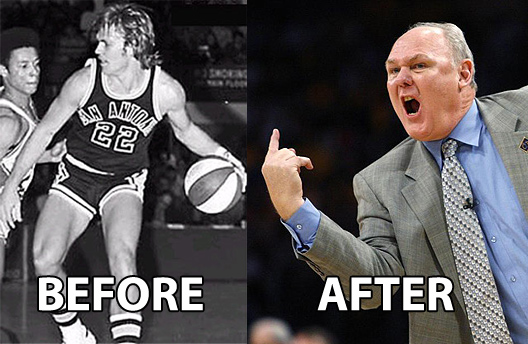
That ball my dad brought me back from San Antonio was one of two gifts from his business trips that I will never forget. The other was a genuine St. Louis Cardinals football helmet. So everything seems to come together, or at least it does when you begin to tell stories about it. The ball bore the autographs of (in order of recognition by me at the time): 1) Swen Nater; 2) George Gervin; 3) George Karl. I imagine their head coach, Tom Nissalke, also signed it since he was our neighbor who lived up the street from us in Madison, Wisconsin (I don't know, don't ask) and was probably the reason my dad got into the Spurs locker room after the game.

[Addendum from my father via e-mail, demonstrating how every history can be improved through surprising complication: "Sorry to disappoint you. Cannot remember the year of the meeting at San Antonio. I can tell you that it was not Nissalke who was instrumental in getting me the autographed ball but the representative of one of the laboratory companies that had a stand at the scientific meeting and when he learned that I planned to attend a game of the Spurs he said he was going too and he would get me the autographed ball. I shall continue digging into my records and hope to find some document (program, abstract, etc.) which might allow me to identify for certain which year was the meeting." My dad's research proved fruitful, determining that he was attending a conference in San Antonio from March 19 to 21 of 1975. That means he had caught the Spurs playing the Virginia Squires at home on March 21, just back from a road trip to -- you guessed it -- the Spirits of St. Louis.]

For many years that ball remained pristine. I saved it -- now displaying, now storing it in a bedroom closet -- long after the ABA merged into the NBA. When I moved out for college it stayed behind in the bedroom. At some point, I came home -- probably from graduate school, maybe later -- and wanted to shoot some hoops. Usually we kept a ball (a regular orange one) in a box in the garage. But for some reason, there wasn't one this time. So, without a second thought I retrieved the old ABA souvenir and used it to shoot away in the driveway, every meaningless dribble wearing away forever a bit of myth made mine. I still am unsure how I could have done that. The truth is, I think that I probably found it in the equipment box, already worn a bit as though someone else had taken a few shots with it. I'm going home in a week or so and I want to see if that ball is still there. If it is, even if it is flat and ordinary, the markings of ordinary time erasing the markings of legend that it once bore, I'm going to bring it back home with me to St. Louis and protect it. Maybe I'll even take it to a Pioneers game and get some autographs. Better yet: maybe I'll bring it with me to a tryout.

Could Be...

Read more...

A Three-Pointer for AnarchoHoops: 101 Words

Tuesday, October 5, 2010

Who do we need?
Once, watching Sheed and the Pistons with me, Claire indignantly asked, “why do they need refs?!”

From Alexander Wolff’s forward to Pickup Artists: “Some folks – the kind who take any exuberant young talent and try to truss it up in a blazer – sneer at basketball in its freest form. Those people would not have an ally in the inventor of the game. . . . The original Doctor J also said, ‘Basketball is a game that cannot be coached. It can only be played.”


Did William Gates, one of the exuberant young talents in Hoop Dreams need Gene Pingatore?

Read more...

  © Blogger template The Beach by Ourblogtemplates.com 2009

Back to TOP