Powered by Blogger.
Showing posts with label Narrative. Show all posts

Clyde the Glide's Guide for the Perplexed

Thursday, March 3, 2011

These thoughts on Walt Frazier's Rockin' Steady first appeared on the audio blog Voice on the Floor. I'm posting here as well for those who wanted to read that more slowly and without my actual voice ringing in their ears.

When people ask me what I do for a living I say I’m a professor. Almost inevitably, there’s a follow-up question: “Oh. That’s cool, what do you teach?” For twenty years, my answer has been some variation on “I teach literature.” If the person was also an academic in the humanities I might be more specific: “I teach Latin American literature” or “Comparative Literature.” But most people aren’t academic humanists, so I’d just say plain “literature.”

I’ve always found it embarrassing and disheartening to see the initial spark of interest sputter and fade when I answered. At best, it seems, literature is escape. For most, I know, literature is boring, pretentious, intimidating, even hateful; and all the more so because it is useless. I love literature. But I’m not proud of the sour taste that the study of literature has left in many people’s mouths. I know it’s not only the fault of literature professors, but certainly some of the blame lies there and, while I do my best to buck that trend, I’m still part of that system.

Lately, I’ve noticed that when that follow-up question comes I involuntarily pause because now I can say something else. I mean: I’ve always taught literature, my PhD is in literature, and my official title at the university is associate professor of comparative literature. But now I am teaching “Cultures of Basketball.” I imagine that will preserve interest. So I say it.
I can tell from the response whether they even heard the word “Cultures” at the beginning of my answer. If they look away glazed, then they heard it alright and I am stuffed back into the irrelevant egghead category – or maybe even worse now because I’ve sullied something as awesome as hoops with my wienerly eggheadery. But if I say it quickly enough – “cultures of BASKETBALL” – then they might miss it. Then I might get all I’ve ever really expected from these brief encounters: A raised eyebrow, a smile, a nod. “These aren’t the droids we’re looking for. You can go about your business. Move along.”

But the real truth is that in my own mind, for better and for worse, they really aren’t different things: literature and cultures of basketball. Because what fascinate me most in either case are the stories we are provoked to tell. It doesn’t make much difference to me whether the provocation comes from a novel, a full-court lob pass, or a good book about the game. I’m fascinated by the relationship that springs up between a reader and a book, a player and the game, or a fan and a play – a relationship that I believe exceeds each of its terms, is more than the sum of its part; a relationship that often gets expressed in the form of a story.

If I thought it would make any sense to the people who ask, I’d want to say I teach stories as a form of feeling, thinking, and acting in relation to the world. I’d borrow the words of the late Joseph Campbell, who spent a lifetime studying, classifying, and writing about the myths of the world, and concluded “we tell stories to try to come to terms with the world, to harmonize our lives with reality.” But who ever heard of that major?

When you spend as much time with stories as I do sometimes they can start to run together. Their uniqueness can fade from view and the different stories begin to appear as examples of a few types of story: for example, the love story, requited or unrequited, comic or tragic. This is how we classify, of course, and while we no doubt temporarily lose something precious and particular when we classify, we also gain (or we create, or we gain by creating) a vision of what is shared and held in common. This sort of vision was the basis for Campbell’s work on world mythology and it led him to some profound insights about the empowering roles that such common elements can play in our individual and collective spiritual and material lives.

I’ve noticed that books on basketball lend themselves to being sorted into a few basic categories. There is, of course, the autobiography and biography. There is the story of a season. There is the playground chronicle. There are historical surveys of the game (either general or emphasizing race, geography, gender, or institutional level or venue). There are the reports of the event that changed the game forever. There are books, often in coffee table format, on a single franchise or college program. Probably there are a few others. In describing these stock categories I don’t mean to disparage the world of basketball literature. Within each of the categories I just named are books that I would count among the most moving and thought provoking I have read.

And I find it interesting to identify the common patterns in the world of basketball mythology and try to understand why those patterns recur and what value they have. The underdog story, the best-there-never-was story, the selfish-individual-learns-team-values story, and so on. From there one might even try restore the specificity of the particular instance and try to understand how – for example – the underdog myth works differently depending on the class and race of the underdog in question. That’s part of the work that I’m trying to do in my course and in my own writing about basketball.

But I also feel drawn by the kind of book that stubbornly resists classification or paraphrase, or that invites multiple, even conflicting classifications. As I was preparing reading lists for my class back in early January, I discovered that the University of Michigan library had shelved the book Rockin’ Steady: A Guide to Basketball and Cool, by former Knicks star Walt Clyde Frazier and then New York Times reporter Ira Berkow, in the Children’s literature section. The particular classification certainly surprised me, but in another way, it didn’t. Clyde’s book is one of those that resists easy classification. You might even say that it resists sense entirely. And you might think therefore that Clyde’s book is useless, especially as a self-proclaimed guide. But I think nothing could be further from the truth. And that may be why the best place for Rockin’ Steady is the Children’s Literature.

For those unfamiliar with the work – and here already the book begins to resist me as I try to give you a mental picture of it – Rockin’ Steady was originally published in 1974 and was recently republished last Fall. Then as now it’s very format was unusual, large, square, fairly slim (at 144 pages), and richly decorated with photos and illustrations. In addition to the Preface by Berkow, a Foreword by Bill Russell and an Afterword by Clyde, the book has six chapters. 1. Cool; 2. Defense; 3. Offense; 4. Statistics; 5. Rockin’ Steady: Game Day Preparation; 6. A General Guide to Looking Good, and Other Matters. Just the list of chapters begins to give a sense of the book’s unruliness: the way that it seems to defy not only the classificatory schemas we might impose on it from outside, but also its own internal categories. Never mind that the “chapter” on Statistics is two pages long and includes only Frazier’s career stats and his four favorite box scores. In what sense of the word, it is fair to ask, is that a chapter? And even it is a chapter, then in what way does it relate to the chapters that come before and after it?

Once you ignore this and just get into the book things can get even more confusing. For example, the chapter on game day preparation naturally enough includes a description of how Clyde’s driver takes him to the arena. But it also includes a long digression on Clyde’s first car. It’s also hard to know exactly how the discussion of catching flies fits into the “General Guide to Looking Good and Other Matters” that comprises Chapter 6. I mean, obviously it’s part of “other matters,” right? Or is it part of “looking good”? How does it connect to the other topics in that chapter like proper sleep, weight lifting, money, and drying off with a towel after a shower? Even a more conventional chapter like “Offense” (conventionally titled I mean), includes the following within a list of moves and how to execute them: “Hook Shot: I never could shoot a hook shot.” In the “Defense” chapter a numbered list entitled “Fundamentals” promises simplicity and order until it grows like a virus to include 24 items, some subdivided and a few several paragraphs long. Fundamentals?

The book, at the same time, is tremendously absorbing, often moving, and has a quasi cult status. Even President Obama remembers buying it at the age of 12. His age reminds me that at Michigan we’ll find this book in the children’s literature section of the library. And that, after all, it is meant to be a guide. So all this raises for me the question of how to put these two sides of the equation together. A book that defies ready classification, that is internally incoherent, filled with digressions and useless instructions and even non-instructions is also simultaneously a guide revered by none other than the President of the United States for its value at a key formative moment in his life. What sort of guide is this? What sort of guidance does it offer? What is Clyde trying to teach me?

One of my strategies when we in class are stuck facing what appears to us to be a contradiction along the lines of “how can this be ‘x’ when it is also ‘y’?” is to investigate whether “this might be ‘x’ because it is also ‘y.’ What if Rockin’ Steady is a guide not despite but because of the way its excessive, digressive, and useless – but nonetheless absorbing – contents spill beyond all categories, even its own illogical ones? What might something like that be a guide to?

The word that springs to mind is “life.” I don’t mean though that Clyde’s book provides a blueprint for how to live your life, of the sort you might find in the self-help section of the book store. I mean that the experience of reading it is something like a laboratory exercise in life itself. Think about it: cool, offense, defense, statistics, game day, and looking good: isn’t that all of life? Let me translate, a general disposition (“cool”), how to make things happen you want to happen (offense), how to stop things from happening that you don’t want to happen (defense), how to relate to bureaucratic, quantitative forms of measurement (statistics), how to relate to particular events (game day), how to relate to qualitative forms of measurement (looking good). Now, doesn’t that kind of resemble the structure of life?

But of course as I’ve already said the book only looks like a how-to manual. If you really expect to come away from it with the instructions necessary to stop, say, Pete Maravich, then I don’t know what to tell you except that the joke is on you. For one thing, Clyde’s strategy involves getting Pete in a position where he’ll be distracted by the hair flopping into his eyes. Really? Then, even so, you’d still have to adapt Clyde’s instructions for stopping Pete Maravich to your own skill set because, well, you’re not Clyde, and neither am I. Except when I am. But wouldn’t it always be the case with any kind of guide to something as volatile and varied as life that you’d have to adapt it?

And wouldn’t it also have to be ironic, like these instructions that are not instructions. A great Argentinean writer, Julio Cortazar, once published a book that included instructions for doing everyday things: How to Cry, How to Climb a Staircase, How to Wind a Watch. Among the effects of such instructions is that we begin not only to look more closely at these everyday activities but also to wonder about our readiness to receive instructions for completing any but the simplest mechanical tasks.

If we step back, along with Clyde, and can laugh not only at him, as he does, but at our own frantic efforts to master this guide, to tie the whole thing up into a neat package that we can summarize and send on its way to the proper shelf then we can begin to see how it delivers an object lesson in dealing with at least those aspects of life that call for self-ironizing humor.
So I’m suggesting that one way to read Rockin Steady is as a kind of tutorial experience in life: confusing, promising, disappointing, edifying, amusing, moving, instructive, frustrating and, above all, meaningless apart from the effort you make to craft a meaning, a story if you will, from the elements it provides.

It might be that in this Clyde’s book is like other books that break molds and don’t fit neatly into the standard schemas by which we organize common patterns. Maybe what those books share is that they drive us to have – and not just hear about -- an experience in the course of reading them, and, thus, in the course of reading them, to gain practice for the lives we will live after we close them.

Those books might not be useful in our usual sense of the word. I’m reminded of the late novelist Italo Calvino who concluded a long article called “Why Read the Classics” with the following equivalent of a shoulder shrug: “it is better than not to read the classics.” I think Calvino was saying it’s not what the classics tell you that make them important, it’s what they do to you while you read them that’s important. In that respect, Rockin’ Steady is, for me, a classic.

And, if I think of classics as texts with which we help form our young, then what better place for Rockin’ Steady than the children’s section?

Read more...

Possibility is dead! Long live possibility!

Saturday, December 11, 2010


What I remember best about it is the blur as I lay on my back in bed, shooting it straight up into the air with perfect back spin: red, white, and blue giving way to the vaguely perceived promise of purple, even lavendar. I was not yet ten, and my dad had brought it back from a business trip to Texas: a genuine ABA basketball autographed by the San Antonio Spurs.


I was thinking about that ball this morning because no sooner had I submitted to the Facebook status gods my wish that there be a pro hoops franchise in Saint Louis (less for the games than for the gear) than I discovered that there is one: the St. Louis Pioneers. All life should be so easy. But wait, there's more. Not only is there a pro team in St. Louis, but they play in -- wait for it -- the American Basketball Association. That's right the ABA. It's not your daddy's ABA, but it wants badly to be. It even licensed the name from the NBA which apparently owns it (of course, it owns everything related to basketball).

What David Stern Sees
On the Pioneers web page, the first image you see is the towering afro of Julius Erving, decked out in his Nets uniform and a thin, gold choker. Then the image morphs to side by side images of players that actually have something to do with St. Louis: Marvin Barnes of the old ABA Spirits of St. Louis and Bob Pettit of the old NBA St. Louis Hawks, and then finally Barnes shifts over to the left hand side of the image and Moses Malone takes over the right hand side, dressed in his Spirits of St. Louis # 13 jersey. It's a chaotic little montage, historically speaking, tying together three icons of the scintillating blackness of the 70s ABA with Pettit, the icon of an era when St. Louis resisted the innovations in the game represented by Erving, Barnes, Malone and the whole ABA, not to mention stubbornly refused to integrate its roster and was the worst place in the NBA for visiting African-American players.

But nevermind all that: St. Louis basketball is back. That's the story, the narrative arc: there is this thing that is one, it is called St. Louis basketball. Like God, or the Word, it was made flesh. That flesh was called, first, the Hawks (Pettit), then the Spirits (Barnes, Malone) and now the Pioneers (um, Erving? the ABA).

a spirit of saint louis
Right, if it seems a bit thin as a narrative, in my mind that's just part of what stamps its authenticity as the heir of the old ABA. That old ABA, you remember it from Terry Pluto's Loose Balls, the Fish that Saved Pittsburgh or, today's versions, Chapter 3 of Free Darko's new basketball history and Will Farrell's Semi-Pro. The best thing about the old ABA, for me is its resistance to narrative. As FreeDarko asks there in Chapter 3: "What the Hell was the ABA?" Even the canonical history of the ABA -- Pluto's Loose Balls -- is really just a garbage can full of awesome quotations from participants, arranged in chronological order, and prefaced with a dizzying table that chronicles the emergence and disappearance of franchises like so many bubbles on the surface of a pot of boiling water.


A Time Machine
What story can you tell about a pot of boiling water? "It wasn't boiling, I heated it up, it boiled. Now it's boiling."? Not much of A Story there, though lots of stories: like when none other than the Spirits' Marvin Barnes once refused to get on a plane home from Louisville (Eastern Time) because it would arrive in St Louis (Central Time) before it had left: "I ain't goin' on no time machine." Oh yes you are, sooner or later. Now the St. Louis Pioneers have given him a middle seat on theirs. But I'm down with the Pioneers' weird historical montage because it's weird and ultimately contradictory, incoherent, and unpolished (when I friended the Pioneers on Facebook I got a message from them with a dead link).


A More Dangerous Time Machine
When the old ABA merged into the NBA, not only did the NBA get some dazzling players, a handful of viable franchises, and the rights to the name, it exercised its irresistible Story-Making power to fold the ABA's own non-narrative existence into the NBA's larger story of global domination. It's the titanic chapter of the dialectic of the NBA where individual creativity and entertainment was sublimated by the Association into what would become the racial harmony of the Bird-Magic era + the awesome marketing extravaganza that is Michael Jordan. And it's not that that's wrong or untrue. The nine-years of ABA basketball are part of the NBA's history and it's right to tell it that way. But as always happens with time machines of this sort, possibilities get left behind. Possibility gets left behind.
Another kind of history
But a watched pot, they say never boils, and the part of the ABA that is unwatched, roiling craziness, unwitnessed by just about everyone: that's also part of what should be registered of its existence, then and now. I don't know how to tell that: maybe a poem, maybe a Nietzschean aphorism, maybe just a physical spasm. But I know it when I see it: the St. Louis Pioneers, whose home games are played at St. Louis Community College and whose roster includes nobody I have ever heard of. The ABA is dead. Long live the ABA. nbsp;At first I felt like a fool for having not known (or forgotten) about the new ABA (which began in 2000). But then as I clicked around some more I realized that this league takes the old ABA's resistance to narrative and intensifies it exponentially. It's hyperlink madness. The same hyperlink madness that led me to find a photo of a genuine ABA ball signed by the San Antonio Spurs just one year after I got mine. In fact, Claire just discovered the fine print on the bottom of this page, where the publishers of the online sports media outlet oursportscentral.com -- dedicated to "major league coverage of independent and minor league sports" -- throw in the towel: "Our SportsCentral no longer actively covers the American Basketball Association (ABA) as a professional league due in part to its inability to publish and play a schedule and the transitory nature of many of its teams." You can get an ABA franchise for around $10K (AI's mom did, back in 2008) and that will make your squad one of the 50 or so that float and sink in a given ABA season.

George Karl: One Last Time Machine

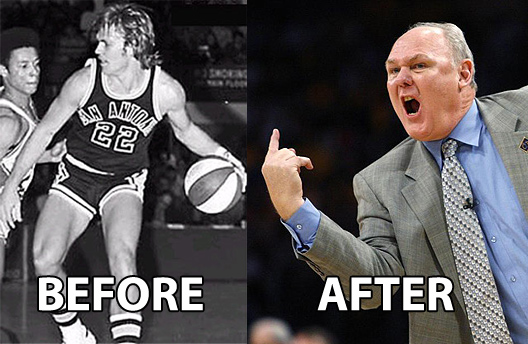
That ball my dad brought me back from San Antonio was one of two gifts from his business trips that I will never forget. The other was a genuine St. Louis Cardinals football helmet. So everything seems to come together, or at least it does when you begin to tell stories about it. The ball bore the autographs of (in order of recognition by me at the time): 1) Swen Nater; 2) George Gervin; 3) George Karl. I imagine their head coach, Tom Nissalke, also signed it since he was our neighbor who lived up the street from us in Madison, Wisconsin (I don't know, don't ask) and was probably the reason my dad got into the Spurs locker room after the game.

[Addendum from my father via e-mail, demonstrating how every history can be improved through surprising complication: "Sorry to disappoint you. Cannot remember the year of the meeting at San Antonio. I can tell you that it was not Nissalke who was instrumental in getting me the autographed ball but the representative of one of the laboratory companies that had a stand at the scientific meeting and when he learned that I planned to attend a game of the Spurs he said he was going too and he would get me the autographed ball. I shall continue digging into my records and hope to find some document (program, abstract, etc.) which might allow me to identify for certain which year was the meeting." My dad's research proved fruitful, determining that he was attending a conference in San Antonio from March 19 to 21 of 1975. That means he had caught the Spurs playing the Virginia Squires at home on March 21, just back from a road trip to -- you guessed it -- the Spirits of St. Louis.]

For many years that ball remained pristine. I saved it -- now displaying, now storing it in a bedroom closet -- long after the ABA merged into the NBA. When I moved out for college it stayed behind in the bedroom. At some point, I came home -- probably from graduate school, maybe later -- and wanted to shoot some hoops. Usually we kept a ball (a regular orange one) in a box in the garage. But for some reason, there wasn't one this time. So, without a second thought I retrieved the old ABA souvenir and used it to shoot away in the driveway, every meaningless dribble wearing away forever a bit of myth made mine. I still am unsure how I could have done that. The truth is, I think that I probably found it in the equipment box, already worn a bit as though someone else had taken a few shots with it. I'm going home in a week or so and I want to see if that ball is still there. If it is, even if it is flat and ordinary, the markings of ordinary time erasing the markings of legend that it once bore, I'm going to bring it back home with me to St. Louis and protect it. Maybe I'll even take it to a Pioneers game and get some autographs. Better yet: maybe I'll bring it with me to a tryout.

Could Be...

Read more...

The Professor is IN

Tuesday, December 7, 2010

Some of you know that I'm going to be teaching a course in the upcoming semester called "The Cultures of Basketball." I have a general sense of what I'd like to explore in the course -- the different meanings and stories we create around the game and the ways in which we create them -- and also a general sense of what I'd like the students to learn -- that their enjoyment of an activity that primarily serves as entertaining distraction can be enriched and complicated by thought, or, to put it in other words: that you can think about something you love without ruining it -- you can even love it more. But that's about all I know for sure. So I'm issuing an open invitation for suggestions. The course is for undergraduates. I don't know too much about the particular students I'll have, but from their responses to a querying e-mail I sent out, it appears they vary in experience from casual pick-up players and fans to members of my university's varsity men's team.  I'll welcome suggestions for materials (books, essays, movies, clips, songs, etc.) of course, but also especially ways of structuring the course itself (historically, by level, by topic, by the genre or type of media through which we create these meanings, etc.).

Read more...

Capsule Reviews (II): On Davis, Araton, Boyd and Wetzel and Yaeger

Sunday, October 3, 2010

The four books that I'm including in this second "capsule review" all revolve around basketball culture (NBA, NCAA, AAU, and HS) over the last three decades. They also all share the perspective that something changed dramatically during that time. But each configures the basic components of the story -- the game, race, money, the media, players, coaches, organizing institutions, apparel -- in slightly different ways. These books left me with the impression of four different sound boards, where the components I just listed are the "channels." The volume of each channel and the combination of channels made for sometimes strikingly different outputs; so much so that it was hard to believe at times that they were looking at the same game.

Seth Davis, author of When March Went Mad: The Game That Transformed Basketball (2009), seems like the happiest of our campers. "The Game" of the title refers to the 1979 NCAA Men's Basketball Championship Game, held in Salt Lake City, Utah. That year's title game featured the Michigan State Spartans and their sophomore point guard Earvin "Magic" Johnson and the Indiana State Sycamores, led by their senior forward Larry Bird. It was the highest rated basketball game, of any level, ever televised: nearly one quarter of all television sets in America tuned into it. By the Fall of 1979, Magic and Bird were preparing for their first NBA training camps and the start of careers that would help to transform that league, ESPN would be broadcasting from Bristol, Connecticut, and the NCAA tournament committee was contemplating another expansion of the men's tournament field (to 48). The money involved is perhaps most astonishing. The 1979 tournament grossed $5.2 million in TV revenues. Twenty years later, CBS paid the NCAA $6 billion dollars for an eleven year deal. Last year, the NCAA opted out of the final three years of that earlier deal and inked a new one that will expand the tournament field to 68 teams and net the NCAA $771 million per year for fourteen years.

I've noted before how silly I think it is to trace discernible historical changes back to a single event. And this is no exception. The very fact that 24.1 percent of American television sets were tuned into the 1979 championship game already indicates that some things had already changed before that game: the game was being broadcast live in prime time, the viewing public already knew the players, having had the opportunity to see them each at least once on national television. Among basketball fans, even young ones like myself, broadcasters Al McGuire, Dick Enberg, and Billy Packer were already household names, personalities you loved to hate and celebrities in their own right. So it's not as though this one game transformed basketball. But it was a great story, it does serve as an acceptable symbolic watershed, and since the power brokers in the media seem to think, according to this book, in the oversimplified terms of the single epoch-making event then, in a certain sense, it does also gain some substantive weight.

Davis's story, however, focuses more than anything on the stories behind the two teams. There's a lot of detail here and that very detail, in chronicling the personalities of the players, the conflicts in the locker rooms, and the ups and downs of MSU and ISU's respective seasons, complicates the narrative tapestry that unfolds toward and from the pivotal championship game. This increasing complexity both diminishes and augments the importance of the game itself. After all, I asked myself, reading Davis's account, is the title game more important than Magic's decision to attend MSU (by no means a foregone conclusion)? More important than Bird's to enroll in ISU after having dropped out of Indiana? More important than the coaching changes that occurred at each school? Than the numerous last second shots that kept Indiana State's won-loss record pristine up until their loss to MSU in the championship game? On the other hand, immersed in the myriad contingent factors that happened to converge to produce this particular game and to lend it narrative richness (not to mention with the retrospective knowledge that Magic and Bird would become great rivals and friends in the NBA -- or was that an effect of this game as well?), it's easy to begin to feel, irrational as that may be, that this game was somehow meant to be, the crowning convergence of a number of factors that could have -- that maybe even should have -- gone a different way.

I liked thinking about this, but I feel that this had more to do with me and the basic structure of the "x that changed y" school of sports history. Perhaps Davis knew what he was doing with that and I am undercrediting him. But it didn't feel that way as I read it. The prose tends to be bland, and most of the fascinating social and culture dimensions of the game are barely grazed. Think about it the prevailing attitude among the typical white male fan toward game at that moment: NBA (black, drug infested, overpaid, unpopular) vs. NCAA (white, clean, spirited, popular). Into this come Michigan State University (less glamorous than Michigan, and led by a black star, but one who is charming and charismatic and comes from a solid working class family) and Indiana State (whoever they are, they are not powerhouse Indiana, and they are led by a white star, but who is surly, dirt poor, and from a broken family -- Bird's parents were divorced, his father had killed himself, and Bird himself had fathered a child out of wedlock). The ironic twists and turns of this can get to be dizzying, but Davis barely registers these dimensions.

Finally, a "game that transformed basketball", and featured two of the greatest players who ever played, deserves a more poetic treatment than it gets here. No doubt my own memories of the beauty and enchantment of that game are intensified by the fact that I was not yet 14 at the time. Still, the miraculous perfection, both fragile and inevitable, of a Magic to Special K (Greg Kelser, Spartans forward) alley-oop jam or of Bird's effortless, economical motion on impossibly long range jumpers; both deserve more "french pastry" -- as Al McGuire used to refer to decorative embellishment -- than Davis gives it. Davis's writing reminded me, most of all, of very good young adult sports fiction.

The cover of the book is mesmerizing to me, mimicking a faded handbill publicizing the game. The image is brilliant, giving the multiple sense of a game that perhaps, then, still needed publicizing and in a media (the handbill) that has long-since been rendered irrelevant, perhaps by the very forces that game set in motion, or, at least, accelerated. The image also effectively activates a perfect nostalgia in the sense that it makes me fondly remember something that never happened. And I guess, ultimately, my disappointment stems not from my intellectual critique of the over-simplified history, but from the fact that, for me, this game did transform basketball and I wanted the book that told its story to rise -- like a Magic alley-oop pass, like a Bird long jumper -- to assume the full social, cultural, and athletic dimensions of that memory. It didn't.

Whether or not this one game was responsible, it is clear that the game and its culture, as described in the other books I've recently read, has indeed undergone a transformation since 1979. In a certain sense, these books pick up where Davis leaves off. In Sole Influence: Basketball, Corporate Greed, and the Corruption of America's Youth (2000), journalists Dan Wetzel and Don Yaeger reveal the yucky crap stuck to the soles of my beloved Air Jordans. This is not primarily the story of exploited third world labor, but rather of the weird culture of those who comb America's playgrounds and schools in search of the next Michael Jordan. In the wake of the massive increase in their sales (and the expansion of the sports apparel market more generally) thanks first of all to Michael Jordan, Nike sparked a kind of advanced competition among shoe manufacturers to identify, equip, and secure the future services of young players who might one day rise to superstardom in the NBA and, like Mike, be skillful pitchmen with crossover appeal. In the course of this competition, "stage" parents, ambitious high school, college, and AAU coaches, sychopantic adult groupies who worship teenage boys, pedophiles, drug dealers, and, of course, the barely adolescent young phenoms themselves all have a part to play.

Wetzel and Yaeger provide excellent reporting, good storytelling, and a clear sense of moral outrage. As the title suggests, this for them is primarily the story of multinational corporations obsessed with adding a dollar to the profit margin and more than willing to ignore the harm they do to the pure souls of America's youth in the process. In this respect, at first glance, they give me sort of the same feeling as watching Michael Moore's Roger and Me: namely, isn't corporate greed redundant? Or, in other words, is this really shocking to you? And it even resonates oddly with nostalgic tales about the old days in the NBA. We might remember, then, team play and hard nosed competition for the love of the game and clean-cut, fair, profit-taking in business as both signs of how things were better back in the day.

That's easy to ridicule, but the devil of that story really is in the details. And as I read the numerous particular stories that Wetzel and Yaeger track down and then weave into this overall narrative of unfettered greed and corruption, I find myself persuaded. For each of the few hundred players that actually make it into the NBA and get rich playing ball, there are many, many more who are drawn into a web that distorts their lives and leaves them with an even more restricted set of opportunities than the meager set they were probably born with. This web, the book makes clear, may sometimes expoit the fantasies and desperation of the kids and their families, but it is unmistakably designed by shoe company executives and spun by a decidedly unsavory and selfish cast of hangers-on. The whole thing is then fueled by a vortex of marketing and consumption facilitated by a proliferation of media exposure.

For Wetzel and Yaeger, the game itself has been a main casualty of the shoe wars, to wit:
"The quality of play the NBA is putting out each night is not up to the aesthetic levels of the past few decades. The level of boorish player behavior, however, is at a record high. The league's newest generation of players, the ones weaned on a steady diet of free gear and AAU ball, is generally regarded as pushing the game to new depths. The worst are vocal defenders of their individual rights. They are shocked when informed marijuana is illegal, hustle is demanded, off season workouts are expected. They talk on the cell phones a lot. They don't dive on the floor very often."
Maybe. Though as I've absorbing massive amounts of basketball narrative in recent months, I'm amazed at how widespread is the feeling, in each generation, that the game is worse than it used to be, and worse in a strange moral sense of the word. In their final chapter, Wetzel and Yaeger make a stab at transforming the growing sense of sad helplessness their own narrative has generated into a call to action. But unfortunately, that call can only, I think because of the moralizing overarching structure of the book, be a Peter Parkeresque insistence that with great power (or, they put it, "rights") come responsibilities. Maybe. But even if we subscribe to that same principle, the call itself forgets the larger social and cultural forces that keep that moral from sticking, forces that the authors themselves have painstakingly exposed.


The last two books offer two distinct takes on what Wetzel and Yaeger see as the injury to the game. Harvey Araton seems to share that sense of the NBA as having experienced a recent dip in beauty and moral quality, though he sees hope in the infusion of international players. Meanwhile, Todd Boyd takes issue with the very characterization of the NBA's recent past as a distortion fueled by cultural misunderstanding and racial fear and resentment.

In Crashing the Borders: How Basketball Won the World and Lost Its Soul at Home (2005), Araton, a New York Times columnist, tells the history of the NBA from around the time of the 1992 Barcelona Olympics to the November 2004 brawl between the Detroit Pistons and the Indiana Pacers, and between the Pacers and the Pistons' fans. The arc of that history, for Araton, is obviously a fall from grace (the losing of its soul). However, Araton also seems to see hope for the game in that the very success it enjoyed abroad (as a result of the 1992 Barcelona dream team's popularity) generated an influx of international players who, as Araton sees it, are revitalizing the game and deprioritizing some of those dimensions of the game (one-on-one play, the slam dunk) that Araton feels have hurt it. I'd say that this is just one more middle-aged white man's lament for the loss of the game of his boyhood when the game itself was more horizontal and the players, regardless of race, more -- as they say today -- "relatable".

But I must give Araton some credit here. While I do feel that nostalgia is the overarching narrative governor in this book, he is more than capable of airing a different, and critical perspective on that way of telling the story, and he is able to accommodate and articulate his own mixed feelings about the game today. And, Araton's sensibilities are capacious enough to deal with the social and political forces running through the game. Above all, I appreciate Araton's willingness to air both this ambivalence and honest uncertainty about how to move forward. This allows me to feel included in the conversation as a conversation (as opposed to just a PTI style sports-guys-shouting dialogue of the deaf).


Professor Todd Boyd, of USC, offers a different take on all this NBA and NCAA history in Young, Black, Rich, & Famous: The Rise of the NBA, the Hip Hop Invasion, and the Transformation of American Culture (2003). Though, frankly, I found this book disappointing, frustrating, and hard to get through, I also found it a refreshing alternative to the more restricted analytical scope of mainstream journalistic accounts and I'm glad it exists. Boyd's book positions itself as history with a thesis, as all history must necessarily be. In this case, the history is of the NBA since the 1970s and the thesis is that as the league's player pool grew to be predominantly black, NBA culture intertwined with other forms of black popular culture (primarily hip hop) characterized by an unapologetic individualism and that white owners and white fans find this racialized cultural amalgam highly threatening. I don't really disagree with this. In fact, I find it, particularly in light of the flap over Lebron using the "R-word", refreshing and valuable. Boyd's periodization of the NBA in relation to music history is also provocative and provides food for thought, though I wish that he had deepened it to include analysis of musical structures themselves (rather than restricting himself to the occasional reference to lyrics or marketing styles). I found it interesting to think about the relationships and transitions between Oscar Robertson and Motown or between Magic Johnson and Michael Jackson; as well as Boyd's more general reflections on the politics of relating basketball to various musical genres such as jazz, classical, funk, or hip hop.

At the same time, I found the structure and style of Boyd's writing confusing and, at times, contradictory and alienating. I have no issues with his desire to marry the "formal and the vernacular" as he puts it. On the contrary, I applaud his intention and admire his skill in doing so. But the book also suffers from flaws that I don't think stem from this particular stylistic strategy: unnecessary repetition that makes the book sometimes feel like a series of essays pretending to be a book, unhelpful oversimplification that makes even a sympathetic reader like me take issue, and the presentation of conjecture (however warranted) as fact. I'm glad this book was written, because the topic is both interesting and important to me. But because the topic is both interesting and important to me, I wish it had been written with more care and subtlety and with more desire to persuade a broader audience.


Read more...

Capsule Reviews (I): On Robertson, McPhee, and Bird and Magic

Sunday, September 19, 2010

Because reading has been almost as huge a part of my life as basketball, I've wanted to include in the blog a regular feature on the books I've been reading. Nothing profound, just some quick impressions.  These will appear regularly in the box on the left hand side of the blog.  But I'll also collect these from time to time as "Capsule Reviews" blogposts.  Here then is the first of these, my brief thoughts on the last three books I've read: Oscar Robertson's 2003 autobiography, The Big O: My Life, My Times, My Game; Larry Bird and Magic Johnson's 2009 recollection (written with Jackie McCullan) of their intertwined NBA careers, When the Game Was Ours, and John McPhee's classic 1965 profile of Bill Bradley.  At the end of each review, I'll rate each book on a scale of one (forced my way through it) to five (would read it again and again) basketballs.

Oscar Robertson, The Big "O": My Life, My Times, My Game (2003) very worthwhile read. Robertson structures his book chronologically, recalling his early childhood in rural Tennessee, his youth and adolescence in Indianapolis, college years at the University of Cincinnati, and pro career in Cincinnati and then in Milwaukee.  Robertson is skilled and interesting in communicating how his game looked and felt from the inside and how it played out on the floor in a number of exciting descriptions of particular games and seasons  But what most moves me in his writing is the honesty and precision with which he weaves emotional, cultural, and social observation into his account of a basketball life.   He emerges as a full human being who also happens to be one of the greatest basketball players of all time.  He is particularly intelligent and refreshingly incisive on the forms of racism he encountered, both on and off the court, and on the economics of pro ball (in which he played a major role as head of the NBA player's union). Finally he is splendidly curmudgeonly on today's NBA, and delightfully ungenerous in comparing contemporary and recent stars with those of his own times.


John McPhee, A Sense of Where You Are: Bill Bradley at Princeton (1965), is a very elegantly written profile of Bill Bradley, former US Senator and New York Knick star, during his college years at Princeton. McPhee, successfully aiming at a general audience who might never have seen or read about a basketball game before, does a wonderful job of breaking down the nuts and bolts of Bradley's individual game and of integrating that into a narrative of his Princeton teams' fortunes in the NCAAs. Bradley was one of the greatest, for sure, but McPhee's intelligent and poetic hagiography unfortunately departs from the author's uncharitable description of his growing aversion to the game (over the course of the 50s):


the game seemed to me to have lost its balance, as players became taller and more powerful, and scores increased...it impressed me as a glut of scoring, with few patterns of attack and almost no defense any more....Moreover, it attracted exhibitionists who seemed to be more intent on amazing a crowd with aimless prestidigitation than with advancing their team by giving a sound performance. 
This seems like an odd characterization of the game in an era whose greatest stars included Bill Russell, Oscar Robertson, and Jerry West. It's also striking in how it prefigures the sort of recurring nostalgic complaint that subsequent generations of writers (including Bird and Johnson, in their book below) would lodge against the current version of the game right up to the present day.


Larry Bird and Earvin "Magic" Johnson, When the Game Was Ours (2009) a light and entertaining read, well plotted, if not very profound or stylistically elegant. Since I was in 8th grade when they first met in the 1979 NCAA championship game, this was enjoyable opportunity to revisit some of the memorable games they played during my high school and college years. Excellent stuff on Bird's legendary trash talking. For younger readers, this would be a good introduction to NBA history in the pre-Jordan era. Of course NBA history goes back much farther, but these guys are an entertaining hinge point between Jordan and Old School. You see a real love for and commitment to the game in both these players. Also, the accounts of Magic's battle with HIV, and of Magic's and Bird's respective retirements I found quite moving.

Read more...

HoosiersNation?

Friday, September 17, 2010

Why are we -- I mean the sports media in this country -- so head over heels in love with the American basketball team that just won the FIBA World Basketball Championships last week?  I probably should have been doing my day job, preparing for my first class on Tuesday morning. But, as I sipped my automatic machine made latte on the 2nd floor balcony of the Red Roof Inn, the four story tower of the Hampton Inn looming across the parking lot, I felt the irresistible lure of setting down some thoughts on this infatuation. I'm not thinking of the action on the court itself so much as the storyline -- the myth -- that has been repeated ad nauseum in the American media.  I encountered one of the many instances of this while reading Mike Lopresti's recent column in USA Today over my complimentary Hot Breakfast at the Big Boy adjacent to my digs at the Red Roof.    It's a beautiful life.

Here, for those who didn't follow the tournament, are the facts:  the US won this year's FIBA World Championships and I'm glad.   None of the players that took the gold medal in Beijing in 2008 agreed to play for Team USA in the World Championships, with the result that Jerry Colangelo, who runs the USA Basketball program and Head Coach Mike Krzyzewski, assembled their roster in the two months prior to the tournament from a different, less acclaimed pool of NBA players.  The team played tough defense and ran the ball well and Kevin Durant had a terrific tournament.   I feel glad for Durant because he seems like a good guy and a good ball player; I feel glad that the team won, played well and avoided any kind of "Ugly American" incident on the court or off.  And that's about the extent of my feeling about what actually happened.  But, as I said, this is not so much a story about what actually happened or about my feelings about what happened, so much as a story about the story that has been circulating about what happened and my feelings about that.

That story inevitably begins with a backstory.  It may take different, sometimes very compressed forms for different writers, but in its main lines it goes something like this (which I'm blocking off as though it were a direct quotation to indicate that I'm paraphrasing):

Once upon a time, the US dominated international play fielding teams of the best college players and then, when the rules changes, with a series of Dream Teams of the very best American NBA players.  But there was a snake in the garden.  To begin with, the NBA's own aggressive globalization efforts began to pay off in the form of vastly improved play from international players in a number of foreign countries: Spain, Argentina, the Balkans, and France.   Then, at the same time, selfish and immature US superstars stopped considering it a priority to represent their country in international competition.  Finally, even those players that did agree to play for Team USA were at a disadvantage because 1) they weren't used to playing with another (unlike other national teams whose players had, in some cases, been playing with one another since their teen years); 2) they were selected for individual greatness and not in terms of the quality of the overall team they would combine to form; 3) they weren't coached with an eye toward the style and unique rules of international competition.  The result:  a dark period of USA Basketball:  a third place finish in the 1998 and 2006 FIBA Worlds,  a sixth place finish in the 2002 FIBA Worlds (held in Indianapolis no less), a third place finish in the 2004 Athens Olympics.  Even a gold medal in the 2000 Olympics was judged a sign of demise since several games were won by margins too narrow for comfort.   Finally, the sun begins to shine through these dissipating clouds when USA basketball got its act together, hiring Colangelo and Krzyzewski and requiring a three year commitment to training and competition from its NBA player pool.   This yielded a gold medal finish in 2008 in Beijing and all was right in our basketball cosmos.
But then,  the story arc dips into another trough of difficulty.


None of those players -- not Lebron James, not Dwyane Wade, not Dwight Howard, not Kobe Bryant -- wanted to play in this year's FIBA tournament.  The players that were selected were dubbed "The B-Team".  We couldn't expect much of this team because, for the rest of the world, the FIBA World Championship is more important than the Olympics.  
To intensify our investment in the drama, the typical storyteller injected some additional stakes


Not only the FIBA gold medal, but our spot in the 2012 Olympics in London was a stake because if the US didn't win the FIBA Worlds and its accompanying automatic qualifying bid in the next Olympic competition they would have to qualify for the Olympics through a round of inter-American competition and this would be more difficult than usual given an imminent NBA labor negotiation and the strong possibility that players who might be on strike at the time of the inter-American competition would be ineligible, leaving the US to face stiffened competition with nothing more than their best amateurs.
Now that the tournament has been played out and disaster averted, journalists and bloggers are falling over themselves to herald the over-achievement of "The B-Team," their moral stock rising, seemingly, on the tide of the "Redeem Team" players refusal to join the competition.  Here's how, again in summary, the story reaches its satisfying resolution.


Kevin Durant, humble and likeable, emerged from the shadows of the Redeem Team superstars James, Bryant, and Wade by putting on a tremendous display of scoring prowess.  While Kobe spent his summer lolling in the reverie of his recent NBA championship, and James and Wade spent theirs conspiring to join forces on the Miami Heat and greedily thrusting themselves into the media spotlight, Durant worked hard to get ready to represent his country in international competition and then, when the tournament began, put the team -- at least on offense -- on his shoulders and carried them to victory.  As for the rest of the players, undersized, not all that good, and unaccustomed to playing together, they pulled together under the wise tutelage of Coach K, played gritty old fashioned defense and then celebrated their surprising victory with the innocence and charm of the (all white) Hickory High Huskers knocking off the big, bad, black team from the big city in the 1989 film Hoosiers.  And it's a darn shame that the selfish superstars like James, Bryant, and Wade will probably displace this likeable bunch of underdogs on the team that represents the US at the 2012 Olympics in London.
So that's the story, the myth, that's being created and circulated and relished in the media here. It's a great, rousing story.  The only problem is that it rests on what might generously be called some exaggerations of actual facts, and some omissions of others.  Let me correct these first.

Kevin Durant was already, before the tournament, recognized as one of the top players in the NBA.  Durant was named College Player of the Year for his efforts as a freshman at the University of Texas (the only year of college ball he played).  In fact, he was heralded as the only freshman ever to win the award.  Then he was the second selection in the NBA draft.  In his first season, he averaged twenty points a game and was named rookie of the year.  In his second season, he averaged twenty-five a game.

Yeah, never heard of him
And this past season, his third in the NBA, he became the youngest player ever to lead the league in scoring, averaging 30 points a game, finished second in MVP voting (behind James and ahead of Bryant, Wade, and Hoard), was selected to the Western Conference all-star team, and was chosen as one of the five players (along with Bryant, Wade, James, and Howard) to the All-Pro team. He also helped his team, the Oklahoma City Thunder, to reach the playoffs, where the young, eighth seeded team pushed the top seeded, and eventual champion, Lakers to six games in their first round best of seven series.  Oh yeah, and when he came out of college to join the NBA, he signed a $60 million endorsement deal with Nike.

Certainly, the rest of Team USA's roster, top to bottom, lacked both the record of individual and team success and the star power of the 2008 Beijing Olympic team.  But it's quite a stretch to characterize them as "B Team" players.  Chauncey Billups was the third overall pick in the 1997 draft, the 2004 NBA Finals MVP, and has been an All-Star each of the past five seasons.  Lamar Odom was the fourth overall pick in the 1999 draft and, though his career has been checkered for personal reasons, was instrumental in the Lakers repeat title run this year as the first player off the bench. Derrick Rose was the first player picked in the 2008 draft, the 2009 Rookie of the Year, and an All-Star in the same year.  Among the other players, several were chosen in the top ten in their NBA draft cohort, and some had been first team All-Americans in college.

The FIBA World Championships may just as important to the players in other countries as the Olympics, maybe even more important for some of them.  But if such a generalization may be in some sense true, it doesn't account for the fact that some of the best and best-known international players in the NBA, the very players whose talent and visibility are held up as evidence that the rest of the world has caught up to the US in basketball  -- Manu Ginobili (Argentina) Nene Hilario (Brazil), Pau Gasol (Spain), Tony Parker and Joakim Noah (France)  Dirk Nowitzki (Germany), and Mehmet Okur (host Turkey) -- chose not to participate in the tournament.   One observer close to a several European players claims that the Olympics are, in fact, their top priority (after the NBA).

Finally, this is subjective (who is to say what is the requisite level of innocence and enthuiasm with which to celebrate an international championship?), but having watched most of the games in the 2008 Olympics, I'd feel hard-pressed to say that the superstars of the Redeem Team weren't excited to be there, and, even more, every bit as jubilant upon finally capturing the Gold with their finals victory over Spain.

Yeah, they don't care.
 Those players -- Kobe and others -- were also running around the court after their victory, slapping the hands of American fans in the stands and, in general, celebrating with the innocence and unbridled exuberance of a group of high schoolers winning their first state championship.

So if Kevin Durant didn't come out of nowhere and was already considered one of the best players in the world, why do we keep acting as if he did and wasn't?  If the rest of the US team didn't consist of a bunch of midget also-rans but rather were almost without exception successful and recognized as such, why did we act like it did and they weren't?  And if the rest of the world didn't bring its best players, why do keep insisting that they did?  And if the Redeem Team was excited to win too, why is it so important to say imagine that they weren't?  Why are the same media experts that participated in the circulation of all the facts that I described above now forgetting them?  What purpose is served by this?

I will be blunt, at the risk of over-simplifying.  I think what is served by this particular story, and this sort of storytelling in particular, is a particular national self-image, often not so subtly racialized if not racist, that we expect our athletes, especially our national athletes, to support.  It's that image that I sum up with the title of this post:  HoosiersNation.

Our National Team?
 That film fabricated the story of an invented small, rural Indiana high school team (the Hickory Huskers)  winning the Indiana state championship against a much more athletically gifted, all black team (with all black coaches and rowdy all black fans) from  South Bend Central.  In the process, players, fans, and coaches alike overcome obstacles, learn life lessons, and redeem their pasts.    Nevermind that the actual Indiana team (Milan) upon which the movie was based beat -- as Oscar Robertson, among others, has pointed out in his autobiography The Big O -- a Muncie Central team coached by a white man, supported by mostly white fans, and whose entire roster included only three black players.

But such realities don't need to get in the way -- any more than the facts I listed above -- of our seemingly endless need to see ourselves as a scrappy group of unheralded white guys rising, through hard work and the subordination of individual ego,  to successfully, joyfully, but humbly, meet the challenge of defeating a talented Other whose abilities and superior resources ultimately, cannot make up for their lack of heart and unselfishness.

How perfect that this year's quarterfinal game was played against the Russian team on the 38th anniversary of the 1972 Olympic Finals in which the (scrappy) US team (of all amateurs) lost to the Russian team on a last second basket, after the referees unfairly awarded the Russian team three different opportunities to replay the final seconds.  Though the players didn't make much of the anniversary, the press certainly did.  Nevermind that the 2010 Russian team (unlike the 1972 Soviet team) had done little in international competition.  Like Rocky facing the machine like Ivan Drago in Rocky IV, our boys were playing out of desire and with heart, and, in the moral universe of our national fantasies, that always wills out over talent, technology, and heartless efficiency.  Finally, as if the brew weren't rich enough, this year's semi-final was played on the 9th anniversary of September 11th, 2001, helping to reinforce our collective desire to see ourselves as innocent victims and underdogs and to stoke our collective desire to assert the superiority of our self-assigned national values against overwhelming odds.

I like this year's US team.  I really do.  And I appreciate and respect what they achieved.  But I'm annoyed by the way in which the media has turned their story into a myth that permits us, as individuals and as a nation, on the court and off, to evade so many realities about ourselves (some good, some not so good) and, like an oversized infant blithely lumbering through a Lilliputian world, to cause so much suffering.  I don't want to identify with that team, that game, or that country.

Read more...

Wilt and Me

Sunday, September 12, 2010

It was the most legendary individual single-game performance in professional basketball history: March 2, 1962, when 25 year-old Wilt “The Big Dipper” Chamberlain scored 100 points for his Philadelphia Warriors team in a 169-147 victory over the New York Knicks.

I wish
Every basketball fan knows about it. Nearly fifty years later the record remains unbroken and likely always will. The closest anyone has come to breaking it is Kobe Bryant, who scored 81 points in a game in January, 2006. Only four thousand people attended Wilt's game, which was played in a half-empty hockey arena in Hershey, Pennsylvania. The Warriors were safely in the playoffs by this point, and the Knicks safely out, so little was at stake as the season wound to a close. No television or film footage of the game exists. No New York reporters were there, and less than a handful of other journalists. Two photographers were there, one left after the first quarter and the other snapped just a few photos.

Wilt, 1962: The Night of 100 Points and the Dawn of a New Era (Three Rivers Press, 2005), by Gary Pomerantz, tells the story of that game based primarily on hundreds of interviews the author conducted with many of those who played in it or watched it. In reconstructing the numerous stories that converged on and then diverged from that historic contest, Pomerantz crafts the claim that the game served as a symbolic announcement of the definitive arrival of a new style of basketball and of “the ascendancy of the black superstar in professional basketball,” and, in that sense, formed part of the massive assertion of African-American culture and rights that developed throughout the period.

I saw Wilt in person one time, saw him play I mean. Probably a fair number of people my age or older who lived in Philadelphia or Los Angeles or even other NBA cities can say the same thing. But I didn’t grow up there. I grew up in Madison, Wisconsin and, to this day, I’m the only person I know besides my Dad, who took me to the game, who ever saw Wilt play in person.

We moved to Madison from Portland, Oregon in July, 1968, the summer I turned three. Though I can’t remember that summer, many of my earliest, and happiest, memories from our first few years in Madison involve basketball. My dad and oldest brother dug a posthole, poured concrete, and put a hoop up in our driveway in 1969. Not long after that, a second rim, bolted to a homemade backboard, around 7 feet off the ground for my benefit, was added to our basketball pole (soon to be painted with hot pink rust-proof paint). Of course, back then there was no cable television and basketball, especially pro, was still struggling to sell itself to fans, to advertisers, and to television executives so there weren’t a lot of games on television, and we had in Madison no home-town franchise.

I do remember watching some college games, especially the UCLA teams coached by the legendary John Wooden, perhaps the greatest, certainly the most dominant, college coach of all time. And I remember watching the NBA game of the week on CBS when that started during the 1973-4 season and, before that, occasional games on ABC. Playing with my older brother, who was a star on his junior high and then high school team, and watching games on TV with my dad were more than enough to get me out onto the driveway at every opportunity, dribbling around, counting down the seconds to the final buzzer in an imaginary championship game, heaving the still heavy ball up at my hoop, going crazy if it went in and restarting the countdown on account of a clock malfunction if it didn’t.

But an entirely new world was opened to me when I saw my first professional games in person. The Milwaukee Bucks joined the National Basketball League as an expansion franchise in the 1968-69 season.
Enthusiasm
When I was a boy, they played several games a year in Madison, either at the University of Wisconsin Field House or, more commonly, at the Dane County Coliseum. I don’t remember which was the first game I saw them play there. The truth is I don’t even remember for certain how many games I went to or which teams I saw them play.

Like most new franchises, the Bucks were bad in their first year, compiling a record of 27 wins and 55 losses. But then they drafted Lew Alcindor (later to become Kareem Abdul-Jabbar) out of UCLA and turned their fortunes around. In their second season they won 56 games and made it to the NBA finals, where they lost to the New York Knicks. Then they picked up Oscar Robertson, the veteran, superstar guard and in the 1970-71 season went 66-16 (88-18 counting their 10-0 preseason record and their 12-2 playoff record) and swept the Baltimore Bullets for the NBA Championship. That would be their only championship, but over the next three seasons – until Oscar retired and, a year after that, Kareem left for L.A. – they remained contenders.

I didn't see many Bucks' games, but I sure listened to a lot of them on the radio. Starting around the time I was 7, there was a lot of tension in my home when I was growing up. My siblings were teenagers so they argued amongst themselves a lot, and they also argued -- especially my oldest brother -- with my parents a lot. But above all, my parents fought with each other, especially at night after I'd gone to bed when, I assume, they thought I wouldn't hear. Everybody tried to be real careful about that. But my bedroom was right above the kitchen and I could hear. It seems like every night. Even if I couldn't make out -- or understand -- most of the words, the tones were unmistakable: my mother's low, mumbled stubbornness, my father's more punctuated, staccato bark. At that time, I had a little AM radio that was shaped like a cube. In fact, it was a dice.
Comfort
It was red and its six sides had white spots on them. The volume and tuning dials were the "two" side of the dice. I'd put that radio as close as I could to my head on the pillow.

 Then the mesmerizing cadence and tone of Eddie Doucette's radio call would pull me away from the fading voices of adult unhappiness and disappointment and resentment, right through the radio to the Spectrum in Philadelphia, or Chicago Stadium, or the Milwaukee Arena -- Mecca as it was known, or Madison Square Garden (today all these arenas, if they even exist, are branded, called names like ATT Center, or Target Garden or what have you). And in these magical spaces, Eddie would comfort and excite me with his description of Kareem's sky-hooks, the Big O's fall-away jumper, and Bobby "the Greyhound" Dandridge's streaking fast-break lay-ups. I'd listen carefully when his color man, Ron "The Professor" Blomberg, would break down the plays and the strategy involved. And then, momentarily all child, I'd laugh when Eddie would interview Bango, the Bucks mascot. Bango, incidentally, was named after the exclamation Eddie coined for a Bucks' basket -- as in "Kareem, on the baseline, fed by Robertson, fakes the pass to Curtis Perry in the lane, turns to his left for the sky hook -- Bango!" and amuse me with his half-time interviews. A small-market franchise, Eddie would never be as widely famous as the big-market radio announcers, but he was more than enough for me and his call would serve as the template on which I'd base my own solitary adventures on the imaginary hardwood of the driveway. Sometimes I feel like I lived to hear the word Bango.

During those first six glorious seasons the Bucks played 20 games in Madison. As I said, I don’t remember for certain, with a few exceptions, exactly which games I attended. What I do remember very clearly are the bright lights of the coliseum, the plush fold out theater seats in the arena, and the cold outside walking from and to the parking lot on frigid Madison winter nights, snow plowed into mountain ranges lining the edges of the lot. I remember poring over and almost accidentally memorizing the facts and photos in the glossy programs. I remember the shiny wooden floor, the perfect glass backboards, the brightly painted lanes, the fancy cube-shaped scoreboard hanging above center court. I remember the warm-ups and the uniforms of the players when they’d peel their warm-ups off. Most of all, I remember the thrill and awe of the size of the players as they trotted in a line out of their locker rooms and onto the court for their pre-game warm-up routines.

There they were in person, so tall, so graceful, so real, so human: here were the Rockets’ Rudy Tomjonavich and little Calvin Murphy; there were Ernie DiGregorio and Bob McAdoo of the Braves; Walt Bellamy and Pistol Pete Maravich of the Hawks; Bob "Butterbean" Love, Chet Walker, and Jerry Sloan of the Bulls; Dave Bing, Bob "The Dobber" Lanier, and Jimmy Walker of the Pistons; Dave Cowens, Hondo John Havlicek, Jo Jo White of the Celtics; Lenny Wilkens, Austin Carr, and Jim Cleamons of the Cavs; Tiny Archibald of the Kings. If you aren’t a basketball fan, and of a certain age, these names won’t mean much to you. But they were legends of the game, many of them now in the Hall of Fame after successful playing and, in some cases, coaching careers. I’d seen them on TV, knew what college they played for, knew their stats and reputations. It sounds a little corny, but to me they were like figures from mythology come to life before my eyes.

And I had very strong feelings about them. On the face of it, those feelings were as simple and definite as a love of chocolate ice cream and a hatred for the smell of cauliflower. I loved Oscar Robertson and hated Rick Barry. I loved Tiny Archibald and hated John Havlicek. I loved Walt "Clyde the Glide" Frazier and hated Gail Goodrich (though I did like his name). When I reflect a little on these players though the bottom drops out of the simplicity and the obscure depths of swirling forces driving these preferences begin to surface. There is, first of all, race. In the list above, the three players I loved were African-American, the three I hated caucasian. And as I think about other affinities and aversion of the day, I realize that was often the case. I'm not entirely sure how this works -- growing up in a suburban neighborhood, in a university town in the midwest I don't remember meeting many black kids or adults, at least not until my new best friend Robb moved into the neighborhood sometime around 1975. And I'm not aware of any conscious feelings or attitudes about race from my early childhood. I don't remember even being aware of race period.

So when I think about who I loved and who I hated I think this: I loved smooth, fluid, fast but unhurried, creative but cool and apparently effortless effectiveness and I hated rough, scurrying, emotional, clumsy, scrapping effectiveness. It was not about effort (Oscar tried just as hard as Rick Barry), not about talent (all the hated players I named are now Hall of Famers), not about effectiveness -- I didn't even notice, let alone love or hate, the ineffective players. No, it was about style, about aesthetics, and something that, apparently, I invested in that style, upon which I then mapped race. I wonder, looking back now, if I didn't associate my hated style and the players who I reduced to incarnations of it with being emotional and out of control and if I didn't hate it because it felt like such a dominant feature of my household growing up, especially of my father. I think that's probably true, but I also think that as the youngest by far, I always felt like I was trying, trying to keep up, trying not to be a crybaby, and that I hated myself for the effort I had to make and I realize that I also hated the sweaty, panting evidence of effort apparent on my hated players. So in hating Rick Barry's matted sweaty hair, his foolish-looking (if incredibly effective) underhanded free throw shooting style, his shoving and holding on defense, his crying to the refs, it seems to me now, I was hating my dad, and my family as a whole, and I was hating myself. And in loving Oscar, and Tiny, and Clyde I was loving a desired possibility, a different way to be.

 It's striking to me now that if that desired possibility ever seemed elusive (and it did and would prove to be so) it wasn't on account of race, or style, or talent. I think I was ten years old before I realized, really realized, that the players I loved were almost all black and I wasn't. Before that time, I remember, I once got permission from my mother to transform an old white undershirt of mine into a Knicks jersey by painting "Knicks" on the front, and the number 10 below the name "Frazier" on the back.
Me, Age 6
Then, for good measure, I took the same black tempra paints and gave myself a goatee that I thought looked like Clyde's. I love that memory because it speaks to me of a time in the past (and perhaps whispers of a possible dimension of myself in the present) when my sense of possibility was so large that I could seamlessly identify with a 28 year old, 6'-4" black man, known almost as much for his fancy hats and suits and his Rolls Royce off the court as for his defensive wizardry and smooth playmaking on the court.

This reminds me that the other common factor of the players I loved, my very favorites, is that they were all playmakers, floor generals, point guards. They were also often, not always, the smallest players on the floor which must have appealed to me as well, not because I already knew that I'd never be tall, but because I was the smallest in my family. But despite their size, with their intelligence, their quickness, their unerring judgment, and their ball-handling skills, they controlled the complex flowing pattern of player and ball movement on the floor. Or at least that's how it looked to me. It would probably be more accurate, I think now, to say that they harmonized themselves with and influenced that pattern, but to me at that time they were in control and what could be better than a world run by the smallest.


But their control of the family -- er, I mean, the game -- achieved despite their smallness was also a positive function of their unselfishness. They controlled not by dominating others, not by bossing or asserting their will or rights, but rather by giving to others. In the economy of
God's Point Guard
my family, as I saw it at the time, things looked pretty simple: my dad was assertive and bossed and yelled and demanded a lot, my mom was quiet and kind and compassionate and generous and understanding. Besides the obvious reasons why a young boy might find the latter a more desirable model than the former, there was also the fact that with my siblings growing up and out of the house, and my father gone much of the time, my mom and I spent a lot of time alone together and had a very close relationship. My mom was the point guard, and in many ways, I learned how to love, how to love the point guard, and how to be one from her. In any event, the effectiveness through unselfishness -- elevated to the level of moral virtue by my Catholic mother's incarnation of the value -- sealed the deal for me as to who I loved and who I hated on the basketball floor.

And the fact of the matter is that in those particular years the very best point guards were black. That would be complicated, in the 1974-75 season, by Buffalo's sensational Rookie of the Year, Ernie Di Gregorio out of Providence, who was white. But in my mind, Ernie played black and was noteworthy most of all because, as a white player playing black he served as another material link in the chain of being connecting my miserable actual existence to my desired alternative existence as Walt Frazier. In other words, what I loved was black not because it was black but because I loved it. And to this day, while I can think of other white players I loved, I cannot think of a single black player I hated.

In a separate category, were the big guys like Lanier, McAdoo, Wes Unseld, Walt Bellamy, and Thurmond, for all of whom I felt a vertigo-like combination of attraction and terror. They were like dinosaurs to me, absurdly large, another species with a whole different way of moving than anyone else on the court, than the smaller guys, and therefore than me. And like dinosaurs, I was fascinated with them, but also a little bit scared by them. I don’t think my mind really knew yet how to assimilate their difference. But it was more than just their size. Their value to teams as shot blockers, rebounders, and inside scorers was undeniable, even to me, but I couldn't really understand or connect to their style and their values. What did it mean? What could it mean? What would it be like to be unable to handle the ball and to be okay with just receiving passes? Wouldn't there be a lot of pressure on you, just someone else doing all the work and you get the pass? -- you better put it in the hole every time or else everyone would surely hate you. I'd rather be the one passing. Then, when the big doofus misses the bunny, I can seethe inside and sublimate my anger by telling him not to worry about it, that I understand he's trying his best. Just like my mother, the point guard.  Much of my adult life can be explained by this.

But despite my identification with point guards, I don’t think I invested more emotion in any one player than in Wilt, the biggest (and baddest) of the big guys; and I don’t think I’ve ever been more excited to see a sporting event than I was to see Wilt play in person in Madison. It happened on March 1, 1972,
Life
I knew about Wilt’s 100 point game, of course, I know about his 50 point per game, 26 rebound per game season in 1961-62, knew about all his individual records, knew also about his rivalry with Bill Russell of the Celtics, about how Wilt struggled to gain recognition as a winner and so belie the perception that he was a selfish individualist who never learned to accommodate his massive talent with a successful team framework.


Wilt was unreal to me as a person, like a President or a superstar celebrity. Even seeing him in person, from just a few yards away, my mind struggled to assimilate his reality. Whereas with even the greatest of the other players I saw live during those years I was able to enjoy the way their mythical greatness was incarnated before my eyes, rendering them human and accessible, with Wilt my young intellectual and mental gears creaked and stalled. He was, undeniably, there, a living individual, walking and talking before my eyes. But somehow I couldn’t quite accept it. He was larger than life, more than real.

Also, my dad hated Wilt. I'd always thought it was because Wilt endorsed Nixon in the 1972 presidential campaign, but when I recently asked my dad about it he didn't remember that at all. He remembers preferring Russell to Chamberlain in the context of their rivalry because of the usual thing: Russell was able more intelligently to integrate his own astonishing abilities with those of his teammates. In my dad's words, "Chamberlain was blessed (or cursed) with a powerful physical presence which he used to neglect team play." Now, this is a much more muted and reasonable expression of this aversion than what I recall, which makes sense since my dad has mellowed considerably and I am no longer a small six year old. But at the time, my dad's preferences and desires seemed enormous to me: they were the most important desires in a household in which everyone's desires seemed more important than mine. On Christmas Eve, when we opened our presents, we opened them in descending order of age. So if he hated Wilt Chamberlain, it was as though, when I looked at Wilt on the television screen, he slowly morphed into a scowling, bullying, roaring demon.

Except it wasn't quite that simple. It still isn't quite that simple. Because already at that age I was finding secret ways to rebel and one of them, in this case, was by secretly loving the player my dad obviously hated. Sure. Except it wasn't quite that simple either. Because, in many ways, though he disliked him, my dad was the Chamberlain of our family:
My Dad, Age 44
our offense revolved entirely around him, he was unapologetically self-assertive to say the least, he was a dominating presence, and he wasn't a great team player.  So maybe in disliking Chamberlain on the grounds that he wasn't a team player, my dad was unconsciously expressing a dislike for himself and a wish to be more like Russell. Or maybe my dad didn't and wouldn't today recognize the Wilt-like aspects of his personality when I was growing up. What I think is for sure, though I wasn't aware of it at the time, is that I identified Wilt and my father and in my secret love of Wilt I found a way to express not only a secret love and admiration for my father but also a secret desire to be the opposite of a point guard, to be the guy who could take 60 shots a game and not feel bad because he knew that he could make 36 of them, knew that he could score 100 points. What would that be like?  It must feel awesome to be Wilt! The center of everyone's attention, all the energy of the game directed toward you, and it doesn't make you feel bad, like you've done something wrong or are hurting someone else, it just feels natural and right.  To this day, I understand success in life, at a very deep level, as something like "know when to take your shot, and know when to give it up." But back then (and still today) I veered madly between my outward worship of the abstract, unselfish point guard ideal and my shameful, secret fascination with the scoring machine, the player who, as they say, has no conscience.

I think this is part of why I responded so strongly to Pomerantz' book, which I picked up by chance in a used bookstore this summer as I was looking for some light reading. That book, as I’ve written here, has led me not only to reading more basketball books, not only to reexamining the rich role that basketball has played in my life, but even to serious consideration that the second half of my working life might be most enjoyably devoted to basketball. The book is good, excellent in some ways, but I think it’s most meaningful to me because it shares and articulates a fascination with the most fascinating game in the career of the one NBA player who most fascinated me in the formative years of my early childhood.

Basketball histories are often structured around an argument that some game, some season, some player, even some play was a turning point, a clear dividing separating one era from another; a moment or a player after whose appearance nothing would ever be the same. This may be an effective storytelling device, but it’s bad history because changes in the course of human affairs in any arena are always too complex to be reduced to a single pivotal moment. That said, such histories can still be effective in drawing attention both to the factors involved in complex changes and to the ways in which individuals and events can come to serve as symbols.

Such is the case with Wilt, 1962, which argues that Wilt’s 100 point game and, more generally, Wilt’s appearance in the league in the Fall of 1959 separated, in effect, one NBA from another. The pre-Wilt, pre-100 point league was mostly white, and mostly dominated by white men, involved a game played mostly at slow speeds, below the rim, and prizing team coherence over individual talent, and presented stars with whom the typical fan (also a white man) could identify, stars who by size, background, lifestyle and even salary weren’t that different from that average fan. The NBA ushered in by Wilt and emphatically announced by his 100 point game, by contrast, would be mostly black, still run, perhaps, by white men, but by white men who increasingly had at least to keep happy or to pretend to keep happy the black stars. It was played at higher speeds, more often above the rim, and made greater room for individual talent and creativity. Moreover, the individual players were less and less like the average fans. If those fans were increasingly black and shared backgrounds (urban, often poor) with the game’s players, the rise in salaries and the emergence of a celebrity lifestyle among at least the game’s players would make them less and less easy to identify with – all more true for the average white fan. And all of these changes, Pomerantz rightly points out, which involve complex configurations of race and class, occurred as the nation was entering a turbulent period of often violent change in relation to race.

Now, it is also true that NBA teams first began to integrate their rosters in 1950, when the first three African-Americans in the league – Earl Lloyd, Sweetwater Clifton, and Chuck Cooper – suited up, almost a decade before Wilt made his debut. Moreover, Bill Russell of the Celtics was the game’s first black superstar, joining the team in late 1956, leading it in rebounding in his rookie season, and playing the key role in a string of Celtics championships during the era. The game itself, for that matter, had already begun to speed up in 1954 with the introduction of the 24 second shot clock (an offensive team had to shoot the ball within 24 seconds of gaining possession or the ball would be turned over to the opponent). And players like Elgin Baylor, Rookie of the Year in the 1958-9 season, was already known as a tremendously creative individual player, who some players and observers consider the first in a line of such players that would include, decades later, the great Michael Jordan. Gone already before Wilt entered the league were the days when players were paid $5 to $15 per game. By the time Wilt entered the league, Bob Cousy was the highest paid NBA player, making $25,000 per year for the Celtics and the average NBA salary was $12,000, nothing of course compared with today’s salaries (Kobe will make 24 million next season), or even those of a decade later, but still nearly 3 times the average American annual salary at the time.


But these facts notwithstanding, a persuasive if necessarily debatable case can be made that Wilt and his 100 point game intensified and, especially, brought attention to, incremental changes that had been building in the preceding decade. Certainly, whatever the broader implications of the 100 point game, it was unprecedented and came to symbolize the appearance of a force that the game would have to contend with: the unstoppable offensive force. Indeed, Wilt had been unstoppable all season, averaging over 50 points and 25 rebounds per game, while playing in all but 8 minutes of the Warriors’ season. No team and no individual defender could contend with Chamberlain’s combination of height, strength, speed, leaping ability, and skills close to the basket, not even Russell and the Celtics. They certainly beat Chamberlain’s teams, but not because they stopped him; rather because they had superior talent at all the other positions on the floor (Russell joined a team that had already had five future Hall of Famers) and were able to integrate that talent.

If Wilt was larger than life on the court, he was also larger than life off the court. The $75,000 dollars he earned in his first year in the league already set him apart from the average player, let alone the average fan. But it went beyond money. Chamberlain lived in Harlem, where he was part-owner of a nightclub, rather than in Philadelphia. He would drive to home games from New York, often the afternoon of a game, after a night rubbing shoulders with James Baldwin, Redd Foxx, and other legends of the Harlem of the era.
Wilt's Club
Though he was reportedly a hard-working and likeable teammate, his contemporaries knew that he was not, as it were, in the same league as they were, in any sense, and found it difficult to get to know him. He appeared on American Bandstand and What’s My Line? and once challenged Ali to a boxing match, certain that with his size and reach Ali would never touch him.  And though he clearly loved the game, it was also clear that he could take it or leave it, was sure that he could excel in any number of arenas outside of basketball.

This combination of factors made Wilt a perfect scapegoat for the average (white) fan who probably felt that he was fast losing control of the game and, as with the game, of his comfortable post-World War Two world. So Wilt came to be known as a sullen, selfish, loser. This is a debate that strictly speaking can never be resolved. But as much as it is undeniable that Wilt was a self-assertive scorer who was gratified by his scoring and rebounding dominance, it is by no means clear that he asserted himself as a scorer only to gratify his ego (which is what would make him, in my book, selfish). Pomerantz has some good, balanced pages on this, especially in the context of the Chamberlain-Russell rivalry. I think that when Wilt was breaking records as a scorer it was because his desire to dominate dovetailed with a probably justifiable belief that his teams would win more games (even if maybe even he knew they weren't good enough to win championships no matter what) that way than with him sharing the ball more. After all, when Wilt was himself surrounded by several Hall of Famers (with the Warriors in the late 60s and then with the Lakers), he maintained his rebounding dominance (which was essential to those teams' success) but shifted his efforts from scoring to assists, in which he once led the league and three other times finished in the top ten. In other words, I think Wilt did what he and his coaches genuinely and probably rightly believed he needed to do for his teams to win as possible. His misfortune, I think, was that what he happened to have to do was take a lot of shots and score a lot of points and his great sin, in the eyes of his critics, was, I think, that he appeared to enjoy it.

But in a certain way, I think it was his full on enjoyment of his life off the court that may have been most unforgivable to the average (white) fan. Put it this way: "not only had Wilt humiliated the older (whiter) version of the game by beating teams who incarnated its values through an exhibition of sheer individual athletic ability and scoring talent, but he also seemed to be just as happy to play beach volleyball, to challenge Muhammed Ali (the Muslim draft-dodger) to a boxing match, or to be out all night carousing (in the ghettoes of New York no less). We white fans like our black basketball players to be humble and grateful for the opportunity we have given them to escape the hardships of the inner city."  In this way, I think, Wilt served as a convenient symbol of all that terrifed, confused, and enraged ordinary white American men in the 1960s.

Pomerantz is on to something in his claim that the 100 point game condenses all these factors (the broader changes in the game and the country and the emergence of Wilt as the fearsome offensive dominator) into a single event. And he is also on to something in tuning into the sharp contrast between the magnitude of the event and the relatively ordinary circumstances within which it occurred, as well as the very ordinary individuals who witnessed it. Pomerantz may be somewhat prosaic in describing the action of the game itself, but he is most skillful and sensitive in pulling us away from the action in order to give us the backstory – gleaned from hundreds of interviews – of the marginal players, the coaches, the courtside public address announcer, the referees, owners, and even the teenage fans who were at the game.

This collision of the ordinary and the extraordinary and of their mixing is what I find most moving in the book. Thus, we meet 14 year old Kerry Ryman who, by his own account, snatched the game ball from Wilt as the game was interrupted and fans mobbed the court when he scored his 100th point with 46 seconds to go. Ryman kept the ball and played with it for decades as he went about his ordinary life in Hershey (I could relate to this, my dad once brought me an ABA basketball signed by the San Antonio Spurs -- their coach, weirdly, was our neighbor Mr. Nissalke -- and I played with it in the driveway so that the autographs of George Karl, Swen Nater, and Larry Kenon are all but vanished). Eventually, a co-worker suggested he try to auction it. In the weeks and months that follow, Ryman appears on the morning television talk shows and seems poised to make hundreds of thousands of dollars off the sale of the ball. But then another, only slightly less ordinary individual steps in. Joe Ruklick, Chamberlain’s back up, who played all of 300 minutes in that season, claimed that he had actually secured the game ball at Chamberlain’s request, stuffing it into a gym bag at the end of the game. Ruklick, whose only claim to fame was having assisted on the 100th point (a claim he ensured was recorded by rushing over to the statistician to be sure he had awarded Ruklick the assist), was by this time a reporter for a small Chicago newspaper. The controversy that ensued lowered the value of Ryman’s game ball so that he ultimately wound up with around $25,000, with which he bought his daughter a used car (keeping hers), and invested the rest in a stock that skyrocketed and then bottomed out, so that after all, he was left with about what he had started with. Wilt, by the way, never claimed to have the game ball and didn't care to have it.

Except that Kerry Ryman had a story, and he had the memory of being at the game, and of having shaken Wilt’s hand. I didn’t get to shake’s Wilt hand when I saw him play in Madison on March 1, 1972, the eve of the ten year anniversary of the game. But I think my memory is no less powerful and no less sweet. Back then, the NBA had 17 teams divided into two conferences, Eastern and Western, and four divisions, Atlantic and Central in the East and Midwest and Pacific in the West. My defending champion Milwaukee Bucks were 55-15 and sitting comfortably in first place in the Midwest Divison, the Lakers were an awesome 57-11, far ahead in the Pacific. Earlier in the year, the Lakers had set a still unbroken record for consecutive victories, winning 33 in a row in November and December. That streak had finally been snapped by the Bucks in January in a game I’d seen on TV. The Lakers had, for their part, already beaten the Bucks twice, once during the win streak, and once after it had ended. There would be one more regular season meeting between these two teams who seemed to be headed for a Western conference playoff collision that was the real championship because none of contenders in the Eastern Conference in that season were really up to the level of either the Bucks or the Lakers.

Though both teams were assured a playoff spot by this point the game had the atmosphere of playoff intensity, both because the best record in the league and so the home-court advantage throughout the playoffs was still at stake, because there is that atmosphere whenever the two best teams in any league compete, and, no doubt, because the major players on each team were among the greatest competitors in the game’s history. Still, there were only 9,227 fans in the 22,000 seat coliseum that night.  That sparse attendance was still not uncommon for an NBA game, especially for a small market team like Milwaukee, and especially for a game played in Madison.

One of the dimensions of my basketball memories from those days is of how much in a minority I was among my friends in Madison as a basketball fan. They were baseball and football fans and basketball hadn’t gripped the imaginations of my suburban, almost all white friends.  I often wished that I could love baseball and football as much as they did, wished that my father, a Spanish immigrant, did and that he was adept at those sports like their fathers always seemed to be.  I wished, in that way, to be more clearly an American boy.  But it wasn't that way:  I played soccer and basketball and while my dad was always unequivocally and enthusiastically supportive of my playing and while I enjoyed watching games with him, he was never very good at basketball, which was new to him.  So for a few years at least, I feel that I was the only kid in Madison who loved and played basketball and I was certainly the only one of my friends to see the Bucks and the Lakers that night.

That Lakers team was named one of the top ten teams of the NBA’s first fifty years. The Bucks team of the previous season, for that matter, substiantally the same team I would be watching that night, could easily have been included in that list. Among the ten players who started that game for their respective teams were five who would be inducted into the Hall of Fame as players (Chamberlain, Jabbar, Robertson, Gail Goodrich, and Jerry West, whose silhouetted image is now the logo for the NBA). Four of them would be named to the list of the 50 greatest players in the NBA’s first half century. The remaining starters were talented role players on these two teams, but would have been stars on other teams. And one player, a Laker reserve who actually had a big game that night, would become a Hall of Fame coach: Pat Riley.  Following this interesting statistical indicator there would be no possibility of watching a single game in today's NBA that would feature so many players with so high a probability of making it into the Hall of Fame -- not last season's Lakers - Celtics finals, not even the All-Star game.

I don't remember very much about the game, almost nothing in fact except Kareem posting up Wilt near the hoop, the swirling movements of West, Goodrich and Robertson on the perimeter, and that the Bucks lost a close one. So I looked up an old newspaper account and found that the Bucks had taken a four point lead into the fourth quarter, extended it to five with just over a minute to play, and then blown the game in the final minute, losing by a point on a Gail Goodrich jumpshot with four seconds to go.  Chamberlain had missed three free throws with the Lakers down by one, the last rebounded by Lakers' forward Happy Hairston, who passed it out to Goodrich for the game winner.  I doubt that in the excitement of what I'd seen I cared very much about the loss. About a month or so later, the Bucks would lose in the Western Conference finals to the Lakers, who would in turn go on to defeat the Knicks for the championship, Wilt’s second as a player. Before too long, Oscar would retire, Kareem would be traded to LA, and I struggled to maintain my love for the Bucks even though they stopped playing in Madison and their roster was now populated with mere mortals rather than the mythical heroes of my early years. But that night I would go back home dumbly trying to assimilate the dimensions of what I had witnessed: Oscar Robertson and Jerry West, Kareem Abdul Jabbar and Wilt Chamberlain, the greatest players ever. And then, the next day, as on so many days after that, I would ask my father to move the car out of the driveway, put on several layers of clothes, grab a rubber Wilson basketball out of the garage, my fingers already growing cold (they would soon be numb), and try, through practice and imagination, to grow my very ordinary self to the size of what I had witnessed, to the extraordinary dimensions of the Big Dipper.

Read more...

  © Blogger template The Beach by Ourblogtemplates.com 2009

Back to TOP