Powered by Blogger.

There Is No Spoon: Towards a Microphenomenal Hoops Criticism

Tuesday, March 1, 2011

It’s Spring Break, I’m home in St. Louis, and while my students are busy doing their hoops homework on the sunny soft beaches of Florida, Texas, and Mexico, the bi-weekly imperative of the course diary is temporarily relaxed. So in addition to finally putting together my reflections on Rockin Steady and why it’s in the Children’s Section of the library for the upcoming edition of Voice on the Floor, I’m also taking this time to try to explore more deeply some basic questions arising from my particular adventures in basketball fandom.

As I understand the history behind the notion of “liberated fandom,” Bethlehem Shoals and the crew at FreeDarko introduced it a few years ago in order to create a space in which basketball discussion could be more than just 1) crowing or moping about our favorite teams or 2) dissecting the personnel decisions of management because we had no control over them. One effect of the idea (if not its intention) seems to me to have been to allow us, even as we still held our team rooting interests, to become attached to individual players regardless of their team affiliation. In that sense, the notion entailed displacing the “team” in order to accommodate appreciation of the individual, regardless of whether he was on your “home” team or a rival, on a good or bad team.

Around the time FreeDarko was founded and the idea first floated, I was in the heart of Pistons territory. I’d been whole heartedly rooting for them since they came back from down 3-1 to beat TMac’s Magic in the first round of the 2003 NBA playoffs. In the draft that year, given what the Pistons already had and what I’d read about him, the now-notorious Darko draft pick (whereby he was made the number 2 pick after LeBron James but ahead of Carmelo Anthony, Dywane Wade and Chris Bosh) made sense to me and I was excited to see him integrated into this intriguing and improving team of under-the-radar flyers.


As Darko’s long long stint on Coach Larry Brown’s bench unfolded into a saga, I must confess that, though somewhat torn, I placidly toed the franchise line. At the time, I was participating regularly on pistonsforum.com (a fine fan site distinguished by the intelligence and courteousness of its core posters). There were a few vocal dissenters on the site who felt for a variety of reasons that Darko should be getting more run (this is before FreeDarko, remember). But I wasn’t one of them. I wouldn’t have minded. I wasn’t anti-Darko or anything. But like the solid coach on the floor point guard I was raised to be, I assumed that Larry Brown had his reasons and that they were good. After all, Larry was the Hall of Fame coach and, most of all, it was hard to argue with the results. The Pistons won the 2004 title and pushed the 2005 finals to Game 7 before dropping a series they could have won. And that was what was important to me.

The next season, Brown was replaced as coach by Flip Saunders and Darko was traded mid-season to the Orlando Magic. They won a bunch of regular season games and would make the Eastern Conference Finals that season and the next two. But they wouldn’t get back to the Finals before the excruciating process of breaking up an aging core and trying to rebuild around younger players began. At some point during those last two seasons I started to feel both bored and uneasy as a Pistons fan.

I felt bored because I knew they’d peaked and I knew they weren’t going to make the finals anymore. It wasn’t even their failure to do so that was bothering me, though. It was that their failure was predictable. But I was uneasy because I felt disloyal compared to my fellow forumites, many of whom were lifelong residents of Detroit and fiercely loyal to the franchise.

I remember one thread from late April 2006 that someone started about other teams and players that fans were having “affairs” with. I was interested in the thread, and so were a few other stalwart Pistons fans. We spent a few days confessing secret love for Kobe, DWade, Nash and others. It was thrilling, but perhaps expressible, even tolerable, only because it was tethered to the solid familiarity of our unwavering loyalty to the Pistons. Little did I know, at that time, that the feelings we were tentatively airing in our little corner of the basketball world had already been named and promoted as the birthright of all fans by the writers over at FreeDarko.

But not without resistance, naturally. For what could strike more to the soft beating heart of the Basketball Fan than the assertion that one might prefer an individual to a team? Isn’t what makes our game the Game the way that individuals sublimate their individual ego-interests for the sake of the W and the eternal glory of the team? We might have incensed a few solid Pistons fans because we were straying from that particular team during the spring of 2006. But imagine the reaction if we had gone further and asserted that we didn’t really care that much about teams period, let alone whether they win or lose.

In hoops, of course, it is still considered that the team wins games (at least least until we start compiling won loss records for franchise players like they do for pitchers in baseball, which may be where we are headed). All the marketing of individual stars, all the talk about the greatest individual players being great because of the rings they’ve won – all of that exists within a context in which, I think, everyone still believes that overall and in the broader scheme of things it is the team that wins the games.

I’m pointing this out in order to draw attention to the maybe obvious fact that “liberated fandom’s” displacement of the centrality of the team also opened the question of what criteria – if not winning, since only teams do that – might be used for judging individual players. Or, in other words, if we love teams either because they are our “home” teams or because they win, then why do we love (or hate) individual players?

The truth is, I think, that this displacement as applied to individual players also reverberated, at least as far as FreeDarko-thinkers were concerned, and so wound up expanding also the scope of reasons for choosing which teams to follow. So “liberated fandom” comes to rest in my mind as asserting the legitimacy of liking individual players as much as teams, and of liking players and teams both for reasons other than effectiveness at producing wins, and therefore making questions of taste and the art of advocating for taste a legitimate enterprise for someone thinking and writing about the game.

I doubt FreeDarko’s brain trust would want to claim that the idea was unknown before they tagged it with a catchy phrase (after all, as a kid in Wisconsin in the 70s, I vastly preferred the Vikings to the Packers because a) I dug purple and gold b) I liked watching Fran Tarkenton run around). And I know for a fact that in the years since they did so, they have, Shoals especially, tried to be careful to protect the nuances of the position.

I say this because I don’t want to overstate the novelty of this position or to rehearse a silly argument about whether there is room at the hoops banquet for raising a glass to those players or groups of players or teams that we love even when they are not effective; maybe even because of the way in which they are not effective. That compromises nobody’s right to cheer for the home team, or to bow in admiration of the one franchise that happens to put it together and secure the title in a given year. It just amplifies the range of what we can love in the game, the field of joy the game can provide and I don’t understand, frankly, how anybody could be against that.

Moreover, having spent most of my career thinking and writing about why I love the books that I love, I’m profoundly grateful for the path FD opened whereby I could apply my interests and skills to something I love even more than books: basketball.

In fact, in the very spirit of contributing the idea of something like a “sports criticism” that would be attentive simultaneously to specific, formal aspects of any given manifestation of the game and to the historical roots and social and cultural implications of that manifestation, as well as offer arguments supporting one’s affinities and aversions, I want here to push the idea of liberated fandom a little further along a path already suggested on FreeDarko and that I alluded to in an earlier post on style in the early NBA. I’m interested in advancing the possibility of a microphenomenal analysis of the game that could be the sports critical equivalent of close reading.

[WARNING: Over simplified literary critical excursus for those interested. Skip the following paragraph if you just want to get on with the ballin’.

In literary studies, close reading has traditionally been viewed as a way of approaching a text that excludes consideration of external factors in the course of interpretation. Understood in this way, it was felt to be at odds with approaches that would interpret texts in light of literary or cultural history, other art forms, philosophy, or society. But I’ve thought for some time that there’s no reason why close reading, where we attend to the formal details of a text (or even of just fragments of a text) like style, diction, and so forth, can’t be seen as a critical part of understanding how a text fits into the history of culture as well as into the social and cultural present of the world.]

Now back to the game. I’m interested in advancing the possibility that we can liberate ourselves from our attachment to individual player identities as well and in so doing open a space in which we can love (or hate) a fragment of physical motion, a facial expression, or an element of style.

As I say, I think this much is already implied by FreeDarko's Macrophenomenal Pro Basketball Almanac. Sure, it hews to the liberated fandom guidelines and organizes itself around individual players as expressions of certain types (the Master Builder, the Uncanny Peacocks, etc.). But when you look closely to see what those individual players are “made of” you find combinations of just the things I noted above: fragments of physical motion, facial expression (or gestures), and elements of style. In any given style guide illustration in that book the things I love are drawn and named in glorious living color. Take Chris Paul: “exacting vision at multiple depths” + inifintesimally brief stoppage of time” + extremely quick change od irection within fixed space” + minute incisions, precise and sharp” and so on. TO love, Chris Paul, in other words, is to love this particular combination of elements.

But can we love and organize our vision and thinking around these elments, and not only around the players that combine them artfully? I am trying to imagine a book on the game that organizes itself around these kinds of elements, fragments, or partial moves. The straight vertical rise: it’s a fragment of physical motion deployed by Ray Allen when he shoots a three, Dwayne Wade when he flushes at the end of a baseline drive, but also a Bill Russell block. Lateral change of speed and or direction: in Iverson’s cross over, but also in Artest’s perimeter defense.

From there, as is suggested in tantalizing, inventive brevity by FD’s almanac, that book would offer musings, meditations, fugues really, on the meanings (basketball, social, aesthetic, and philosophical) of these fragments. I would be free to love and follow “the move” (my shorthand for a piece of motion) as it migrates like an electric current from player to player, offense to defense, team to team, around the league, beyond the league, traversing all seemingly impermeable barriers at the speed of light and thereby reconfiguring all we hitherto deemed to be solid.

I know the Matrix is well-worn as a source for comparisons, but I can’t resist trying this one on for size. The so-called “old League”, where we are bound to our team affiliations regardless of who is wearing the jerseys, is like the Matrix when we don’t know how it works, like at the beginning of the movie. Liberated fandom is like being in the Matrix once you know how it works. It radically increases your potential and actual capacity within it, but still within certain limits. What I am fantasizing is having the eyes to be in the Matrix but seeing it all in code, like Neo does before he explodes the agent at the end. I’m dreaming of having the eyes to see all the zooming quantum particles of hoops action zooming around in all their defiant uncertainty and simplicity.

I feel like this would accommodate yet another – microphenomenal -- level on which I am drawn to the game. Not now only because “my team” wins (or loses artfully), not now only because “my player” excels (or fails to do so) through some freakish and exciting combination of skills, but also because “my move” – the bit of pure motion or rest that I love above all others – has momentarily gripped hold of the action on the court and become, for the briefest flash of time, the center around which the basketball universe turns.

But don’t let me mislead you. My enthusiasm for this, my fervent wish for the eyes to see and appreciate it, and my firm advocacy for amplifying our hoops vocabulary so that we might become fluent in the language of these dynamic fragments – none of that means that I don’t care about teams or players or about the game as a mystifying, beautiful whole.

On the contrary, for me, it is my way of caring about teams and individual players both. I want, in other words, to see at all levels at the same time and to be free to love (or hate) teams or players because I can see the way that they are themselves just uniquely invented combinations of these faster than light fragments. It might be something like a high-def sports criticism that could then begin to approximate the complexity not only of the game on the floor, but of the webs of affect that bind us to it.

Read more...

Wilt: Just like any other 7 foot black millionaire anarchist who lives next door and is friends with Richard Nixon

Tuesday, January 4, 2011

What is Wilt: Just Like Any Other 7 Foot Black Millionaire Who Lives Next Door doing in the special anarchist collection of the University of Michigan library? Why is Rockin’ Steady: A Guide to Basketball and Cool by Walt “Clyde the Glide” Frazier shelved in the Children’s Literature section? As I was putting books on reserve for my upcoming course on hoops culture, these surprising discoveries got me thinking about what such misplacements can teach us about creative reclassification as means of shedding a burst of light on the shadowed sides of a too-familiar subject.

Wilt an anarchist? Hold up. I'll get to Clyde another day, but for now I want to deal with Wilt. I like anarchism and I like Wilt and I'm going to do my level best to invent a way for it to make profound sense for his autobiography to be in the anarchist collection. All I remember about Wilt’s political life was that he supported Nixon’s presidential run in 1968. For me it’s hard to spin that into anarchism or even radicalism. But, the truth is I last read Wilt’s autobiography in 1975 around the age of 10. So I took another look at the chapter on his involvement in that campaign.

Here’s the outline of the story as Wilt tells it in his anarchist autobiography. Sometime in the mid 1960s, Wilt befriends Nixon on a NY to LA plane ride (a lot happened to Wilt on planes, if the book is to be believed). Nixon impressed Wilt with his intellect and his “willingness to see things in global, rather than just national, terms.” Unconsciously, Wilt admits, he may also have been drawn to Nixon because he, like Wilt, had been saddled as a loser who couldn’t win the big one and as not very smart. Wilt hopes that if he works on the campaign then he’ll have the ear of the new President and be able to influence him on issues he feels strongly about, including overpopulation (“sweeping birth-control programs in the more backward countries”), equal opportunity for blacks, and the legalization and regulation of euthanasia and victimless crimes such as “gambling, prostitution, marijuana, and pornography.”

So first of all, how did Wilt and Nixon, who are both already megacelebrities by the 1960s -- even if they are both not smart losers, wind up sitting next to each other on a cross-country flight? What are the chances of that? Were they in coach? Who made the first move? And, what was Nixon thinking, I wonder. Fast forward years later, Wilt's in the oval office, sitting in front of Nixon who is at his desk. Kissinger in a chair maybe in the corner by the door. How would that have gone down?


Wilt begins, "I think we need some birth-control programs in the more backward countries." Nixon presses a button underneath his desk that starts the tape rolling, nods and smiles and thinks to himself: "This Bill Russell is more interesting than I expected." "For that matter," Wilt continues, encouraged, "I think it's cruel to keep some baby alive when it's born with so many mental and physical abnormalities that it can't possibly enjoy life. I feel the same way about prolong life for some sick old person who's in constant pain -- the way they did with President Truman last year." "But Bi - er, Wilt," says Nixon, leaning back in his chair smirking slyly, all faux innocence testing Wilt, "what about those who say it's humane to preserve life?" Wilt doesn't miss a beat, leaning forward in his chair he gestures with his huge palm, which flutters above Nixon's desk like an enormous black bird. Richard trembles slightly. "I'll tell you what to say to those people Richard: I think the only humane thing to do is end life. We need laws to make that possible." "Sweeping birth control abroad and euthanasia at home, Richard, and you've got that overpopulation problem beat." Nixon, chuckling, almost to himself "We've got our experiments in population control underway in Southeast Asia, you know, Wilt." The edges of Kissinger's lips curl up slightly.

Wilt’s high hopes are disappointed before Nixon even gets out of the gate, by the latter’s choice of Spiro Agnew as a running mate. Charged with selling the Nixon-Agnew ticket to black delegates at the 1968 RNC in Miami, Wilt counsels Agnew: “to say ‘black,’ not ‘Negro,’ and say it like he means it and isn’t afraid of it.” And to “say ‘law and order and justice,’ not just ‘law and order’ – and mean it.” Agnew appears to go along but then the next day “Spiro had a meeting with a group that had a lot of blacks in it. Do you know that dumb fuck must have said ‘Negro’ and ‘law and order’ 10,000 times? I’m sitting right there, looking at him, and sliding further down in my chair every minute. I finally walked out.” He’s further disappointed, once Nixon is elected, by his appointments to the Supreme Court and Attorney General and by his new posse of Watergate-bound henchmen. But the last straw? “I was also pissed off when Richard had our astronauts put an American flag on the moon. Outer space is supposed to be for all mankind, not just Americans. I was disappointed in Richard then.” Wilt wasn't the only one to have been fooled by Tricky Dick. Or to have been disappointed.

Of course, it depends entirely on what you mean by “anarchy,” but the only thing that to me reads as even vaguely anarchical (besides the story itself) is Wilt’s penchant for the world perspective on things; that, and maybe the fact that in the face of those who questioned his support for a Republican candidate Wilt declared himself to be the proto-liberated fan: “I’ve never paid much attention to labels and stereotypes. In sports, I root for individual players, not teams; in politics I vote for the man, not the party.”

And maybe there, in that last quotation, is something like a clue, or rather – more frankly – something that could be spun into a plausible or at least cool-ish reading of Wilt-as-Anarchist. Leonard Koppett once argued brilliantly that the essence of basketball is deception, but he also showed that if there is law of organization in basketball it is that it is “a team game to the nth degree,” more than any other sport. And, while Koppett and other good thinkers will readily admit that you can’t have a great team without great individual players, the law of the game still implies that if in conflict, the interests of the individual must be surbordinate to those of the team.

And so perhaps there is something a little anarchic in Wilt’s assertion of his preference for the individual over the team, the man over the party. Not just because he’s going against the accepted dogma ("basketball is a team game", "African-Americans who support republicans are working against their own interests as African-Americans" – both of which statements are no less likely to be true for being dogma); but because in asserting this he is also affirming that individuals are greater than the categories (party, team) we might employ in order to channel their powers and understand their meaning.

I don’t think that by itself that makes Wilt an anarchist. I do think it makes him a radical empiricist in the tradition of William James, who criticized what he called “vicious intellectualism” or “the abuse of naming”: “the treating of a name as excluding from the fact named what the name’s definition fails to positively positively to include" so that you might "contend that a person whom you have once called an 'equestrian' is thereby forever made uanble to walk on his own feet."

We know Wilt was sensitive to labels, sensitive to the abuse of naming. Labeled a scorer, he bent over backward to lead the league in assists – ironically, probably hurting his team in the process. Labeled a loser, he won a championship and then said that was enough for him, which somehow seems to negate the championship in the eyes of history. There are great players with no rings. It's almost as though, in basketball lore, Wilt has negative rings -- though he had two. Wilt always stood out at a time in American history when standing out as tall, black, physically powerful, and wealthy provoked fear and anxiety and set him up to be labeled.

And so, philosophical and political labels -- precisely -- aside, I bet he felt a desire, proportionate to the labeling, to be himself and to be accepted as such. I don’t know whether Wilt would agree with any thing I’m saying, nor do I really believe that what I’m saying is the explanation for why his autobiography is in the anarchist section of the library. But I do think there’s something anarchical (maybe it’s what FreeDarko calls “the nuclear option”) in the legacy of Wilt – something uncontainable by any hierarchically organizing powers.

Both his solitary individuality and his uncontainability -- he's "amazin'" he's "a problem that'll never be solved" -- seem echoed in the fact his is the only basketball book in the anarchist library. Well, not quite. Of the 76 works in the Michigan library that are classified under the same Library of Congress class and subclass as Wilt’s book (GV 884) – only two others are shelved in the anarchist collection: 1) Bad as I wanna Be, by Dennis Rodman and 2) ... wait for it ... Bad as I wanna dress: the unauthorized Dennis Rodman paper doll book.

In the dazzling novel Hopscotch, there’s a moment where one of the characters is reading a tract called “The Light of World Peace.” Its author, Ceferino Piriz, enumerates the number and type of “National Corporations” (like Ministries or Cabinet Departments, but more encompassing) that would exist in his ideal nation. He proposes a National Corporation of Houses of Collection in which he includes “deposits, warehouses, archives, museums, cemeteries, jails, asylums, homes for the blind, etc.” He reasons that “an archive keeps files in a collection; a cemetery keeps corpses in a collection; a jail keeps prisoners in a collection, etc..” The character over whose shoulder we are reading admires the Piriz, commenting that “he has an intuition for relationships, and that, basically, is true intelligence.

And that character’s emphasis on relationships reminds me that for all the individuality and uniqueness, asserted with ironic understatement in the subtitle of his autobiography – “just like any other 7 foot black millionaire who lives next door” – there is an assertion of relatedness that perhaps corresponds somehow to the affective yearning that those who knew him report Wilt feeling – to be loved. After all, even his involvement in the Nixon campaign seems motivated mostly by an affective connection, expressed perhaps in the self-conscious way he draws attention to the fact that he only ever calls Nixon "Richard" in the book. Journalist Pete Axthelm ventured a similar view even at the time.

To be like any other 7 foot black millionaire who lives next door, of course, is to be like almost nobody else, which is in a sense to be alone, in a group of one’s own, sui generis. But it is to be that because one is related to so many others who aren’t normally related to one another: 7 footers, blacks, millionaires, and neighbors. Wilt, in that sense, the ultimate individual, and the champion and poster-boy -- for better and for worse -- of the rights of the expression of individual potency comes also to stand for relatedness, and for relationship. Maybe it is that combination of an irreducible freedom that finds its highest expression in relation, that makes Wilt at home in the anarchist library.

Or maybe it's something else.

P.S. - for Jorge Luis Borges

Just as I was putting the finishing touches on this, I received the following e-mail reply from Ms. Julie Herrada, Curator of the Labadie Collection, whom I had queried about the book's placement:

Dear Mr. Colas,
Thank you for your inquiry. You ask a very good question. The book in question is indeed one which could easily fit in the general stacks. We purchased it on our Diversity fund in 1999. The Labadie Collection contains materials not only on radical history but also in Black history, Latino/Chicano history, and other subject areas that were once covered under the heading of “minorities”. Sometimes this overlaps with the general circulating collections. This particular copy of Wilt is a first edition with a dust jacket in excellent condition, which makes it more suitable for closed stacks than for the open stacks where dust jackets are routinely discarded before a book is placed on the shelf. It is true that the Labadie has relatively few books in the GV section of the catalog, but we do have over 100 titles, including, one on the Negro League team, the Detroit Stars; a few books on the boxer Jack Johnson; sports in Apartheid South Africa; Floyd Patterson, Dennis Rodman, Alvin Ailey, etc. We even have a couple dozen periodicals in this subject area.

I hope this answers your question. We would be happy to place this book on reserve in our reading room for your class if you wish. Please keep in mind that our hours are 10 a.m. – 5 p.m. M-F and 10 a.m. – noon on Saturdays.

Read more...

Inside Man: Some Thoughts on Spike Lee's "He Got Game" (1998)

Thursday, December 30, 2010

Considering that I am going to be teaching this stuff, it was about time that I finally filled the gap and saw Spike Lee’s 1998 “He Got Game.” While I was occasionally bored or disappointed, I did care enough to watch the whole thing through (not a given for me), and (after a helpful conversation with Claire) I ultimately felt like I expect I might have had I stumbled upon a Brecht play: good message if somewhat heavy handed, cleverly aware of its own medium, and certain moments of aesthetic genius.

If you're looking for ambiguity, this is not the film for you. "He Got Game" unambiguously states the case that in the ever-increasingly high stakes game of finding the second-coming of the transcendent superstar who will win games, fill seats, and sell shoes, the gifted urban adolescent athlete is pure of heart, clear of head and surrounded by scummy parasitic schemers and criminals offering cash, gifts, and women in exchange for a commitment that the young star, will turn pro or sign with their college program. In "He Got Game," Jesus Shuttlesworth, the nation's number one prospect (played pretty convincingly by a young Ray Allen) turns it all down, except for one bizarre lapse where he hooks-up with a couple of pretty gross white prostitutes procured for him by the staff at "Tech U."

I applaud Lee for painting the scene in this way. Though both the goodness of Jesus and the badness of the coaches, agents, and hangers-on feel exaggerated to the point of inexplicable implausibility, this is an appropriate corrective to the somehow still prevailing myth that the young (usually African-American) superstar athlete is morally confused at best (on account of a perilous upbringing) and the (usually white) fixers, scouts, middle-men, agents, and coaches who surround him -- apart from a few opportunistic bad apples -- are just trying "to do what's best for the kids and the game goshdarnit."

Lee reminds us -- and we seem to require it no matter how many books like George Dohrman's Play their Hearts Out or Darcy Frey's The Last Shot, or documentaries like "Hoop Dreams" (and Lee offers a nod to the latter, whose two stars Arthur Agee and William Gates make cameos in the opening credits), come out -- that if you love the game, and Spike definitely loves the game, these are some of the conditions of possibility for what you love. It goes with the territory. Sort of the way that Morgan Spurlock's "Super Size Me" reminded me of what goes into my Big Mac. If I have to choose my basketball propaganda film: I'll take this vision over "Hoosiers"'s nostalgic fantasy of the time we scrappy little white folks pulled it together and through effort and the superior evolutionary leap called teamwork beat that team of frighteningly athletic but hopelessly individualistic Blacks.

Anyway, propaganda aside, "Super Size Me" made me hungry for McDonald's. And He Got Game made me hungry for more game, especially Ray Allen's work-of-art jump shot. But I think for subtly different reasons that have to do with what makes Spike Lee more than a superb (and much needed) propagandist. Super Size me didn't make me want McDonald's because it's images of the food were enticing, or because Spurlock told a narrative that I could relate to. I think it made me want the food because the food is made to be addictive and so almost any mention of it reminds my body that I want it. He Got Game made me want more basketball because when Lee wasn't talking with his voice, but just with his eyes and camera he created tableaus and fragments of narrative into which I could project myself.

So this is genius:


Aaron Copland's score connotes nothing more than the innocent expansive landscape of rural America where individuals with pluck and determination carve each their own modest path and the sum of all those modest paths, the sum of those small triumphs is the greatness of the country as a whole, registered in the crescendos. Lee gives us what the music leads us to expect -- the farm boy playing ball in the dirt driveway a stone's throw from golden fields -- but then gives us more to boot: the middle-aged black men shooting and hanging around an urban playground, two girls executing a perfect give-and-go, a young African-American boy working on his cross in an abandoned lot. All of it tied together with the fabric of Copland's score: do you get the picture yet? he's painting you a portrait of America.

Lee also gets the beauty of the ball in motion, say, on its arc toward the basket: he understands and communicates with his camera far better than I ever could in words the possibility, perfection, and power in that path. He gets and transmits effectively the combination of grace, beauty and force in the basketball player in improvisational motion.

When he shows me, in the clip above, or in the opening credits, just a fragment of a shot in the air, or the beginnings of a move toward the hoop, I can fill in the rest with the memories and fantasies of my own lifetime.

Lee also taps into a particular narrative that, while obviously not strictly speaking universal, certainly works for me: the story of the love and hatred, the collaboration and rivalry that is the relationship between father and son. My dad never pushed me the way that Jake pushes young Jesus in the film's flashbacks, relentlessly baiting him with trash-talk, swatting his every shot attempt, and even knocking him to the ground. But I still felt pushed to tears and desperate rage and moments of excellence by something that I attributed to my father. And so also the fantasy of Jesus, now grown, dominating his father and turning the physical and psychological tables in a final game of one on one, appeals in equal measure.

My own relationship with my dad has certainly evolved over the decades. I now deeply appreciate what he has taught me. I love what he is that I am, for better and for worse, and what he is that, for better and for worse, I will never be. But whatever is unresolved in my relationship to my dad, I am certain, would be resolved once and for all if we could play one game of one on one, under the floodlights. But it would have to have these three elements: 1) me swatting his shot and saying "get that shit outta here" 2) me saying "What you want? Jump shot, dunk?" and, most of all, 3) him relentlessly talking trash -- "I think I'l go around again", "I'm teaching, like I always been teaching" -- even in the face of the overwhelmingly obvious reality that I'm now the better player.


Read more...

Possibility is dead! Long live possibility!

Saturday, December 11, 2010


What I remember best about it is the blur as I lay on my back in bed, shooting it straight up into the air with perfect back spin: red, white, and blue giving way to the vaguely perceived promise of purple, even lavendar. I was not yet ten, and my dad had brought it back from a business trip to Texas: a genuine ABA basketball autographed by the San Antonio Spurs.


I was thinking about that ball this morning because no sooner had I submitted to the Facebook status gods my wish that there be a pro hoops franchise in Saint Louis (less for the games than for the gear) than I discovered that there is one: the St. Louis Pioneers. All life should be so easy. But wait, there's more. Not only is there a pro team in St. Louis, but they play in -- wait for it -- the American Basketball Association. That's right the ABA. It's not your daddy's ABA, but it wants badly to be. It even licensed the name from the NBA which apparently owns it (of course, it owns everything related to basketball).

What David Stern Sees
On the Pioneers web page, the first image you see is the towering afro of Julius Erving, decked out in his Nets uniform and a thin, gold choker. Then the image morphs to side by side images of players that actually have something to do with St. Louis: Marvin Barnes of the old ABA Spirits of St. Louis and Bob Pettit of the old NBA St. Louis Hawks, and then finally Barnes shifts over to the left hand side of the image and Moses Malone takes over the right hand side, dressed in his Spirits of St. Louis # 13 jersey. It's a chaotic little montage, historically speaking, tying together three icons of the scintillating blackness of the 70s ABA with Pettit, the icon of an era when St. Louis resisted the innovations in the game represented by Erving, Barnes, Malone and the whole ABA, not to mention stubbornly refused to integrate its roster and was the worst place in the NBA for visiting African-American players.

But nevermind all that: St. Louis basketball is back. That's the story, the narrative arc: there is this thing that is one, it is called St. Louis basketball. Like God, or the Word, it was made flesh. That flesh was called, first, the Hawks (Pettit), then the Spirits (Barnes, Malone) and now the Pioneers (um, Erving? the ABA).

a spirit of saint louis
Right, if it seems a bit thin as a narrative, in my mind that's just part of what stamps its authenticity as the heir of the old ABA. That old ABA, you remember it from Terry Pluto's Loose Balls, the Fish that Saved Pittsburgh or, today's versions, Chapter 3 of Free Darko's new basketball history and Will Farrell's Semi-Pro. The best thing about the old ABA, for me is its resistance to narrative. As FreeDarko asks there in Chapter 3: "What the Hell was the ABA?" Even the canonical history of the ABA -- Pluto's Loose Balls -- is really just a garbage can full of awesome quotations from participants, arranged in chronological order, and prefaced with a dizzying table that chronicles the emergence and disappearance of franchises like so many bubbles on the surface of a pot of boiling water.


A Time Machine
What story can you tell about a pot of boiling water? "It wasn't boiling, I heated it up, it boiled. Now it's boiling."? Not much of A Story there, though lots of stories: like when none other than the Spirits' Marvin Barnes once refused to get on a plane home from Louisville (Eastern Time) because it would arrive in St Louis (Central Time) before it had left: "I ain't goin' on no time machine." Oh yes you are, sooner or later. Now the St. Louis Pioneers have given him a middle seat on theirs. But I'm down with the Pioneers' weird historical montage because it's weird and ultimately contradictory, incoherent, and unpolished (when I friended the Pioneers on Facebook I got a message from them with a dead link).


A More Dangerous Time Machine
When the old ABA merged into the NBA, not only did the NBA get some dazzling players, a handful of viable franchises, and the rights to the name, it exercised its irresistible Story-Making power to fold the ABA's own non-narrative existence into the NBA's larger story of global domination. It's the titanic chapter of the dialectic of the NBA where individual creativity and entertainment was sublimated by the Association into what would become the racial harmony of the Bird-Magic era + the awesome marketing extravaganza that is Michael Jordan. And it's not that that's wrong or untrue. The nine-years of ABA basketball are part of the NBA's history and it's right to tell it that way. But as always happens with time machines of this sort, possibilities get left behind. Possibility gets left behind.
Another kind of history
But a watched pot, they say never boils, and the part of the ABA that is unwatched, roiling craziness, unwitnessed by just about everyone: that's also part of what should be registered of its existence, then and now. I don't know how to tell that: maybe a poem, maybe a Nietzschean aphorism, maybe just a physical spasm. But I know it when I see it: the St. Louis Pioneers, whose home games are played at St. Louis Community College and whose roster includes nobody I have ever heard of. The ABA is dead. Long live the ABA. nbsp;At first I felt like a fool for having not known (or forgotten) about the new ABA (which began in 2000). But then as I clicked around some more I realized that this league takes the old ABA's resistance to narrative and intensifies it exponentially. It's hyperlink madness. The same hyperlink madness that led me to find a photo of a genuine ABA ball signed by the San Antonio Spurs just one year after I got mine. In fact, Claire just discovered the fine print on the bottom of this page, where the publishers of the online sports media outlet oursportscentral.com -- dedicated to "major league coverage of independent and minor league sports" -- throw in the towel: "Our SportsCentral no longer actively covers the American Basketball Association (ABA) as a professional league due in part to its inability to publish and play a schedule and the transitory nature of many of its teams." You can get an ABA franchise for around $10K (AI's mom did, back in 2008) and that will make your squad one of the 50 or so that float and sink in a given ABA season.

George Karl: One Last Time Machine

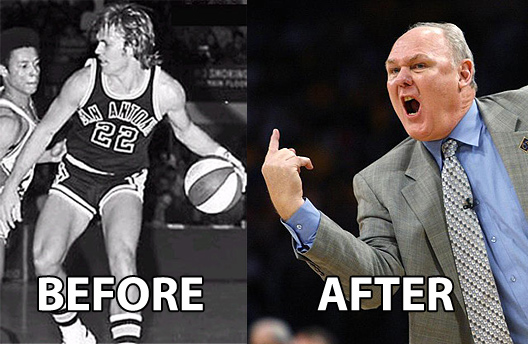
That ball my dad brought me back from San Antonio was one of two gifts from his business trips that I will never forget. The other was a genuine St. Louis Cardinals football helmet. So everything seems to come together, or at least it does when you begin to tell stories about it. The ball bore the autographs of (in order of recognition by me at the time): 1) Swen Nater; 2) George Gervin; 3) George Karl. I imagine their head coach, Tom Nissalke, also signed it since he was our neighbor who lived up the street from us in Madison, Wisconsin (I don't know, don't ask) and was probably the reason my dad got into the Spurs locker room after the game.

[Addendum from my father via e-mail, demonstrating how every history can be improved through surprising complication: "Sorry to disappoint you. Cannot remember the year of the meeting at San Antonio. I can tell you that it was not Nissalke who was instrumental in getting me the autographed ball but the representative of one of the laboratory companies that had a stand at the scientific meeting and when he learned that I planned to attend a game of the Spurs he said he was going too and he would get me the autographed ball. I shall continue digging into my records and hope to find some document (program, abstract, etc.) which might allow me to identify for certain which year was the meeting." My dad's research proved fruitful, determining that he was attending a conference in San Antonio from March 19 to 21 of 1975. That means he had caught the Spurs playing the Virginia Squires at home on March 21, just back from a road trip to -- you guessed it -- the Spirits of St. Louis.]

For many years that ball remained pristine. I saved it -- now displaying, now storing it in a bedroom closet -- long after the ABA merged into the NBA. When I moved out for college it stayed behind in the bedroom. At some point, I came home -- probably from graduate school, maybe later -- and wanted to shoot some hoops. Usually we kept a ball (a regular orange one) in a box in the garage. But for some reason, there wasn't one this time. So, without a second thought I retrieved the old ABA souvenir and used it to shoot away in the driveway, every meaningless dribble wearing away forever a bit of myth made mine. I still am unsure how I could have done that. The truth is, I think that I probably found it in the equipment box, already worn a bit as though someone else had taken a few shots with it. I'm going home in a week or so and I want to see if that ball is still there. If it is, even if it is flat and ordinary, the markings of ordinary time erasing the markings of legend that it once bore, I'm going to bring it back home with me to St. Louis and protect it. Maybe I'll even take it to a Pioneers game and get some autographs. Better yet: maybe I'll bring it with me to a tryout.

Could Be...

Read more...

Capsule Reviews (IV): Bios of Pistol Pete and AI, Jabbar on the Reservation

Friday, December 10, 2010

Bios of two of the most culturally unassimilable and phenomenally skilled individual players to ever play the game -- Pistol Pete Maravich and Allen Iverson -- are featured here, along with Kareem Abdul Jabbar's memoir of his mid-life crisis spent as an assistant coach for a high school team on White Mountain Apache reservation.


Mark Kriegel, Pistol: The Life of Pete Maravich (2007) Excellent biography of the hoops prodigy and college wonder whose pro career rarely lived up to its promise. Kriegel is a terrific prose stylist, and is both sensitive and thorough in portraying the powerful and powerfully vexed relationship between the Pistol and the father who formed him in the image of his own fantasies, as well as the social and athletic environment that shaped them both. Maravich emerged for me as a skill wizard whose growth as an all around player was stunted by a combination of his father's unwillingness to let go and his own unwillingness to accept opportunities to break away. By the end, when Pistol is carrying his father, dying of cancer, around his house in his arms, the full force of the story Kriegel had been telling hit me like an anvil. A touching, absorbing, sometimes humorous, informative must read.


Kareem Abdul-Jabbar, A Season on the Reservation: My Sojourn with the White Mountain Apache (1999) Nearly ten years after his retirement from the NBA as the all-time leading scorer, Kareem's interest in Native American history leads him unexpectedly to a one-season assistant coaching gig on the reservation. The strength of this book lies in the honesty with which Kareem lays out the surprises and difficulties he encountered along the way and in his attempt to connect his historical interests to his contemporary encounter with these teenagers. There's no simple tale of underdog triumph, or even of middle-age enlightenment. It's just a quietly told (perhaps a bit too quietly told), real-feeling story of some people thrown together in many ways by history and chance, who make each others' lives a little bit better by sharing a passion for the game.


Larry Platt, Only the Strong Survive: The Odyssey of Allen Iverson (2003). Nearly a decade old, I turned to this recently because of Iverson's decision to play ball in Turkey when no NBA team would pick him up. Despite his explicit intentions to the contrary, Platt's take veers pretty close to the hagiographical. But that's okay because AI is a saint. No, seriously, the book is at its strongest in helping to see the forces in AI's formative years that would shape not only his style of play on the court, but also his relationship to coaches and other players. AI may not have been a saint, but he is certainly a human being, and Platt does a good job of portraying the fear and the courage that drove one of the most exciting college and NBA players of the past two decades. Anyone who has dismissed AI for anything other than his play on the court needs to read this book and wake up. The book is also strong in its analysis of the cultural and economic meaning of AI as he entered the NBA from Georgetown and in this sense intersects well with Todd Boyd's book and others that I reviewedhere

Read more...

The Professor is IN

Tuesday, December 7, 2010

Some of you know that I'm going to be teaching a course in the upcoming semester called "The Cultures of Basketball." I have a general sense of what I'd like to explore in the course -- the different meanings and stories we create around the game and the ways in which we create them -- and also a general sense of what I'd like the students to learn -- that their enjoyment of an activity that primarily serves as entertaining distraction can be enriched and complicated by thought, or, to put it in other words: that you can think about something you love without ruining it -- you can even love it more. But that's about all I know for sure. So I'm issuing an open invitation for suggestions. The course is for undergraduates. I don't know too much about the particular students I'll have, but from their responses to a querying e-mail I sent out, it appears they vary in experience from casual pick-up players and fans to members of my university's varsity men's team.  I'll welcome suggestions for materials (books, essays, movies, clips, songs, etc.) of course, but also especially ways of structuring the course itself (historically, by level, by topic, by the genre or type of media through which we create these meanings, etc.).

Read more...

Pat Riley's Pickle: L'il Gherkin on the Heat and Coach Spo

Thursday, December 2, 2010


If you can't, or don't want to, beat 'em, join 'em. Just when everyone outside Miami was feeling that karmic justice had settled in on the basketball universe by making Miami a mediocre team so that we could pay attention to the teams and players who are actually doing something worth talking about this season, the imp of the schedule sends the Heat to Cleveland for Lebron's first return to the city he ditched. Armored vehicles, undercover cops, bans on "vulgar and profane" t-shirts, threats of violence, cats and dogs living together: TNT knows drama! In honor of the event, L'il Gherkin offers Go Yago! his two cents on the Heat's woes and the future of coach Erik Spoelstra.

Why have so many people been crapping all over Lebron? Didn’t he do what true champions do? Go to the team with the best chance of winning. It’s not like he went to NY where he would get the most money from salary as well as advertising and promotions. Or stayed in Cleveland where he wouldn’t win anything because management was never able to surround him with good enough supporting players. Sure he didn’t do what he said he would do (stay in Cleveland till he won a championship there), which explains why Cavalier fans should be upset. And of course they are, but I think New York, and basically the rest of the country except Miami is upset with Lebron.

I often wonder if there was a “correct” choice for Lebron. If he had chosen a different team would the outrage over his decision have been subdued and perhaps his public image saved? The recent struggles of the Heat are the only reason I am currently thinking about this subject again since the decision was made. It’s not like the Heat are playing awful, in fact they are over .500. And while they aren’t blowing any teams away with Wade’s struggles, injuries to key role players, and the drama between Coach Erik Spoelstra and the players it seems that we are at a crucial turning point. If the Heat end the month of December at or below .500 it’s likely Spoelstra will be fired and then the team will start to hit the panic button.

Luckily it’s still very early in the season and, not to the point where there’s any need to worry about missing out on the playoffs. Also; it’s fair to keep in mind how weak the Eastern conference is and, winning 41 games is probably enough for the 8th spot in the playoffs. Now I’m not suggesting that the Heat will only go .500. Realistically a team with such talent, despite the lack of chemistry should easily make the playoffs in the East. Now add to that the fact that the big 3 will eventually learn to play together the right way and that Mike Miller, at least, will return to the line-up, and there’s no reason why this team cannot win 50 games. Talentwise this is a team that could, in future seasons, rival the greats (71-72 Lakers, 85-86 Celtics and of course the 95-96 Bulls) but is Spoelstra capable of leading this team to greatness? After only two coaching seasons we don’t really know enough about him to make that judgment but from what I’ve seen he shows a great understanding for the game. Spoelstra did a fantastic job as the coach of the Heat the last two years but with this added star power it’s a much different situation. Managing the egos of two superstars and a perennial all-star is a job left for the greats. Especially when your team is calling “players only” meetings, it seems that things are starting to get out of control.

So what is Pat Riley to do? Slick his hair back like Gordon Gekko, and take control of this star stacked team? I gotta’ be honest, I’ve always been a huge Pat Riley fan, aside from the hair I loved the intensity he brought to his coaching and let’s be honest he is an elite coach. With 5 rings as a head coach he is clearly the better choice over Spoelstra, but then again he has also affirmed his faith in the Heat head coach. What is the best action at this point? Unfortunately there isn’t much Riley can do for now. You cannot relieve Spoelstra of his duties yet and it would be silly to give him a clear bill of confidence for the remainder of the season. However in a month there will be another Decision to be made. Hopefully for the owner’s sake the team is either playing up to potential or continuing to struggle. Anything in between will prolong the wait and see period for as long as it takes. And of course, the longer it takes to make a decision, the worse. - by L'il Gherkin

Read more...

  © Blogger template The Beach by Ourblogtemplates.com 2009

Back to TOP