Powered by Blogger.
Showing posts with label Childhood. Show all posts

Possibility is dead! Long live possibility!

Saturday, December 11, 2010


What I remember best about it is the blur as I lay on my back in bed, shooting it straight up into the air with perfect back spin: red, white, and blue giving way to the vaguely perceived promise of purple, even lavendar. I was not yet ten, and my dad had brought it back from a business trip to Texas: a genuine ABA basketball autographed by the San Antonio Spurs.


I was thinking about that ball this morning because no sooner had I submitted to the Facebook status gods my wish that there be a pro hoops franchise in Saint Louis (less for the games than for the gear) than I discovered that there is one: the St. Louis Pioneers. All life should be so easy. But wait, there's more. Not only is there a pro team in St. Louis, but they play in -- wait for it -- the American Basketball Association. That's right the ABA. It's not your daddy's ABA, but it wants badly to be. It even licensed the name from the NBA which apparently owns it (of course, it owns everything related to basketball).

What David Stern Sees
On the Pioneers web page, the first image you see is the towering afro of Julius Erving, decked out in his Nets uniform and a thin, gold choker. Then the image morphs to side by side images of players that actually have something to do with St. Louis: Marvin Barnes of the old ABA Spirits of St. Louis and Bob Pettit of the old NBA St. Louis Hawks, and then finally Barnes shifts over to the left hand side of the image and Moses Malone takes over the right hand side, dressed in his Spirits of St. Louis # 13 jersey. It's a chaotic little montage, historically speaking, tying together three icons of the scintillating blackness of the 70s ABA with Pettit, the icon of an era when St. Louis resisted the innovations in the game represented by Erving, Barnes, Malone and the whole ABA, not to mention stubbornly refused to integrate its roster and was the worst place in the NBA for visiting African-American players.

But nevermind all that: St. Louis basketball is back. That's the story, the narrative arc: there is this thing that is one, it is called St. Louis basketball. Like God, or the Word, it was made flesh. That flesh was called, first, the Hawks (Pettit), then the Spirits (Barnes, Malone) and now the Pioneers (um, Erving? the ABA).

a spirit of saint louis
Right, if it seems a bit thin as a narrative, in my mind that's just part of what stamps its authenticity as the heir of the old ABA. That old ABA, you remember it from Terry Pluto's Loose Balls, the Fish that Saved Pittsburgh or, today's versions, Chapter 3 of Free Darko's new basketball history and Will Farrell's Semi-Pro. The best thing about the old ABA, for me is its resistance to narrative. As FreeDarko asks there in Chapter 3: "What the Hell was the ABA?" Even the canonical history of the ABA -- Pluto's Loose Balls -- is really just a garbage can full of awesome quotations from participants, arranged in chronological order, and prefaced with a dizzying table that chronicles the emergence and disappearance of franchises like so many bubbles on the surface of a pot of boiling water.


A Time Machine
What story can you tell about a pot of boiling water? "It wasn't boiling, I heated it up, it boiled. Now it's boiling."? Not much of A Story there, though lots of stories: like when none other than the Spirits' Marvin Barnes once refused to get on a plane home from Louisville (Eastern Time) because it would arrive in St Louis (Central Time) before it had left: "I ain't goin' on no time machine." Oh yes you are, sooner or later. Now the St. Louis Pioneers have given him a middle seat on theirs. But I'm down with the Pioneers' weird historical montage because it's weird and ultimately contradictory, incoherent, and unpolished (when I friended the Pioneers on Facebook I got a message from them with a dead link).


A More Dangerous Time Machine
When the old ABA merged into the NBA, not only did the NBA get some dazzling players, a handful of viable franchises, and the rights to the name, it exercised its irresistible Story-Making power to fold the ABA's own non-narrative existence into the NBA's larger story of global domination. It's the titanic chapter of the dialectic of the NBA where individual creativity and entertainment was sublimated by the Association into what would become the racial harmony of the Bird-Magic era + the awesome marketing extravaganza that is Michael Jordan. And it's not that that's wrong or untrue. The nine-years of ABA basketball are part of the NBA's history and it's right to tell it that way. But as always happens with time machines of this sort, possibilities get left behind. Possibility gets left behind.
Another kind of history
But a watched pot, they say never boils, and the part of the ABA that is unwatched, roiling craziness, unwitnessed by just about everyone: that's also part of what should be registered of its existence, then and now. I don't know how to tell that: maybe a poem, maybe a Nietzschean aphorism, maybe just a physical spasm. But I know it when I see it: the St. Louis Pioneers, whose home games are played at St. Louis Community College and whose roster includes nobody I have ever heard of. The ABA is dead. Long live the ABA. nbsp;At first I felt like a fool for having not known (or forgotten) about the new ABA (which began in 2000). But then as I clicked around some more I realized that this league takes the old ABA's resistance to narrative and intensifies it exponentially. It's hyperlink madness. The same hyperlink madness that led me to find a photo of a genuine ABA ball signed by the San Antonio Spurs just one year after I got mine. In fact, Claire just discovered the fine print on the bottom of this page, where the publishers of the online sports media outlet oursportscentral.com -- dedicated to "major league coverage of independent and minor league sports" -- throw in the towel: "Our SportsCentral no longer actively covers the American Basketball Association (ABA) as a professional league due in part to its inability to publish and play a schedule and the transitory nature of many of its teams." You can get an ABA franchise for around $10K (AI's mom did, back in 2008) and that will make your squad one of the 50 or so that float and sink in a given ABA season.

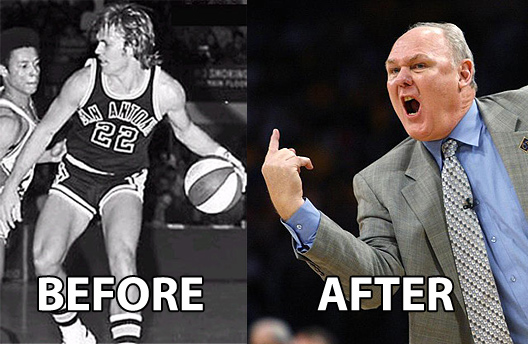
George Karl: One Last Time Machine

That ball my dad brought me back from San Antonio was one of two gifts from his business trips that I will never forget. The other was a genuine St. Louis Cardinals football helmet. So everything seems to come together, or at least it does when you begin to tell stories about it. The ball bore the autographs of (in order of recognition by me at the time): 1) Swen Nater; 2) George Gervin; 3) George Karl. I imagine their head coach, Tom Nissalke, also signed it since he was our neighbor who lived up the street from us in Madison, Wisconsin (I don't know, don't ask) and was probably the reason my dad got into the Spurs locker room after the game.

[Addendum from my father via e-mail, demonstrating how every history can be improved through surprising complication: "Sorry to disappoint you. Cannot remember the year of the meeting at San Antonio. I can tell you that it was not Nissalke who was instrumental in getting me the autographed ball but the representative of one of the laboratory companies that had a stand at the scientific meeting and when he learned that I planned to attend a game of the Spurs he said he was going too and he would get me the autographed ball. I shall continue digging into my records and hope to find some document (program, abstract, etc.) which might allow me to identify for certain which year was the meeting." My dad's research proved fruitful, determining that he was attending a conference in San Antonio from March 19 to 21 of 1975. That means he had caught the Spurs playing the Virginia Squires at home on March 21, just back from a road trip to -- you guessed it -- the Spirits of St. Louis.]

For many years that ball remained pristine. I saved it -- now displaying, now storing it in a bedroom closet -- long after the ABA merged into the NBA. When I moved out for college it stayed behind in the bedroom. At some point, I came home -- probably from graduate school, maybe later -- and wanted to shoot some hoops. Usually we kept a ball (a regular orange one) in a box in the garage. But for some reason, there wasn't one this time. So, without a second thought I retrieved the old ABA souvenir and used it to shoot away in the driveway, every meaningless dribble wearing away forever a bit of myth made mine. I still am unsure how I could have done that. The truth is, I think that I probably found it in the equipment box, already worn a bit as though someone else had taken a few shots with it. I'm going home in a week or so and I want to see if that ball is still there. If it is, even if it is flat and ordinary, the markings of ordinary time erasing the markings of legend that it once bore, I'm going to bring it back home with me to St. Louis and protect it. Maybe I'll even take it to a Pioneers game and get some autographs. Better yet: maybe I'll bring it with me to a tryout.

Could Be...

Read more...

In the Beginning was The Handle

Sunday, October 24, 2010

"Hi! Can Yago play?"

Which came first, the comforting feel of the ball in my hands or my ability to keep it in my hands?

I don't know. But I know I don’t remember ever feeling bad with a basketball in my hand.

To this day, there is some mysterious connection that occurs when I pick up the ball, a current that begins to flow. I do remember sometimes feeling bad when thinking about basketball, especially in high school, especially junior and sometimes, more rarely, senior year. I might feel bad in a game when the ball was knocked out of my hands, but never, ever when the ball was in my hands. When the ball was in my hands, and even just when I stepped on the court, all was right: I always felt good, confident, hopeful, optimistic, relaxed, and at ease.
Don't Think Too Much

If I wasn’t playing I was looking forward to playing. When I finished playing I felt a bit of sadness, loss. Sometimes I’d feel disappointed in how I’d played. Sometimes I’d feel frustrated about the play of teammates or the breaks that hadn’t gone our way. Sometimes (usually) I’d feel nervous looking ahead to a game. But those feelings never grew to the point where I dreaded playing, or was afraid to play. On the contrary, they were always swaddled in eager anticipation of the next game, the next time the ball would be in my hands. Usually, just lying back in my bed, picking up my ball, move it around in my hands, just feeling it was enough to comfort me.

Near the beginning of his basketball memoir My Losing Season, the novelist Pat Conroy talks about the staccato rhythms of the ball on the floor:

Where did all those games go, the ones I threw myself headlong into as a boy, a rawboned kid who fell in love with the smell and shape of a basketball, who longed for its smooth skin on the nerve endings of my fingers and hands, who lived for the sound of its unmistakable heartbeat, its staccato rhythms, as I bounced it along the pavement throughout the ten thousand days of my boyhood.
I know well the comfort of that feel and of that sound. The sense of absolute easy, effortless control dribbling the basketball. It was on a string, a part of my hand. Casually dribbling, then springing into motion, intensifying the rhythm of the ball, which followed me a like a cheerfully obedient pet. And there was a kind of pleasure I felt and indulged in varying and controlling the rhythm of the ball hitting the pavement on the floor. I can’t consciously keep a beat to save my life, but with the ball in my hands, I was a percussionist -- the ball and pavement my instruments -- and more than once I dribbled around the driveway laying down the track of the bouncing ball over the rhythms of Earth, Wind and Fire blaring out of my father’s boom box (which he’d allowed me to take out to the garage).

I don't know. But I know I developed and refined my handle playing against my older brothers and my father in the driveway, probably starting around the summer I turned 5. They were bigger, stronger, and faster than me. Tony was the best athlete and most skilled, my Dad was the toughest and most physical, and Juan was the one would wear me down psychologically. But the truth is, I couldn’t shoot over any of them and I couldn’t back any of them down, and they were all three aggressive defenders who got up in my chest, suffocating me, and they all three got under my skin. If they took it easy on me on account of our age and size differences, they were masters at disguising it. My game was protecting the ball, and using its motion as I protected it to create an opening, a passage, a line of flight through which I could burst on my way to the hoop. Post moves, jumpers, fade-aways, they came later (in response to different defenders and different defenses).

This primal ability to protect the ball stayed with me and served me well, even years later, in high school. Our coach installed the North Carolina four-corners offense for the first time in my junior year when I joined the varsity as the starting point guard.
It's all about me
It might have been my favorite part of the game. We would lead by a point or two in the final couple of minutes, coach would signal for the four corners, and I would be back in my driveway, dribbling and dribbling, beating my man, dishing off to one of my teammates in the corner, keeping alive an endless possession, the feel of the ball in my hands - an opportunity to be selfish in a system that mostly had me thinking about others.

Those possessions in high school might end with a teammate’s easy lay-up; more often with me shooting free-throws, which I made, especially at the end of games. I loved being at the line at the end of close games with the ball in my hand. But at the beginning, when I was a kid, it was all lay-ups, earned lay-ups crafted in traffic, under duress. They never gave up, even when I’d created my half-step margin, they rode on the back of my hip, the steel bar of a man’s arm across my chest, a sharp knee in my thigh as I pushed past, knowing in my bones and muscles that the path to the hoop was mine, a thing I had made and that I had a right to.

Tony was the best athlete and the most skilled of my first three opponents. And so even as I got my step on him (earned when I was older, granted perhaps by him sometimes when I was younger, either because he wanted to keep it interesting or he wanted to teach me wordlessly), I know it wasn’t done. He might block my shot from behind and so I developed the knowledge of using my body and the hoop to protect the shot, to protect my space.

I learned that I could go under the basket to shoot the reverse, I learned to change my shot in mid-air, I learned to stop on a dime, fake, and when he had committed and gone up or by me I would toss it up softly off the board. So if my handle and my quickness were my first game, finishing strongly and creatively near the hoop were the second, and a corollary of the first, and like my handle forged by the conditions of the games and especially the opponents I had at hand.

(Here is a hoops axiom: You develop what your toughest competition forces you develop, or, You become what you cannot yet beat. It is true at the improvisational level of a single one-on-one play and it is true at the level of teams and organizations from season to season.)

My ball handling skills could also have been built upon the foundation of drills I would only learn later, and they were certainly eventually enhanced by those drills. But the fundamentals and their principled, systematic and orderly, development by rote came much later. First there was this pragmatic academy founded on the chaotic urgency of my small body and my desire to keep up, my will to be grown, and equal at least to the best around me. Somehow, there was no intimidation, no fear. I was anger and determination, I was that ball on a string in the beginning and that crazy, intuitively calculated prayer I would toss up off the glass at the end.

Read more...

An End to Innocence, or How I Learned to Shoot a Jump Shot

Wednesday, October 6, 2010

My brother, Tony, through my childhood eyes
Tony is nine years older than I, my oldest sibling. As a boy, I idolized him completely. It wasn’t one thing in particular about him that I idolized, it was just his way of being in the world: energetic, confident, attractive, imaginative and spectacular in both success and failure. There’s a lot that I didn’t know about Tony’s life when I was young, a lot about his struggles that I didn’t really discover, let alone understand, until much later.

When Tony graduated high school, I was not quite nine years old. After one year of college (where he studied agronomy, trying to nourish into reality a long held dream of being a farmer), he moved out of my parents house and embarked on the first in a series of jobs in construction. At this point, the daily reality of him begins to fade from my memory, yielding to a simple, vague image of Tony as the embodiment of misunderstood strength, a strength that masked a tenderness and sensitivity that I fantasized he only revealed to me, his baby brother. He called me “Bean.”

But the concrete focal point of my admiration had already been established years before. Tony was a naturally gifted athlete with a special gift for basketball. He played ball as he lived: with an intensity that veered into recklessness, with intelligence, and with grace. He was also played out of position. An even 6 feet tall, with great quickness, strength and leaping ability, not to mention a fine jump shot and good ballhandling skills, he ought to have played guard. But on his high school team, he played center. He excelled, and maybe enjoyed himself. I don’t know. But I’ve often imagined that playing center confined the expression of his skill and athleticism and that somehow that stands for other hard luck constraints he would face in life. But I didn’t know any of that then. I just remember that on Friday or Saturday nights my parents would take me to his games and then for the rest of the weekend I would replay those games by myself in the driveway.


Me, in the driveway
I wasn’t in the driveway trying to do the particular things that I’d seen Tony do, nor was I practicing the things that he had shown me that I might want to learn first. I was just playing basketball by myself. Dribbling that perfectly beautiful orange rubber ball with the mysterious lines whose pattern I could never quite grasp around the driveway and then trying to heave it through the hoop. Just playing basketball. The patch of grass around the basketball pole grew bare so that when it rained mud puddles formed. My dad (or one of my brothers – I don’t remember which) put a couple of small pieces of scrap plywood there so that I could use that space without the ball thudding in a puddle, dead. Someone – I was so ignorant of the many little things that the grown-ups did to make my life easier -- also rigged a couple of extra workshop lights to the gutter of the garage to illuminate the driveway so that I could play after dark. In the winter, we shoveled away the snow, put salt on the patches of ice, and wore gloves. Year round, I played nearly every day.

When I got to middle school I made my school team and began to learn about plays and defenses and teamwork. But in terms of individual skills, I still just did what I had always done in the driveway. I dribbled, passed, and shot the ball, just as I had naturally grown to do them. Even the drills we did in practice to reinforce those skills were pretty much the same as what I did in the driveway, except that there were other people around doing them too. I got along just fine, an above average guard with good ball-handling, passing, and shooting skills and a growing intellectual and intuitive sense of the ways of the game. And I loved the game.

Most kids, when they shoot a basketball, will just push it up toward the basket from around their chest with two hands. They might leave their feet to do so, but it is more that the momentum created by their upper bodies pull their feet up off the ground in a kind of half-hearted, uncontrolled jump after the fact of the shot. And for most kids, including me, if you do it enough times, it starts to work pretty well. But around eighth grade, some of the kids suddenly grow, not just taller, but facial hair and defined muscles. If you happen to be defended by one of these kids when you are trying to push that ball up to the basket from your chest, you are very likely, as they used to say, to wind up with “Spalding” imprinted on your forehead. You’ll get your shot blocked.
This sucks

Enter what is called a “jump shot.” Enter my first teacher. Enter my first lesson in the art and value and pain of discipline, practice, and the cultivation of a second nature. Or, in another words, enter the trying rewards of being banished from The Garden. One day in eighth grade, before our season had started, as we were all just shooting around before practice, or maybe it was after practice, Coach drew me away from the group and toward a side hoop. “Yago,” he said, “I expect you to do more scoring this year. But you are doing to have to develop a jump shot.”

Now, I was a pretty conformist kid, afraid enough of getting in trouble and eager enough to please that I rarely questioned or rebelled against authority. And I didn’t this time either. But I did feel a kind of dread and inner resistance upon hearing Coach’s words. It wasn’t that I didn’t want to learn to shoot a jump shot, or didn’t want to score more points, or help the team. I think it was mainly that I didn’t want to change what had always worked just fine for me, and then maybe partly also that I was a little afraid that I wouldn’t be able to learn to shoot a jump shot. It’s still that way for me sometimes, for example when someone has read a draft of something I’ve written and tells me they have some suggestions.

But as I say I was a pretty obedient kid and I did respect my Coach. So that day I learned the mechanics of the jump shot. In almost every way, it ran absolutely counter to everything my body and mind had been doing with a basketball for the last nearly ten years. To begin with, there were the physical changes in my shot. Now, I had to shift the ball from my chest to just above my forehead, my right arm cocked at a ninety angle below the ball. Plus I had to push with just my right hand, positioned in the center of the ball, halfway between the bottom and the middle, while my left hand was relegated to a spot alongside the ball, merely guiding its path. And then, of course, I had to jump. But I had to jump, while beginning to push the ball, and releasing it only at the top of my jump. You might be surprised at how hard it is just to execute the motion – let alone putting the ball in the hoop -- if you’ve never done it before. It was incredibly awkward. My first attempts looked much more like the seizures of an epileptic frog than like the graceful jumpers I’d seen my older brother drain hundreds of times.

But the very hardest change was the mental one. Or rather, more precisely, the hardest change was the fact that now there was a mental aspect. For the first time, I had to think about what I was doing with a basketball in my hands. The physical motions of the jump shot certainly were awkward. But I felt absolutely out of my element thinking at the same time, trying to coordinate the rapid fire list of instructions I had internalized with the still unfamiliar and uncomfortable motions of my body. I felt intensely self-conscious and judgmental. Before this I felt myself one with my body and the ball. I dribbled. I passed. I shot. It went in or it didn’t. I don’t even remember thinking I was good or bad or that I’d done something well or poorly.

But a separation now grew within me. My mind knew what it was supposed to do and what my body was supposed to. And my body would gamely, but highly erratically try to follow along. Running alongside this was an annoying mosquito buzz of self-assessment, usually negative and rarely constructively so. This split weighed on me. It introduced a dimension of experience and tragedy into what had been for me a completely innocent and joyful activity. Of course, I didn’t think in these terms at that age. I just felt for the first time in my life ill-at-ease with a basketball in my hands. And so also for the first time in my life I felt unhappiness on a basketball court.

Not only that, but my accuracy plummeted. I could barely hit the court with my new jump shot, let alone put it through the hoop. And I wasn’t even doing it with one of those big, muscly, hairy guys with body odor in my face. Coach encouraged me, told me not to worry about it, that this happens to everyone when they learn a jump shot and that soon, if I kept at it, I’d be more accurate than I had been before and in a greater variety of game situations. But I had almost no faith that this jump shot thing had been a good idea.

Almost no faith. But a lot of some other things that wound up working much the way that faith is supposed to work. Whether it was the desire to please someone I respected, a prideful aversion to looking like an idiot, or some kind of stubbornness within me, I don’t know. I know it wasn’t some sort of Rocky-esque heroic determination to succeed, grounded in a solid belief in what I was doing. Whatever it was, semi-depressed,


This feels weird


I stuck with the jump shot. I shot hundreds a day. I took extra time in the gym after practice. Then after dinner, go out to the garage, retrieve my ball out of the big wooden box my dad had built for our sports equipment, switch on the lights, and shoot jump shots. I no longer just dribbled aimlessly around the driveway, heaving set shots at the hoop. I no longer played out the last seconds of a championship game culminating in my hitting the winning bucket at the buzzer (or, if I missed, in getting fouled and sinking the winning free throws or, if I missed those, getting another chance because my opponent had stepped in the lane prematurely).

I wasn’t just playing any more. I was practicing. Five spots: baseline on either side of the hoop, each wing (a forty-five degree angle from the baseline), and right in front of the hoop. I did what Coach told me to do. I shot from those spots, beginning just five feet or so away. I tried to shoot one hundred shots from each spot. Sometimes I made it to 100. More often, I’d yield to despair and discouragement and pack it in after about fifty, angrily slam the ball into the wooden box and storm upstairs to my room (having sullenly grabbed a handful of chocolate chip cookies), where I’d eat and rage silently in self-pity at the injustice of having to change my shot.

But then, after a few minutes of sulking I would take my other basketball, and just lay there in bed, practicing the arm motions of the shot, practicing my follow through, the ball just rising with backspin in a straight line for a few feet before descending back into the open palm of my right hand. I still don’t know how that works. What made me pick up the ball and do that. It could have been – it could be – so many different things. Just contingencies of the moment I guess.

All the while, I was growing physically stronger and little by little I didn’t have to think so much about the motions. I still practiced constantly. But I made up little games for myself. Make three in a row from a spot and then move to the next spot. Make three in a row from all five spots and then back up a couple of steps and do it again. Then as a treat I would let myself take a few dribbles to one side or the other and then pull up to shoot the jump shot. Or I’d toss the ball, with back spin (so that it would bounce back toward me), step to it and catch it like a pass and then square up to shoot. It felt like an eternity at the time (imagine how time felt to Adam and Eve after they got in trouble with God), but looking it back it probably wasn’t more than a month or so before the bulk of my time spent in the driveway looked a lot like it always had. Sure there was some structured practice at the beginning. But mostly I’d dribble around the driveway, counting down the final seconds in my mind, evade an imaginary defender and then pull up, rising over his helpless teammate, and effortlessly swish a jump shot to win the championship game.

The striking thing to me is that it is still with me. I love to get into pickup games, especially full court. But sometimes, when I can’t find a game, or just because, I take my ball and go to the gym or the playground and I practice my jump shot. I’m not 13 anymore trying to get better to as to impress a coach, or make a team, or get to the next level. I have no hopes of that sort.
Same, but different
I’m 45 and my knees often hurt and there is no next level for me. But I still start on the baseline, five feet away, and take a five jumpers. I still check and correct my mechanics when shots go awry. I still work my way around the perimeter, gradually increasing the distance until I’m working my way around the three point line. A hundred, two hundred, three hundred shots. I don’t really find myself imagining game winning shots anymore. I think I'm probably a better shooter than I ever have been, but I don't think that even matters to me too much. But I find that take a deep, comforting pleasure in the feel of the ball, the sight of the rim above me, the breaking of a sweat, the entering into a rhythm and, above all, the sound of the ball rustling the net. I love this practice that has no purpose other than itself, this practice that has become play.

I only wish that I could play a game of one on one with my brother.

Read more...

You can't guard me

Wednesday, September 29, 2010

How do you get to be a trash talker? What is that all about anyway? Why do I love it? And, since I love it, why can’t I seem to do it? I don’t mean, why am I incapable of executing trash talk. I mean, why am I unwilling to talk smack? What does it mean to me that stops me short?

A couple of weeks ago, on one of my recent commuting trips from St. Louis to Ann Arbor, where my job is, I went to the North Campus Recreation Building to try to run some pick-up ball. It took a little doing, since faculty members at the University of Michigan don’t get into the campus recreational facilities for nothing, but I finally got some cash, paid my $10 for a courtesy day pass, checked out a ball, and made my way to the gym.

There are two courts at the NCRB. On one there was a full court game going with a line several players deep for next game. I went across the gym to the other court and saw that one half had a volleyball game going and the other a half-court four on four game with only a couple of guys standing around on the sidelines. I’d have preferred a full court run, but was kind of tight for time so I approached one of the young guys who was holding a ball near the baseline and watching the half-court action. He was a lanky kid, around 6-1. I asked him if he had next, he nodded silently, and I asked if I could run with him. He nodded again, again silently. Then he wandered around to the sideline and asked another guy – short and stocky – if he wanted to play with us as well. When the game finally ended, we picked up another 6 footer, also lanky, who had shown some outside shooting ability for the losing team.

While the winning team filed over to the water fountain, my new teammates and I shot around a little bit. I like to know the names of my teammates. It helps with communication on defense and on offense, and, I believe, facilitates building a little chemistry, even in a half-court pick up game. I also think it makes me feel a little less inhibited during the game. The winners came back and we started our game, up to 12, straight up, by 1s and 2s (that means that shots from behind the three point line count as 2 points and everything else counts as 1 point and that the first team to 12 wins without having to win by 2 points).

We won that game, Charles, Leon, Andy, and myself, and then we won five more after that before I had to get going and so we retired, undefeated. I had a great work out, played pretty well, and enjoyed the wins, some of which involved exciting rallies in which we banded together to lock down on defense and worked patiently to get higher percentage shots on offense.

Nonetheless, I couldn’t help but feel a little empty, a little disconnected from the action. Though we were all – my teammates and our opponents -- clearly working hard to win games, something was missing. The only sounds were the pounding of the ball, the squeaks of their sneakers on the polished wood floor, and the occasionally correctly called out “pick right!”, “Switch!” or “Shot!” and then the obediently mumbled “good game” after the run ended. They were competent, business-like and joyless. I thought about my recent experiences playing on the outdoor courts at Heman Park in St. Louis, and how joyful and expansive I feel after every run, even when my team loses so that we don’t get to hold court like my team did in Ann Arbor.

I’m guessing that most people reading this know that trash talk, also known as talking smack or smack talk (and probably by a bunch of other names that I don’t know), involves a running commentary on the action while a game is underway. It usually takes the form of boasting about your own talent, declaring the success of the play you are about to execute, or insulting your opponents abilities, or a combination of all of these. Sometimes it sounds serious and intense, though in my experience it’s mostly humorous.

At Heman Park, it seems to me, everyone talks trash, everyone but me. From the prepubescent 8th grader, Mook, who is talented but still shoots a push shot from his chest to the 6-4 “old school” guy, whose name I don’t know, but who dominated play the couple of times he showed up to play, trash gets talked. Even Bob, a 64 year-old white dude with knee braces, a backward baseball cap, and wrap around sunglasses. Bob can’t even walk without visible effort, but he talks trash. Just like Mook, just like Old School.

One player, about 6-3 and in his late 20s, I would guess, and who looks like Dwyane Wade, pulls the ball out to the three point line, executes a series of complex stationary cross-over and between-the-legs dribbles, all the while repeating “Class is in session. Hoopin’ 101.” Then, he laughs, and just before either flying past his defender or draining the three ball, asks “You ready for school?” and then, after the play, “Go home! You ain’t ready for school!”

My favorite is probably Vic, the nearly toothless drunk who plays in street clothes and boots and one time not only won our game of “buckets” (the St. Louis version of “21” – actually played to 32); but then went on to lead our four to two victories before leaving us with this vintage piece of smack for our opponents – “Y’all can’t guard me and I’m drunk. I’m’a come back sober and y’all really see something.” Everyone broke out laughing and a bystander came back with “If you were sober you couldn’t even find your way here.”

I loved this exchange as I love all the trash talk on the courts at Heman. It’s an integral part of my enjoyment of the game. So, given the choice, I’ll take the game with the good trash talkers. The question is why doesn’t it come out of me? By the time I was in high school I was regularly playing on playgrounds in Madison where trash talk was the rule of the day, so it’s not as though this is some unfamiliar cultural form or a court protocol that’s foreign to me. On the contrary, I immediately relax when I hear it, as though I were returning to my native land after a long stay abroad.

I feel like I have the requisite qualities for talking trash. I’m competitive. I love dominating as much as the next guy. I have no problem telling guys where to go on offense or defense, even guys I don’t know, or that are individually more talented than I am. I do tend to be a little shy socially at the park or gym, but that just seems to beg the question of why that is so and why my shyness doesn’t prevent me from asserting myself in other ways on the floor. So, like with anything else I find puzzling about my own behavior I asked my therapist about this (yeah, I know). Doc did the therapist thing and threw the question back at me. In fact, I knew this would happen, like I know what would happen if I took the ball into the paint on Ben Wallace. “Let’s explore this. What comes to mind for you?”


“Larry Bird.” I could’ve said Michael Jordan or Reggie Miller or Kevin Garnett. Or, my favorite trash talker, because he looks like he’s having so much fun doing it: Rasheed Wallace. But at the time I had been reading Bird and Magic Johnson’s book about when the league was theirs. One of the things that stood out to me in that account – more as a reminder of a fact I’d forgotten than as something new – was Bird’s legendary trash talking. The usual stories were there, the ones I remember from his playing days. How on a Christmas game he told Chuck “The Rifleman” Person (who had previously made some comment about “The Rifleman going Bird hunting”) that he, Bird, had a present for him. Then he proceeded to launch a three right in front of Person on the Pacers bench while saying “Merry Fucking Christmas”, just before the ball dropped through. Or the time he pointed out to Xavier McDaniel the spot on the floor from where he would hit the game winning shot. Then went to that spot, got the ball, and hit the game winner over McDaniel.

So I tell my therapist about this and he sees me smiling and animated as I tell the stories and just voices this observation, asking me why I think I’m drawn to that story. My first stab is the obvious. “It’s the confidence. I mean, I feel pretty confident when I’m playing basketball and I know my limitations so I’m not too often in a position where I’m trying to do something that’s not going to work. But that just seems like a crazy level of confidence,” I say. Then I trail off, unconvinced and feeling that by-now familiar feeling that there are more thoughts and more feelings. I’m observing them in my head or wherever they are, like a dark opening into a darker forest, and briefly but deliberately mulling over whether I feel like going there, like starting down that path that I know is going to lead to something surprising, something that is closer to the bone.

This time I do. I continue, “It’s not just the confidence. I have that when I play. It’s the verbal aggressiveness. It’s one thing to be confident, it’s another thing to explicitly assert your superiority by telling your opponent what you are going to before or while you are doing it, and then doing it anyway, showing up that they are powerless to stop you so superior are you.” Now, let me just acknowledge that I’m rarely in the position of superiority (the need to acknowledge that is like a vacuum sucking the trash-talk energy right out of me), but that fact doesn't stop most of the players at Heman from talking trash.


Please like me (or at least don't be mad at me)
The more relevant explanation is that I’m too concerned with other people’s feelings, too worried that too much feeling, too much self-expression, too much me will cause problems for them. So I’m a pleaser (interestingly, though Magic could talk trash, he rarely did, and close teammates described him as a pleaser too). This concern with other people’s perceptions becomes a kind of abyss for me when it comes to trash talking. A corollary avenue of exploration would be my almost compulsive need to say “My bad” on the court. My guy scores, no matter how tough the shot, no matter how good my defense, I will say “My bad” to my teammates (and “Tough shot” to the opponent). Pathetic.

First off, there’s just the obvious worry that I won’t deliver on the promise of whatever smack I throw out there. I see myself falling away on a baseline jumper – “Money!” – and then watch in horror as the ball barely grazes the bottom of the net. Then, there’s an additional worry that my trash talk will be outdated or in some other way idiomatically clumsy or inappropriate. But most of all, I’m worried that the other guy will be mad at me, won’t like me anymore.

What’s interesting to me about this is that the first two worries, which really aren’t seriously inhibiting concerns of mine, are the more likely outcomes in reality. On the other hand, my third concern, which I think is what really holds me back, is the least likely, particularly in a neighborhood game like the ones at Heman park where I know most of the guys by their first name and they know me. Maybe I’m unrealistically terrified in proportion as I am desperately grateful for the sense of inclusion that playing at Heman gives me.

That’s probably true. But it’s also true that after throwing all this out there for my therapist, as a kind of afterthought, I added “Larry Bird must have been filled with rage.” Awkward moment. I realize I have never read or heard that about Larry Bird. I feel as though my psyche just farted. Loud. I realize I’m not talking about Bird anymore. I’m talking about myself. It’s not just asserting myself, not just worrying about doing something awkwardly, it’s about expressing something particular that I feel: my rage. And it’s made all the more tempting because trash talk on a city playground is an absolutely acceptable form of expression and all the more alarming because I certainly have no reason to be angry with my opponent at Heman Park. That’s just what scares me about rage, that it will be out of off target, out of proportion, and out of control.


My fear, my wish

I think about the only basketball situation in which I was ever really comfortable talking trash. It was when I used to play one on one with my older brother, Juan. Juan is 8 years older than me, the second in our family. Our oldest brother was probably the best athlete in the family and Juan never played competitively. But he was no slouch. He was about four inches taller and about 25 or 30 pounds heavier than me. He had a pretty good jump shot from the wings, released from behind his head which made it hard to block, and he was (having also played against my dad) physical and aggressive on defense and on the boards. As I got older, and spent more and more time playing ball and as Juan got older and spent less and less time playing ball, I began to beat him more regularly. And I started talking trash to him.

Did I not care what Juan thought of me? Was I so sure of his affection for me that I could risk giving free rein to these scandalously excessive self-expressions? Maybe. But Juan, in addition to his accurate over the head jump shot, has a wickedly incisive, dry sense of humor. In other words, he started it (or at least that’s how I remember it). He might call me too weak, or too small, or tell me I didn’t have the heart to really d him up. And that would make me angry and in my anger I would play harder and better and then, especially by the time I was around 18 or 19, I would want to humiliate him, not just by beating him, but by telling him I was beating him and how I was beating him and making it evident that there was nothing he could do to stop it.

I think of how many of my formative basketball experiences in that driveway in Madison were filled with rage. I don’t know why (it’s typical of me to think that there had to be some reason, to try to domesticate and justify and rationalize rage). I just know that as I contended with my father’s physical play, or my brother Juan’s teasing, or my oldest brother Tony’s effortless, unreachable superiority over me – as I contended with the feeling of being too damn small, smaller than everyone else, the rage would grow in me. I see my small body going harder, faster, digging in on defense, seeking rather than trying to avoid contact, unafraid of pain.

I see the bemused expression on my brothers’ faces as I hurl my angry body around the court, and I get angrier and I’m determined that when I grow, when I finally, grow, I will leave them standing still, a blur on my way to the hoop. “You can’t guard me.” I will swat the ball back in their faces, then give it to them to try again, and then swat it again. “Get that weak shit outta here.” And then, when it’s game point, I will spot up from way in the corner, 25 feet away from the hoop and when they dare me to shoot it, I will look them in the eye, and then as I effortlessly shoot my jumper I will say “Cash.” Of course, the ball will go in, and they will finally collapse like the deactivated droids in The Phantom Menace, left powerless and humiliated by the recognition that they can’t stop me.

(Sorry. My bad.)

Read more...

The Voices of My Father

Friday, September 24, 2010

Sometimes it felt like this too
What is my father’s voice? What does it sound and feel like? What does it say? What difference does it make? In a recent post, I told part of that story, recalling how radio broadcasts would help me mute the sound of his voice as he and my mother argued and also, how, at a metaphorical level, my father desires and voice loomed as large in my childhood perceptions as Wilt Chamberlain in the Philadelphia Warriors offense. But in fishing out the memories of those feelings, I’ve also snagged some others, other memories, other stories, other feelings. They don't all literally involve his voice, but the most important one does.

My dad was one of my earliest opponents on the basketball court (my two older brothers and, on occasion my sister or her boyfriend, were the others). My father loved to watch basketball, and he was a quick and intelligent student of the game’s more subtle dynamics, but, a Spanish immigrant to the United States, he was neither experienced nor skilled as a player. Moreover, around the time I was 8 or 9, he suffered a serious back injury that made it impossible for him to run and jump. Most of my memories of playing against my dad come from that time, when he was grounded, but still willing – somehow – to come out and play with me.

What a complex classroom in basketball and in life those contests would be. I say he was inexperienced, unskilled, and hampered by injury. But my father, as I recall his game, possessed a fair bit of natural athletic ability. I don’t remember him jumping, but I imagine he had pretty good hops in his day. Around 5-9 with a medium build, he was quick with wiry strong muscles in his legs and arms.

And he was a very determined competitor, which I appreciated because playing ball at that time was for me most of all about playing against grown-ups and thereby feeling like less of the family baby and I couldn’t tolerate the idea that someone was going easy on me. I’m aware now that the grown ups were 1) probably going easy on me to some degree and 2) protecting me from the knowledge of that. But the memory I have of my experience of those games is of an all-out war of bodies and minds.

Offensively, my dad had a somewhat limited repertoire. He had a fairly accurate one-handed set shot, given the time to set it up. He had a pretty quick first step to the basket, but for the most part he needed to look at the ball to dribble and so that slowed his drives to the hoop. He also had a methodical way of backing in toward the basket, keeping his dribble alive, and then, finally close enough, a kind of quick turn-around toss, half shot, half hook, off the backboard. That was tough for me to stop because he was bigger and stronger and I remember still feeling the dread of the inevitable as I desperately dug in, trying to hold my ground.

But what I remember most viscerally is his suffocating style of defense. My dad gave new meaning to the phrase man-up. I see him feet wide apart, crouched low, back ramrod straight, my dad played torso to torso defense. He got as close as he possibly could without touching, his hands stretched to the side or straight up in the air depending on whether I was shooting. Most vividly in my memory, as I begin to dribble (because of course I can’t get a shot off over him when he’s so close with his hands up – I am probably somewhere around 5-1 or 5-2 or so at the time), his arms begin to come together, a kind of stiff-armed hug so that as I continue to press my drive around him I feel like I’m trying to go through a turnstile the wrong way: there’s a little play, but I’m not getting through that way. I imagine that we acknowledged fouls in those games, but I don’t actually remember calling them or having them called on me at all.


Kinda like my dad playing defense

I do remember the combination of frustration and determination that his intense defense used to provoke in me, as well as the sense of elation and triumph I would feel when I scored. Sometimes I felt so beaten and trapped that I wanted to cry in frustration and complaint. Sometimes, I’m sure, I did (I cried easily as a boy). But sometimes, I found that my father’s will to stop me seemed to infect me in transmuted form and I felt an unshakeable will not to give up until I got past him. Then, no matter how many times I slammed into that turnstile, I’d backtrack my dribble, try a still emerging cross-over or fake, and try to get around him on the other side, or I’d try a wider path to the hoop, trying just to elude his reach entirely. Five, six, ten times this might happen and more than anything what stays with me is the sense that I lost myself, in a way that felt good, in that tiny, intense battle for a swath of poured concrete.

On those times I made it, I felt elated, proud, relieved, but also a little anxious – I couldn’t tell what my dad felt and that worried me: was he proud? Hurt? Angry? All I felt that I could be sure of was that he was determined and serious. But probably I was wrong even about that. Maybe all he was doing was trying to endure the pain caused by the herniated disk in his back. Maybe he was thinking about something else entirely. Yet it never felt that way. It felt like he was all there, and all about stopping me by hook or by crook, and that there was something personal at stake in it for both of us.

Maybe sometimes this was confusing for me, or unsettling, but most of all I remember those games against my dad as strengthening, and building my confidence, not to mention certain skills and qualities in my game that I still notice today in pick-up games, when I am being guarded by a stronger, bigger, more physical player. I still usually respond by going to the basket with extra determination, I still do my best to bang underneath and to hold my ground when he tries to post me up. And so, above all, I feel the surging and energizing desire to win – more, to vanquish. And if I do, when I do, I feel as much that it has to do with will, with wanting it more, and I think of my dad, and feel sure that nobody but him could have instilled that in me.

I’m reminded a little of Dave Hickey’s excellent essay “The Heresy of Zone Defense” in the book Air Guitar, his collection of essays in art criticism. Hickey opens this way, with a description of this play:


Julius [Erving] takes the ball in one hand and elevates, leaves the floor. Kareem [Jabbar] goes up to block his path, arms above his head. Julius ducks, passes under Kareem’s outside arm and then under the backboard. He looks like he’s flying out of bounds. But no! Somehow, Erving turns his body in the air, reaches back under the backboard from behind, and lays the ball up into the basket from the left side.
Hickey thinks about the joy the play elicits, still today, watching it in replay and decides that the perfection of the play is as much Kareem’s doing as Dr. J’s. Kareem’s perfect defense elicited Dr. J’s perfect response. That’s how I think of my dad, now, as my Kareem: as the one whose perfect intensity and, ultimately, respect for me as his opponent, elicited from me my best, not only a set of technical skills, but also endurance and determination, not to mention the ability to transform feelings of frustration and anger into a combination of focused desire and intelligent calculation on the floor.

But my dad was more than my opponent. For once I started playing competitively, he was also my biggest, most conscientious, and most enthusiastic and vocal fan. I started playing soccer in competitive leagues when I was around 5 or 6 and played every season through my senior in high school. I started playing competitive basketball in 6th grade and, likewise, played all the way through high school. I'm sure he must have missed a game or two because I know he was traveling regularly during part of that time. But I don't remember him ever missing a single game.

Always he was there, with my mother, a fixture among the sparse crowd of parents and friends on the sidelines of a soccer game, or up about five or six rows behind our bench in our more crowded basketball games, home and away. He had a terribly painful bad back. I don't know if it really hurt him to sit in the pull-out wooden bleachers, or to stand for the duration of a soccer game. I always imagined that it must, that this why he paced the sidelines. But if it did, he never told me about it, never complained to me about that.

What’s more, and I've never heard of any other dad doing this, he kept track of the statistics at my basketball games all the way from 6th grade through high school. He used a small yellow steno pad and one of the ever-present fine-point pens from his shirt pocket. And on that, in neatly labeled colums, he recorded my field goals attempts, field goals, free throw attempts, free throws, assists, steals, turnovers, rebounds, fouls, and points. I believe that when I joined the high school varsity, he started doing this for the whole team as well, at least in my senior year.

My dad never used these statistics as the basis to criticize me or my teammates. I don’t remember him actually ever even making any neutral observations about the statistics he eventually came to enter into a database and to print from his new personal computer in the early 1980s. My dad was a scientist, a very capable scientist, with a brilliant statistical mind, and love of numbers. Though I never had his aptitude, I did love the mathematical games and tricks he shared with me when I was a boy, and I did love to pore over sports statistics. I even, I am a little embarrassed to say, kept track of the statistics of the different players I would imagine myself to be incarnating in one-on-one games against my friend Robb (I kept track, consulting him of course, of his “players” statistics too). All of this to say that I think what my dad was doing there was connecting more deeply to my life. It was enough that he was always there at the games, no matter what else might be going on. But he also joined one of his abilities and passions to one of mine and in so doing enhanced and augmented the space we shared.

Of all these memories, though, of competing with my dad, of poring over statistics with him, the one that most sticks out in my mind is the sound of his voice – deep, hoarse, slightly accented – bellowing over the sound of my coaches and the hundreds of fans at one of our basketball games: “Go Yago! Goooooo Yago!!!!” My friends sometimes made a little fun of me for that and I felt simultaneously embarrassed and annoyed with them and, very secretly, grateful to my dad for being the kind of dad-fan who yells for and not at his kid. Not all my friends’ dads were like that. Some of them never came to games. Others came but were quiet supporters. Others came and berated their sons publicly during and after each game. My dad came, kept stats, and shouted “Go Yago!!!!” (Maybe he also laid into the refs a little bit.)

It’s not just that he yelled “Go Yago!!!”, it’s that in that Go Yago he expressed all the pride and love and joy he drew not only from my accomplishments but from my participation. My dad let me know that he was proud of me when I won an award, or made all my free throws, or had a high assist-turnover ratio. But he also let me know, just as frequently, that he was proud of me and loved just watching me run down the floor. He just loved to watch me run. I don’t even know if it was the running per se. I dimly feel that my running on the court (or on the soccer field) really just stands for my being. And, in that way, that in loving my running my father was expressing his love for me, just as I was, just because I was. So “Go Yago” – the name of my basketball blog – is most deeply that: a calling forth of the love and acceptance of my father for me, not because I accomplish a particular thing or because I do it well, but just because I am and my being brings him joy.

Read more...

Wilt and Me

Sunday, September 12, 2010

It was the most legendary individual single-game performance in professional basketball history: March 2, 1962, when 25 year-old Wilt “The Big Dipper” Chamberlain scored 100 points for his Philadelphia Warriors team in a 169-147 victory over the New York Knicks.

I wish
Every basketball fan knows about it. Nearly fifty years later the record remains unbroken and likely always will. The closest anyone has come to breaking it is Kobe Bryant, who scored 81 points in a game in January, 2006. Only four thousand people attended Wilt's game, which was played in a half-empty hockey arena in Hershey, Pennsylvania. The Warriors were safely in the playoffs by this point, and the Knicks safely out, so little was at stake as the season wound to a close. No television or film footage of the game exists. No New York reporters were there, and less than a handful of other journalists. Two photographers were there, one left after the first quarter and the other snapped just a few photos.

Wilt, 1962: The Night of 100 Points and the Dawn of a New Era (Three Rivers Press, 2005), by Gary Pomerantz, tells the story of that game based primarily on hundreds of interviews the author conducted with many of those who played in it or watched it. In reconstructing the numerous stories that converged on and then diverged from that historic contest, Pomerantz crafts the claim that the game served as a symbolic announcement of the definitive arrival of a new style of basketball and of “the ascendancy of the black superstar in professional basketball,” and, in that sense, formed part of the massive assertion of African-American culture and rights that developed throughout the period.

I saw Wilt in person one time, saw him play I mean. Probably a fair number of people my age or older who lived in Philadelphia or Los Angeles or even other NBA cities can say the same thing. But I didn’t grow up there. I grew up in Madison, Wisconsin and, to this day, I’m the only person I know besides my Dad, who took me to the game, who ever saw Wilt play in person.

We moved to Madison from Portland, Oregon in July, 1968, the summer I turned three. Though I can’t remember that summer, many of my earliest, and happiest, memories from our first few years in Madison involve basketball. My dad and oldest brother dug a posthole, poured concrete, and put a hoop up in our driveway in 1969. Not long after that, a second rim, bolted to a homemade backboard, around 7 feet off the ground for my benefit, was added to our basketball pole (soon to be painted with hot pink rust-proof paint). Of course, back then there was no cable television and basketball, especially pro, was still struggling to sell itself to fans, to advertisers, and to television executives so there weren’t a lot of games on television, and we had in Madison no home-town franchise.

I do remember watching some college games, especially the UCLA teams coached by the legendary John Wooden, perhaps the greatest, certainly the most dominant, college coach of all time. And I remember watching the NBA game of the week on CBS when that started during the 1973-4 season and, before that, occasional games on ABC. Playing with my older brother, who was a star on his junior high and then high school team, and watching games on TV with my dad were more than enough to get me out onto the driveway at every opportunity, dribbling around, counting down the seconds to the final buzzer in an imaginary championship game, heaving the still heavy ball up at my hoop, going crazy if it went in and restarting the countdown on account of a clock malfunction if it didn’t.

But an entirely new world was opened to me when I saw my first professional games in person. The Milwaukee Bucks joined the National Basketball League as an expansion franchise in the 1968-69 season.
Enthusiasm
When I was a boy, they played several games a year in Madison, either at the University of Wisconsin Field House or, more commonly, at the Dane County Coliseum. I don’t remember which was the first game I saw them play there. The truth is I don’t even remember for certain how many games I went to or which teams I saw them play.

Like most new franchises, the Bucks were bad in their first year, compiling a record of 27 wins and 55 losses. But then they drafted Lew Alcindor (later to become Kareem Abdul-Jabbar) out of UCLA and turned their fortunes around. In their second season they won 56 games and made it to the NBA finals, where they lost to the New York Knicks. Then they picked up Oscar Robertson, the veteran, superstar guard and in the 1970-71 season went 66-16 (88-18 counting their 10-0 preseason record and their 12-2 playoff record) and swept the Baltimore Bullets for the NBA Championship. That would be their only championship, but over the next three seasons – until Oscar retired and, a year after that, Kareem left for L.A. – they remained contenders.

I didn't see many Bucks' games, but I sure listened to a lot of them on the radio. Starting around the time I was 7, there was a lot of tension in my home when I was growing up. My siblings were teenagers so they argued amongst themselves a lot, and they also argued -- especially my oldest brother -- with my parents a lot. But above all, my parents fought with each other, especially at night after I'd gone to bed when, I assume, they thought I wouldn't hear. Everybody tried to be real careful about that. But my bedroom was right above the kitchen and I could hear. It seems like every night. Even if I couldn't make out -- or understand -- most of the words, the tones were unmistakable: my mother's low, mumbled stubbornness, my father's more punctuated, staccato bark. At that time, I had a little AM radio that was shaped like a cube. In fact, it was a dice.
Comfort
It was red and its six sides had white spots on them. The volume and tuning dials were the "two" side of the dice. I'd put that radio as close as I could to my head on the pillow.

 Then the mesmerizing cadence and tone of Eddie Doucette's radio call would pull me away from the fading voices of adult unhappiness and disappointment and resentment, right through the radio to the Spectrum in Philadelphia, or Chicago Stadium, or the Milwaukee Arena -- Mecca as it was known, or Madison Square Garden (today all these arenas, if they even exist, are branded, called names like ATT Center, or Target Garden or what have you). And in these magical spaces, Eddie would comfort and excite me with his description of Kareem's sky-hooks, the Big O's fall-away jumper, and Bobby "the Greyhound" Dandridge's streaking fast-break lay-ups. I'd listen carefully when his color man, Ron "The Professor" Blomberg, would break down the plays and the strategy involved. And then, momentarily all child, I'd laugh when Eddie would interview Bango, the Bucks mascot. Bango, incidentally, was named after the exclamation Eddie coined for a Bucks' basket -- as in "Kareem, on the baseline, fed by Robertson, fakes the pass to Curtis Perry in the lane, turns to his left for the sky hook -- Bango!" and amuse me with his half-time interviews. A small-market franchise, Eddie would never be as widely famous as the big-market radio announcers, but he was more than enough for me and his call would serve as the template on which I'd base my own solitary adventures on the imaginary hardwood of the driveway. Sometimes I feel like I lived to hear the word Bango.

During those first six glorious seasons the Bucks played 20 games in Madison. As I said, I don’t remember for certain, with a few exceptions, exactly which games I attended. What I do remember very clearly are the bright lights of the coliseum, the plush fold out theater seats in the arena, and the cold outside walking from and to the parking lot on frigid Madison winter nights, snow plowed into mountain ranges lining the edges of the lot. I remember poring over and almost accidentally memorizing the facts and photos in the glossy programs. I remember the shiny wooden floor, the perfect glass backboards, the brightly painted lanes, the fancy cube-shaped scoreboard hanging above center court. I remember the warm-ups and the uniforms of the players when they’d peel their warm-ups off. Most of all, I remember the thrill and awe of the size of the players as they trotted in a line out of their locker rooms and onto the court for their pre-game warm-up routines.

There they were in person, so tall, so graceful, so real, so human: here were the Rockets’ Rudy Tomjonavich and little Calvin Murphy; there were Ernie DiGregorio and Bob McAdoo of the Braves; Walt Bellamy and Pistol Pete Maravich of the Hawks; Bob "Butterbean" Love, Chet Walker, and Jerry Sloan of the Bulls; Dave Bing, Bob "The Dobber" Lanier, and Jimmy Walker of the Pistons; Dave Cowens, Hondo John Havlicek, Jo Jo White of the Celtics; Lenny Wilkens, Austin Carr, and Jim Cleamons of the Cavs; Tiny Archibald of the Kings. If you aren’t a basketball fan, and of a certain age, these names won’t mean much to you. But they were legends of the game, many of them now in the Hall of Fame after successful playing and, in some cases, coaching careers. I’d seen them on TV, knew what college they played for, knew their stats and reputations. It sounds a little corny, but to me they were like figures from mythology come to life before my eyes.

And I had very strong feelings about them. On the face of it, those feelings were as simple and definite as a love of chocolate ice cream and a hatred for the smell of cauliflower. I loved Oscar Robertson and hated Rick Barry. I loved Tiny Archibald and hated John Havlicek. I loved Walt "Clyde the Glide" Frazier and hated Gail Goodrich (though I did like his name). When I reflect a little on these players though the bottom drops out of the simplicity and the obscure depths of swirling forces driving these preferences begin to surface. There is, first of all, race. In the list above, the three players I loved were African-American, the three I hated caucasian. And as I think about other affinities and aversion of the day, I realize that was often the case. I'm not entirely sure how this works -- growing up in a suburban neighborhood, in a university town in the midwest I don't remember meeting many black kids or adults, at least not until my new best friend Robb moved into the neighborhood sometime around 1975. And I'm not aware of any conscious feelings or attitudes about race from my early childhood. I don't remember even being aware of race period.

So when I think about who I loved and who I hated I think this: I loved smooth, fluid, fast but unhurried, creative but cool and apparently effortless effectiveness and I hated rough, scurrying, emotional, clumsy, scrapping effectiveness. It was not about effort (Oscar tried just as hard as Rick Barry), not about talent (all the hated players I named are now Hall of Famers), not about effectiveness -- I didn't even notice, let alone love or hate, the ineffective players. No, it was about style, about aesthetics, and something that, apparently, I invested in that style, upon which I then mapped race. I wonder, looking back now, if I didn't associate my hated style and the players who I reduced to incarnations of it with being emotional and out of control and if I didn't hate it because it felt like such a dominant feature of my household growing up, especially of my father. I think that's probably true, but I also think that as the youngest by far, I always felt like I was trying, trying to keep up, trying not to be a crybaby, and that I hated myself for the effort I had to make and I realize that I also hated the sweaty, panting evidence of effort apparent on my hated players. So in hating Rick Barry's matted sweaty hair, his foolish-looking (if incredibly effective) underhanded free throw shooting style, his shoving and holding on defense, his crying to the refs, it seems to me now, I was hating my dad, and my family as a whole, and I was hating myself. And in loving Oscar, and Tiny, and Clyde I was loving a desired possibility, a different way to be.

 It's striking to me now that if that desired possibility ever seemed elusive (and it did and would prove to be so) it wasn't on account of race, or style, or talent. I think I was ten years old before I realized, really realized, that the players I loved were almost all black and I wasn't. Before that time, I remember, I once got permission from my mother to transform an old white undershirt of mine into a Knicks jersey by painting "Knicks" on the front, and the number 10 below the name "Frazier" on the back.
Me, Age 6
Then, for good measure, I took the same black tempra paints and gave myself a goatee that I thought looked like Clyde's. I love that memory because it speaks to me of a time in the past (and perhaps whispers of a possible dimension of myself in the present) when my sense of possibility was so large that I could seamlessly identify with a 28 year old, 6'-4" black man, known almost as much for his fancy hats and suits and his Rolls Royce off the court as for his defensive wizardry and smooth playmaking on the court.

This reminds me that the other common factor of the players I loved, my very favorites, is that they were all playmakers, floor generals, point guards. They were also often, not always, the smallest players on the floor which must have appealed to me as well, not because I already knew that I'd never be tall, but because I was the smallest in my family. But despite their size, with their intelligence, their quickness, their unerring judgment, and their ball-handling skills, they controlled the complex flowing pattern of player and ball movement on the floor. Or at least that's how it looked to me. It would probably be more accurate, I think now, to say that they harmonized themselves with and influenced that pattern, but to me at that time they were in control and what could be better than a world run by the smallest.


But their control of the family -- er, I mean, the game -- achieved despite their smallness was also a positive function of their unselfishness. They controlled not by dominating others, not by bossing or asserting their will or rights, but rather by giving to others. In the economy of
God's Point Guard
my family, as I saw it at the time, things looked pretty simple: my dad was assertive and bossed and yelled and demanded a lot, my mom was quiet and kind and compassionate and generous and understanding. Besides the obvious reasons why a young boy might find the latter a more desirable model than the former, there was also the fact that with my siblings growing up and out of the house, and my father gone much of the time, my mom and I spent a lot of time alone together and had a very close relationship. My mom was the point guard, and in many ways, I learned how to love, how to love the point guard, and how to be one from her. In any event, the effectiveness through unselfishness -- elevated to the level of moral virtue by my Catholic mother's incarnation of the value -- sealed the deal for me as to who I loved and who I hated on the basketball floor.

And the fact of the matter is that in those particular years the very best point guards were black. That would be complicated, in the 1974-75 season, by Buffalo's sensational Rookie of the Year, Ernie Di Gregorio out of Providence, who was white. But in my mind, Ernie played black and was noteworthy most of all because, as a white player playing black he served as another material link in the chain of being connecting my miserable actual existence to my desired alternative existence as Walt Frazier. In other words, what I loved was black not because it was black but because I loved it. And to this day, while I can think of other white players I loved, I cannot think of a single black player I hated.

In a separate category, were the big guys like Lanier, McAdoo, Wes Unseld, Walt Bellamy, and Thurmond, for all of whom I felt a vertigo-like combination of attraction and terror. They were like dinosaurs to me, absurdly large, another species with a whole different way of moving than anyone else on the court, than the smaller guys, and therefore than me. And like dinosaurs, I was fascinated with them, but also a little bit scared by them. I don’t think my mind really knew yet how to assimilate their difference. But it was more than just their size. Their value to teams as shot blockers, rebounders, and inside scorers was undeniable, even to me, but I couldn't really understand or connect to their style and their values. What did it mean? What could it mean? What would it be like to be unable to handle the ball and to be okay with just receiving passes? Wouldn't there be a lot of pressure on you, just someone else doing all the work and you get the pass? -- you better put it in the hole every time or else everyone would surely hate you. I'd rather be the one passing. Then, when the big doofus misses the bunny, I can seethe inside and sublimate my anger by telling him not to worry about it, that I understand he's trying his best. Just like my mother, the point guard.  Much of my adult life can be explained by this.

But despite my identification with point guards, I don’t think I invested more emotion in any one player than in Wilt, the biggest (and baddest) of the big guys; and I don’t think I’ve ever been more excited to see a sporting event than I was to see Wilt play in person in Madison. It happened on March 1, 1972,
Life
I knew about Wilt’s 100 point game, of course, I know about his 50 point per game, 26 rebound per game season in 1961-62, knew about all his individual records, knew also about his rivalry with Bill Russell of the Celtics, about how Wilt struggled to gain recognition as a winner and so belie the perception that he was a selfish individualist who never learned to accommodate his massive talent with a successful team framework.


Wilt was unreal to me as a person, like a President or a superstar celebrity. Even seeing him in person, from just a few yards away, my mind struggled to assimilate his reality. Whereas with even the greatest of the other players I saw live during those years I was able to enjoy the way their mythical greatness was incarnated before my eyes, rendering them human and accessible, with Wilt my young intellectual and mental gears creaked and stalled. He was, undeniably, there, a living individual, walking and talking before my eyes. But somehow I couldn’t quite accept it. He was larger than life, more than real.

Also, my dad hated Wilt. I'd always thought it was because Wilt endorsed Nixon in the 1972 presidential campaign, but when I recently asked my dad about it he didn't remember that at all. He remembers preferring Russell to Chamberlain in the context of their rivalry because of the usual thing: Russell was able more intelligently to integrate his own astonishing abilities with those of his teammates. In my dad's words, "Chamberlain was blessed (or cursed) with a powerful physical presence which he used to neglect team play." Now, this is a much more muted and reasonable expression of this aversion than what I recall, which makes sense since my dad has mellowed considerably and I am no longer a small six year old. But at the time, my dad's preferences and desires seemed enormous to me: they were the most important desires in a household in which everyone's desires seemed more important than mine. On Christmas Eve, when we opened our presents, we opened them in descending order of age. So if he hated Wilt Chamberlain, it was as though, when I looked at Wilt on the television screen, he slowly morphed into a scowling, bullying, roaring demon.

Except it wasn't quite that simple. It still isn't quite that simple. Because already at that age I was finding secret ways to rebel and one of them, in this case, was by secretly loving the player my dad obviously hated. Sure. Except it wasn't quite that simple either. Because, in many ways, though he disliked him, my dad was the Chamberlain of our family:
My Dad, Age 44
our offense revolved entirely around him, he was unapologetically self-assertive to say the least, he was a dominating presence, and he wasn't a great team player.  So maybe in disliking Chamberlain on the grounds that he wasn't a team player, my dad was unconsciously expressing a dislike for himself and a wish to be more like Russell. Or maybe my dad didn't and wouldn't today recognize the Wilt-like aspects of his personality when I was growing up. What I think is for sure, though I wasn't aware of it at the time, is that I identified Wilt and my father and in my secret love of Wilt I found a way to express not only a secret love and admiration for my father but also a secret desire to be the opposite of a point guard, to be the guy who could take 60 shots a game and not feel bad because he knew that he could make 36 of them, knew that he could score 100 points. What would that be like?  It must feel awesome to be Wilt! The center of everyone's attention, all the energy of the game directed toward you, and it doesn't make you feel bad, like you've done something wrong or are hurting someone else, it just feels natural and right.  To this day, I understand success in life, at a very deep level, as something like "know when to take your shot, and know when to give it up." But back then (and still today) I veered madly between my outward worship of the abstract, unselfish point guard ideal and my shameful, secret fascination with the scoring machine, the player who, as they say, has no conscience.

I think this is part of why I responded so strongly to Pomerantz' book, which I picked up by chance in a used bookstore this summer as I was looking for some light reading. That book, as I’ve written here, has led me not only to reading more basketball books, not only to reexamining the rich role that basketball has played in my life, but even to serious consideration that the second half of my working life might be most enjoyably devoted to basketball. The book is good, excellent in some ways, but I think it’s most meaningful to me because it shares and articulates a fascination with the most fascinating game in the career of the one NBA player who most fascinated me in the formative years of my early childhood.

Basketball histories are often structured around an argument that some game, some season, some player, even some play was a turning point, a clear dividing separating one era from another; a moment or a player after whose appearance nothing would ever be the same. This may be an effective storytelling device, but it’s bad history because changes in the course of human affairs in any arena are always too complex to be reduced to a single pivotal moment. That said, such histories can still be effective in drawing attention both to the factors involved in complex changes and to the ways in which individuals and events can come to serve as symbols.

Such is the case with Wilt, 1962, which argues that Wilt’s 100 point game and, more generally, Wilt’s appearance in the league in the Fall of 1959 separated, in effect, one NBA from another. The pre-Wilt, pre-100 point league was mostly white, and mostly dominated by white men, involved a game played mostly at slow speeds, below the rim, and prizing team coherence over individual talent, and presented stars with whom the typical fan (also a white man) could identify, stars who by size, background, lifestyle and even salary weren’t that different from that average fan. The NBA ushered in by Wilt and emphatically announced by his 100 point game, by contrast, would be mostly black, still run, perhaps, by white men, but by white men who increasingly had at least to keep happy or to pretend to keep happy the black stars. It was played at higher speeds, more often above the rim, and made greater room for individual talent and creativity. Moreover, the individual players were less and less like the average fans. If those fans were increasingly black and shared backgrounds (urban, often poor) with the game’s players, the rise in salaries and the emergence of a celebrity lifestyle among at least the game’s players would make them less and less easy to identify with – all more true for the average white fan. And all of these changes, Pomerantz rightly points out, which involve complex configurations of race and class, occurred as the nation was entering a turbulent period of often violent change in relation to race.

Now, it is also true that NBA teams first began to integrate their rosters in 1950, when the first three African-Americans in the league – Earl Lloyd, Sweetwater Clifton, and Chuck Cooper – suited up, almost a decade before Wilt made his debut. Moreover, Bill Russell of the Celtics was the game’s first black superstar, joining the team in late 1956, leading it in rebounding in his rookie season, and playing the key role in a string of Celtics championships during the era. The game itself, for that matter, had already begun to speed up in 1954 with the introduction of the 24 second shot clock (an offensive team had to shoot the ball within 24 seconds of gaining possession or the ball would be turned over to the opponent). And players like Elgin Baylor, Rookie of the Year in the 1958-9 season, was already known as a tremendously creative individual player, who some players and observers consider the first in a line of such players that would include, decades later, the great Michael Jordan. Gone already before Wilt entered the league were the days when players were paid $5 to $15 per game. By the time Wilt entered the league, Bob Cousy was the highest paid NBA player, making $25,000 per year for the Celtics and the average NBA salary was $12,000, nothing of course compared with today’s salaries (Kobe will make 24 million next season), or even those of a decade later, but still nearly 3 times the average American annual salary at the time.


But these facts notwithstanding, a persuasive if necessarily debatable case can be made that Wilt and his 100 point game intensified and, especially, brought attention to, incremental changes that had been building in the preceding decade. Certainly, whatever the broader implications of the 100 point game, it was unprecedented and came to symbolize the appearance of a force that the game would have to contend with: the unstoppable offensive force. Indeed, Wilt had been unstoppable all season, averaging over 50 points and 25 rebounds per game, while playing in all but 8 minutes of the Warriors’ season. No team and no individual defender could contend with Chamberlain’s combination of height, strength, speed, leaping ability, and skills close to the basket, not even Russell and the Celtics. They certainly beat Chamberlain’s teams, but not because they stopped him; rather because they had superior talent at all the other positions on the floor (Russell joined a team that had already had five future Hall of Famers) and were able to integrate that talent.

If Wilt was larger than life on the court, he was also larger than life off the court. The $75,000 dollars he earned in his first year in the league already set him apart from the average player, let alone the average fan. But it went beyond money. Chamberlain lived in Harlem, where he was part-owner of a nightclub, rather than in Philadelphia. He would drive to home games from New York, often the afternoon of a game, after a night rubbing shoulders with James Baldwin, Redd Foxx, and other legends of the Harlem of the era.
Wilt's Club
Though he was reportedly a hard-working and likeable teammate, his contemporaries knew that he was not, as it were, in the same league as they were, in any sense, and found it difficult to get to know him. He appeared on American Bandstand and What’s My Line? and once challenged Ali to a boxing match, certain that with his size and reach Ali would never touch him.  And though he clearly loved the game, it was also clear that he could take it or leave it, was sure that he could excel in any number of arenas outside of basketball.

This combination of factors made Wilt a perfect scapegoat for the average (white) fan who probably felt that he was fast losing control of the game and, as with the game, of his comfortable post-World War Two world. So Wilt came to be known as a sullen, selfish, loser. This is a debate that strictly speaking can never be resolved. But as much as it is undeniable that Wilt was a self-assertive scorer who was gratified by his scoring and rebounding dominance, it is by no means clear that he asserted himself as a scorer only to gratify his ego (which is what would make him, in my book, selfish). Pomerantz has some good, balanced pages on this, especially in the context of the Chamberlain-Russell rivalry. I think that when Wilt was breaking records as a scorer it was because his desire to dominate dovetailed with a probably justifiable belief that his teams would win more games (even if maybe even he knew they weren't good enough to win championships no matter what) that way than with him sharing the ball more. After all, when Wilt was himself surrounded by several Hall of Famers (with the Warriors in the late 60s and then with the Lakers), he maintained his rebounding dominance (which was essential to those teams' success) but shifted his efforts from scoring to assists, in which he once led the league and three other times finished in the top ten. In other words, I think Wilt did what he and his coaches genuinely and probably rightly believed he needed to do for his teams to win as possible. His misfortune, I think, was that what he happened to have to do was take a lot of shots and score a lot of points and his great sin, in the eyes of his critics, was, I think, that he appeared to enjoy it.

But in a certain way, I think it was his full on enjoyment of his life off the court that may have been most unforgivable to the average (white) fan. Put it this way: "not only had Wilt humiliated the older (whiter) version of the game by beating teams who incarnated its values through an exhibition of sheer individual athletic ability and scoring talent, but he also seemed to be just as happy to play beach volleyball, to challenge Muhammed Ali (the Muslim draft-dodger) to a boxing match, or to be out all night carousing (in the ghettoes of New York no less). We white fans like our black basketball players to be humble and grateful for the opportunity we have given them to escape the hardships of the inner city."  In this way, I think, Wilt served as a convenient symbol of all that terrifed, confused, and enraged ordinary white American men in the 1960s.

Pomerantz is on to something in his claim that the 100 point game condenses all these factors (the broader changes in the game and the country and the emergence of Wilt as the fearsome offensive dominator) into a single event. And he is also on to something in tuning into the sharp contrast between the magnitude of the event and the relatively ordinary circumstances within which it occurred, as well as the very ordinary individuals who witnessed it. Pomerantz may be somewhat prosaic in describing the action of the game itself, but he is most skillful and sensitive in pulling us away from the action in order to give us the backstory – gleaned from hundreds of interviews – of the marginal players, the coaches, the courtside public address announcer, the referees, owners, and even the teenage fans who were at the game.

This collision of the ordinary and the extraordinary and of their mixing is what I find most moving in the book. Thus, we meet 14 year old Kerry Ryman who, by his own account, snatched the game ball from Wilt as the game was interrupted and fans mobbed the court when he scored his 100th point with 46 seconds to go. Ryman kept the ball and played with it for decades as he went about his ordinary life in Hershey (I could relate to this, my dad once brought me an ABA basketball signed by the San Antonio Spurs -- their coach, weirdly, was our neighbor Mr. Nissalke -- and I played with it in the driveway so that the autographs of George Karl, Swen Nater, and Larry Kenon are all but vanished). Eventually, a co-worker suggested he try to auction it. In the weeks and months that follow, Ryman appears on the morning television talk shows and seems poised to make hundreds of thousands of dollars off the sale of the ball. But then another, only slightly less ordinary individual steps in. Joe Ruklick, Chamberlain’s back up, who played all of 300 minutes in that season, claimed that he had actually secured the game ball at Chamberlain’s request, stuffing it into a gym bag at the end of the game. Ruklick, whose only claim to fame was having assisted on the 100th point (a claim he ensured was recorded by rushing over to the statistician to be sure he had awarded Ruklick the assist), was by this time a reporter for a small Chicago newspaper. The controversy that ensued lowered the value of Ryman’s game ball so that he ultimately wound up with around $25,000, with which he bought his daughter a used car (keeping hers), and invested the rest in a stock that skyrocketed and then bottomed out, so that after all, he was left with about what he had started with. Wilt, by the way, never claimed to have the game ball and didn't care to have it.

Except that Kerry Ryman had a story, and he had the memory of being at the game, and of having shaken Wilt’s hand. I didn’t get to shake’s Wilt hand when I saw him play in Madison on March 1, 1972, the eve of the ten year anniversary of the game. But I think my memory is no less powerful and no less sweet. Back then, the NBA had 17 teams divided into two conferences, Eastern and Western, and four divisions, Atlantic and Central in the East and Midwest and Pacific in the West. My defending champion Milwaukee Bucks were 55-15 and sitting comfortably in first place in the Midwest Divison, the Lakers were an awesome 57-11, far ahead in the Pacific. Earlier in the year, the Lakers had set a still unbroken record for consecutive victories, winning 33 in a row in November and December. That streak had finally been snapped by the Bucks in January in a game I’d seen on TV. The Lakers had, for their part, already beaten the Bucks twice, once during the win streak, and once after it had ended. There would be one more regular season meeting between these two teams who seemed to be headed for a Western conference playoff collision that was the real championship because none of contenders in the Eastern Conference in that season were really up to the level of either the Bucks or the Lakers.

Though both teams were assured a playoff spot by this point the game had the atmosphere of playoff intensity, both because the best record in the league and so the home-court advantage throughout the playoffs was still at stake, because there is that atmosphere whenever the two best teams in any league compete, and, no doubt, because the major players on each team were among the greatest competitors in the game’s history. Still, there were only 9,227 fans in the 22,000 seat coliseum that night.  That sparse attendance was still not uncommon for an NBA game, especially for a small market team like Milwaukee, and especially for a game played in Madison.

One of the dimensions of my basketball memories from those days is of how much in a minority I was among my friends in Madison as a basketball fan. They were baseball and football fans and basketball hadn’t gripped the imaginations of my suburban, almost all white friends.  I often wished that I could love baseball and football as much as they did, wished that my father, a Spanish immigrant, did and that he was adept at those sports like their fathers always seemed to be.  I wished, in that way, to be more clearly an American boy.  But it wasn't that way:  I played soccer and basketball and while my dad was always unequivocally and enthusiastically supportive of my playing and while I enjoyed watching games with him, he was never very good at basketball, which was new to him.  So for a few years at least, I feel that I was the only kid in Madison who loved and played basketball and I was certainly the only one of my friends to see the Bucks and the Lakers that night.

That Lakers team was named one of the top ten teams of the NBA’s first fifty years. The Bucks team of the previous season, for that matter, substiantally the same team I would be watching that night, could easily have been included in that list. Among the ten players who started that game for their respective teams were five who would be inducted into the Hall of Fame as players (Chamberlain, Jabbar, Robertson, Gail Goodrich, and Jerry West, whose silhouetted image is now the logo for the NBA). Four of them would be named to the list of the 50 greatest players in the NBA’s first half century. The remaining starters were talented role players on these two teams, but would have been stars on other teams. And one player, a Laker reserve who actually had a big game that night, would become a Hall of Fame coach: Pat Riley.  Following this interesting statistical indicator there would be no possibility of watching a single game in today's NBA that would feature so many players with so high a probability of making it into the Hall of Fame -- not last season's Lakers - Celtics finals, not even the All-Star game.

I don't remember very much about the game, almost nothing in fact except Kareem posting up Wilt near the hoop, the swirling movements of West, Goodrich and Robertson on the perimeter, and that the Bucks lost a close one. So I looked up an old newspaper account and found that the Bucks had taken a four point lead into the fourth quarter, extended it to five with just over a minute to play, and then blown the game in the final minute, losing by a point on a Gail Goodrich jumpshot with four seconds to go.  Chamberlain had missed three free throws with the Lakers down by one, the last rebounded by Lakers' forward Happy Hairston, who passed it out to Goodrich for the game winner.  I doubt that in the excitement of what I'd seen I cared very much about the loss. About a month or so later, the Bucks would lose in the Western Conference finals to the Lakers, who would in turn go on to defeat the Knicks for the championship, Wilt’s second as a player. Before too long, Oscar would retire, Kareem would be traded to LA, and I struggled to maintain my love for the Bucks even though they stopped playing in Madison and their roster was now populated with mere mortals rather than the mythical heroes of my early years. But that night I would go back home dumbly trying to assimilate the dimensions of what I had witnessed: Oscar Robertson and Jerry West, Kareem Abdul Jabbar and Wilt Chamberlain, the greatest players ever. And then, the next day, as on so many days after that, I would ask my father to move the car out of the driveway, put on several layers of clothes, grab a rubber Wilson basketball out of the garage, my fingers already growing cold (they would soon be numb), and try, through practice and imagination, to grow my very ordinary self to the size of what I had witnessed, to the extraordinary dimensions of the Big Dipper.

Read more...

  © Blogger template The Beach by Ourblogtemplates.com 2009

Back to TOP